


Pax-4 Monoclonal Antibody
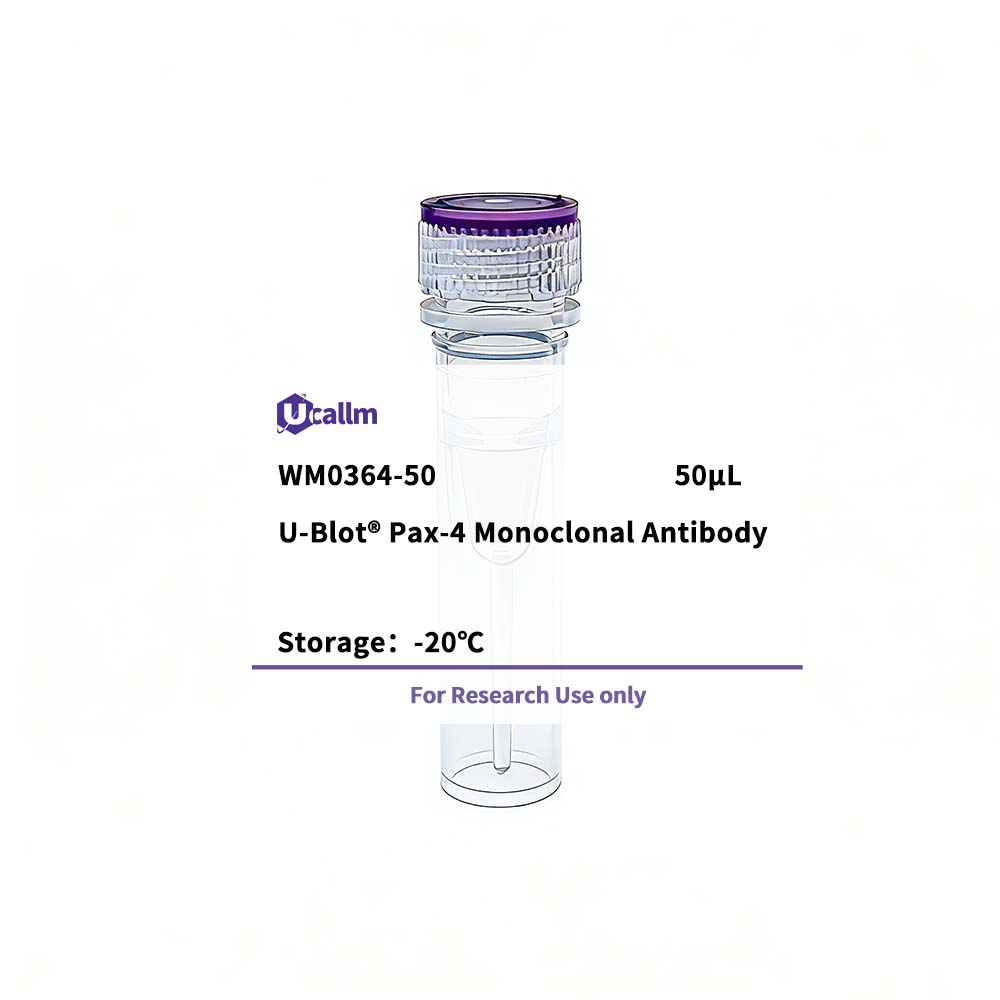
Ucallm_WM0364-50
Price range: $268.00 through $328.00
Product details
Background:
This gene is a member of the paired box (PAX) family of transcription factors. Members of this gene family typically contain a paired box domain, an octapeptide, and a paired-type homeodomain. These genes play critical roles during fetal development and cancer growth. The paired box 4 gene is involved in pancreatic islet development and mouse studies have demonstrated a role for this gene in differentiation of insulin-producing beta cells. [provided by RefSeq, Jul 2008],
Specifications
| Size | 50μL/100μL |
| Target | Pax-4 |
| Reactivity | Human |
| Applications | WB, ELISA |
| MW(Calculated) | 38kD |
| MW(Observed) | |
| Host Species | Mouse |
| Isotype | |
| Conjugate/Modification | Unmodified |
| Recommended Dilution Ratio | WB 1:500-1:2000; ELISA 1:10000; Not yet tested in other applications. |
| Formulation | Liquid in PBS containing 50% glycerol, 0.5% BSA and 0.02% sodium azide. |
| Purification | Affinity purification |
| Storage | -15°C to -25°C/1 year(Do not lower than -25°C) |
| Concentration | |
| Clonality | Monoclonal |
| Clone Number | 19B9 |
| Immunogen | Purified recombinant fragment of human Pax-4 expressed in E. Coli. |
| Specificity | Pax-4 Monoclonal Antibody detects endogenous levels of Pax-4 protein. |
| Gene Name | PAX4 |
| Protein Name | Paired box protein Pax-4 |
| Other Name | PAX4; / Paired box protein Pax-4 |
| Species | Human |
| Gene ID | 5078 |
| Uniprot | O43316, |
| Species.1 | Mouse |
| Gene ID.1 | |
| Uniprot.1 | P32115 |
| Species.2 | |
| Gene ID.2 | |
| Uniprot.2 | |
| Cellular Localization | Nucleus. |
| Tissue Expression | Colon,Insulinoma,PCR rescued clones,Placenta, |
| Signaling_pathway | |
| Research Areas | >>Maturity onset diabetes of the young |
| Function | Disease:Defects in PAX4 are a cause of noninsulin-dependent diabetes mellitus (NIDDM) [MIM:125853]; also known as diabetes mellitus type 2 or maturity-onset diabetes. NIDDM is characterized by an autosomal dominant mode of inheritance, onset during adulthood and insulin resistance.,Disease:Defects in PAX4 are the cause of maturity-onset diabetes of the young type 9 (MODY9) [MIM:612225]. MODY [MIM:606391] is a form of diabetes mellitus characterized by an autosomal dominant mode of inheritance, age of onset of 25 years or younger and a primary defect in insulin secretion.,Disease:Genetic variations in PAX4 are associated with susceptibility to insulin-dependent diabetes mellitus (IDDM) [MIM:222100]. IDDM normally starts in childhood or adolescence and is caused by the body's own immune system which destroys the insulin-producing beta cells in the pancreas. Classical features are polydipsia, polyphagia and polyuria, due to hyperglycemia-induced osmotic diuresis.,Disease:Genetic variations in PAX4 are associated with susceptibility to ketosis-prone diabetes mellitus (KPD) [MIM:612227]. KPD belongs to a rare subgroup of type 2 diabetes with severe insulin deficiency, mostly observed in subjects of sub-Saharan African ancestry, such as west Africans, Caribbeans and African-Americans. Its phenotype is distinct from the common type 2 and type 1 diabetes. It is characterized by a fulminant initial insulin dependence, without the immunological markers observed in classical type 1 diabetes, followed by a subsequent clinical course which varies from non-insulin treated type 2 diabetes to insulin-dependent idiopathic type 1 diabetes. A severe dysfunction of the insulin-producing beta-cells is attested to by the observation that 25% of the subjects are insulin dependent at diabetes onset, whereas the remaining 75% will develop permanent insulin dependence within 10 years.,Function:Plays an important role in the differentiation and development of pancreatic islet beta cells. Transcriptional repressor that binds to a common element in the glucagon, insulin and somatostatin promoters. Competes with PAX6 for this same promoter binding site. The Pax4v isoform appears to be a dominant negative form antagonizing PAX4 transcriptional activity.,sequence Caution:According to the human genome assembly there is a stop codon in position 349.,similarity:Belongs to the paired homeobox family.,similarity:Contains 1 homeobox DNA-binding domain.,similarity:Contains 1 paired domain., |
Please login to post questions
Related products





