SKU: WR4375 Categories: ,

U-Blot® PDGFR-α Rabbit mAb

Price range: $268.00 through $328.00

SKU: WR4375-50
Enter the quantity you would like, or drag the panel to find the quantity and price that best for you
Bulk QuoteAuthorize OEM & ODM

Product details

Background:platelet derived growth factor receptor alpha(PDGFRA) Homo sapiens This gene encodes a cell surface tyrosine kinase receptor for members of the platelet-derived growth factor family. These growth factors are mitogens for cells of mesenchymal origin. The identity of the growth factor bound to a receptor monomer determines whether the functional receptor is a homodimer or a heterodimer, composed of both platelet-derived growth factor receptor alpha and beta polypeptides. Studies suggest that this gene plays a role in organ development, wound healing, and tumor progression. Mutations in this gene have been associated with idiopathic hypereosinophilic syndrome, somatic and familial gastrointestinal stromal tumors, and a variety of other cancers. [provided by RefSeq, Mar 2012],


Specifications

Size50μL/100μL
TargetPDGFR-α
ReactivityHuman, Mouse, Rat
ApplicationsWB, IF, IP, ELISA
MW(Calculated)123kD
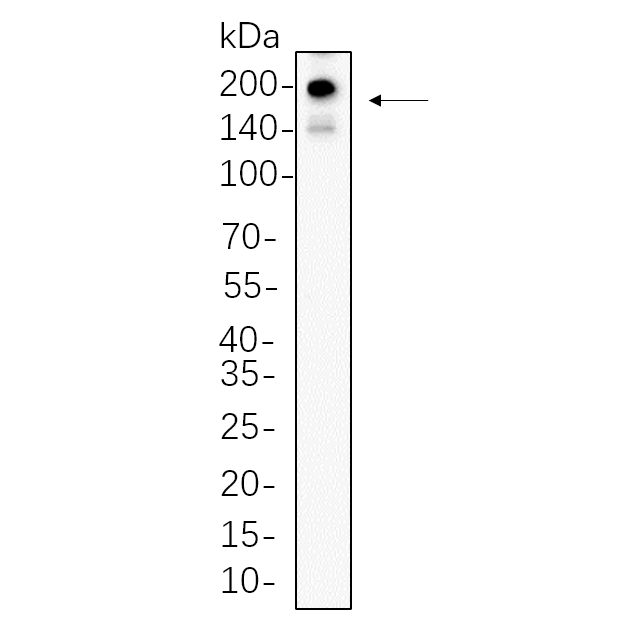
MW(Observed)190kD
Host SpeciesRabbit
IsotypeIgG,Kappa
Conjugate/ModificationUnmodified
Recommended Dilution RatioWB 1:2000-1:10000; IF 1:200-1:1000; ELISA 1:5000-1:20000; IP 1:50-1:200;
FormulationPBS, 50% glycerol, 0.05% Proclin 300, 0.05%BSA
PurificationRecombinant Antibody expressed in animal component-free (ACF) media, purified via Protein A affinity chromatography.
Storage-15°C to -25°C/1 year(Do not lower than -25°C)
Concentration
ClonalityMonoclonal
Clone NumberRM0591R
ImmunogenThe specific immunogen used to produce this antibody is proprietary information.
SpecificityEndogenous
Gene NamePDGFRA PDGFR2 RHEPDGFRA
Protein NamePlatelet-derived growth factor receptor alpha (PDGF-R-alpha) (PDGFR-alpha) (Alpha platelet-derived growth factor receptor) (Alpha-type platelet-derived growth factor receptor) (CD140 antigen-like family member A) (CD140a antigen) (Platelet-derived growth factor alpha receptor) (Platelet-derived growth factor receptor 2) (PDGFR-2) (CD antigen CD140a)
Other NamePlatelet-derived growth factor receptor alpha; / PDGF-R-alpha; / PDGFR-alpha; / Alpha platelet-derived growth factor receptor; / Alpha-type platelet-derived growth factor receptor; / CD140 antigen-like family member A; / CD140a antigen; / Platelet-derived growth factor alpha receptor; / Platelet-derived growth factor receptor 2; / PDGFR-2; / CD antigen CD140a
SpeciesHuman
Gene ID5156
UniprotP16234,
Species.1Mouse
Gene ID.118595
Uniprot.1P26618,
Species.2Rat
Gene ID.225267
Uniprot.2P20786
Cellular LocalizationCell membrane; Single-pass type I membrane protein . Cell projection, cilium . Golgi apparatus .
Tissue ExpressionDetected in platelets (at protein level). Widely expressed. Detected in brain, fibroblasts, smooth muscle, heart, and embryo. Expressed in primary and metastatic colon tumors and in normal colon tissue.
Signaling_pathwayCellular Processes >> Cellular community - eukaryotes >> Focal adhesion;Cellular Processes >> Cellular community - eukaryotes >> Gap junction;Cellular Processes >> Cell motility >> Regulation of actin cytoskeleton;Human Diseases >> Cancer: overview >> Pathways in cancer;Human Diseases >> Cancer: overview >> MicroRNAs in cancer;Human Diseases >> Cancer: overview >> Central carbon metabolism in cancer;Human Diseases >> Cancer: specific types >> Glioma;Human Diseases >> Cancer: specific types >> Melanoma;Human Diseases >> Cancer: specific types >> Prostate cancer;Environmental Information Processing >> Signal transduction >> MAPK signaling pathway;Environmental Information Processing >> Signal transduction >> Ras signaling pathway;Environmental Information Processing >> Signal transduction >> Rap1 signaling pathway;Environmental Information Processing >> Signal transduction >> JAK-STAT signaling pathway;Environmental Information Processing >> Signal transduction >> Calcium signaling pathway;Environmental Information Processing >> Signal transduction >> Phospholipase D signaling pathway;Environmental Information Processing >> Signal transduction >> PI3K-Akt signaling pathway
Research Areas>>EGFR tyrosine kinase inhibitor resistance; / >>MAPK signaling pathway; / >>Ras signaling pathway; / >>Rap1 signaling pathway; / >>Calcium signaling pathway; / >>Phospholipase D signaling pathway; / >>Endocytosis; / >>PI3K-Akt signaling pathway; / >>Focal adhesion; / >>Gap junction; / >>JAK-STAT signaling pathway; / >>Regulation of actin cytoskeleton; / >>Human cytomegalovirus infection; / >>Pathways in cancer; / >>MicroRNAs in cancer; / >>Glioma; / >>Prostate cancer; / >>Melanoma; / >>Central carbon metabolism in cancer; / >>Choline metabolism in cancer
FunctionTyrosine-protein kinase that acts as a cell-surface receptor for PDGFA, PDGFB and PDGFC and plays an essential role in the regulation of embryonic development, cell proliferation, survival and chemotaxis. Depending on the context, promotes or inhibits cell proliferation and cell migration. Plays an important role in the differentiation of bone marrow-derived mesenchymal stem cells. Required for normal skeleton development and cephalic closure during embryonic development. Required for normal development of the mucosa lining the gastrointestinal tract, and for recruitment of mesenchymal cells and normal development of intestinal villi. Plays a role in cell migration and chemotaxis in wound healing. Plays a role in platelet activation, secretion of agonists from platelet granules, and in thrombin-induced platelet aggregation. Binding of its cognate ligands - homodimeric PDGFA, homodimeric PDGFB, heterodimers formed by PDGFA and PDGFB or homodimeric PDGFC -leads to the activation of several signaling cascades; the response depends on the nature of the bound ligand and is modulated by the formation of heterodimers between PDGFRA and PDGFRB. Phosphorylates PIK3R1, PLCG1, and PTPN11. Activation of PLCG1 leads to the production of the cellular signaling molecules diacylglycerol and inositol 1,4,5-trisphosphate, mobilization of cytosolic Ca(2+) and the activation of protein kinase C. Phosphorylates PIK3R1, the regulatory subunit of phosphatidylinositol 3-kinase, and thereby mediates activation of the AKT1 signaling pathway. Mediates activation of HRAS and of the MAP kinases MAPK1/ERK2 and/or MAPK3/ERK1. Promotes activation of STAT family members STAT1, STAT3 and STAT5A and/or STAT5B. Receptor signaling is down-regulated by protein phosphatases that dephosphorylate the receptor and its down-stream effectors, and by rapid internalization of the activated receptor.
Please login to post questions

Back to Top
Product has been added to your cart
