SKU: WR4428 Categories: ,

U-Blot® PDPK1 Rabbit mAb

Price range: $268.00 through $328.00

SKU: WR4428-50
Enter the quantity you would like, or drag the panel to find the quantity and price that best for you
Bulk QuoteAuthorize OEM & ODM

Product details

Background:catalytic activity:ATP + a protein = ADP + a phosphoprotein.,function:Phosphorylates and activates not only PKB/AKT, but also PKA, PKC-zeta, RPS6KA1 and RPS6KB1. May play a general role in signaling processes and in development (By similarity). Isoform 3 is catalytically inactive.,PTM:Phosphorylated on tyrosine and serine/threonine. Phosphorylation on Ser-241 in the activation loop is required for full activity. PDK1 itself can autophosphorylate Ser-241, leading to its own activation.,similarity:Belongs to the protein kinase superfamily.,similarity:Belongs to the protein kinase superfamily. AGC Ser/Thr protein kinase family. PDK1 subfamily.,similarity:Contains 1 PH domain.,similarity:Contains 1 protein kinase domain.,subcellular location:Membrane-associated after cell stimulation leading to its translocation. Tyrosine phosphorylation seems to occur only at the plasma membrane.,subunit:Interacts with TUSC4.,tissue specificity:Appears to be expressed ubiquitously.,


Specifications

Size50μL/100μL
TargetPDPK1
ReactivityHuman, Mouse, Rat
ApplicationsWB, IHC, IF, ELISA
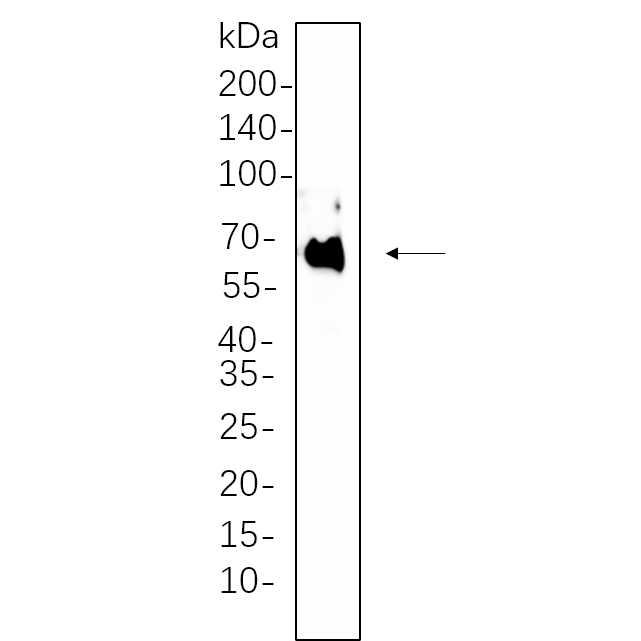
MW(Calculated)63kD
MW(Observed)58-68kD
Host SpeciesRabbit
IsotypeIgG,Kappa
Conjugate/ModificationUnmodified
Recommended Dilution RatioIHC 1:200-1:1000; WB 1:2000-1:10000; IF 1:200-1:1000; ELISA 1:5000-1:20000; / Note: For IHC, we suggest antigen retrieval with TE buffer pH 9.0 (Cat#WT1004)
FormulationPBS, 50% glycerol, 0.05% Proclin 300, 0.05%BSA
PurificationRecombinant Antibody expressed in animal component-free (ACF) media, purified via Protein A affinity chromatography.
Storage-15°C to -25°C/1 year(Do not lower than -25°C)
Concentration
ClonalityMonoclonal
Clone NumberRM0647R
ImmunogenThe specific immunogen used to produce this antibody is proprietary information.
SpecificityEndogenous
Gene NamePDPK1
Protein Name3-phosphoinositide-dependent protein kinase 1
Other NamePDPK1; / PDK1; / 3-phosphoinositide-dependent protein kinase 1; / hPDK1
SpeciesHuman
Gene ID5170
UniprotO15530,
Species.1Mouse
Gene ID.118607
Uniprot.1Q9Z2A0,
Species.2Rat
Gene ID.281745
Uniprot.2O55173
Cellular LocalizationMembrane, Cytoplasm
Tissue ExpressionAppears to be expressed ubiquitously. The Tyr-9 phosphorylated form is markedly increased in diseased tissue compared with normal tissue from lung, liver, colon and breast.
Signaling_pathwayCellular Processes >> Transport and catabolism >> Autophagy - animal;Cellular Processes >> Cell growth and death >> Apoptosis;Cellular Processes >> Cellular community - eukaryotes >> Focal adhesion;Organismal Systems >> Immune system >> T cell receptor signaling pathway;Organismal Systems >> Immune system >> Fc epsilon RI signaling pathway;Organismal Systems >> Endocrine system >> Insulin signaling pathway;Organismal Systems >> Endocrine system >> PPAR signaling pathway;Organismal Systems >> Endocrine system >> Thyroid hormone signaling pathway;Organismal Systems >> Nervous system >> Neurotrophin signaling pathway;Human Diseases >> Cancer: specific types >> Prostate cancer;Human Diseases >> Cancer: specific types >> Endometrial cancer;Human Diseases >> Cancer: specific types >> Non-small cell lung cancer;Environmental Information Processing >> Signal transduction >> FoxO signaling pathway;Environmental Information Processing >> Signal transduction >> Sphingolipid signaling pathway;Environmental Information Processing >> Signal transduction >> PI3K-Akt signaling pathway;Environmental Information Processing >> Signal transduction >> AMPK signaling pathway;Environmental Information Processing >> Signal transduction >> mTOR signaling pathway
Research Areas>>Platinum drug resistance; / >>PPAR signaling pathway; / >>FoxO signaling pathway; / >>Sphingolipid signaling pathway; / >>Autophagy - animal; / >>mTOR signaling pathway; / >>PI3K-Akt signaling pathway; / >>AMPK signaling pathway; / >>Apoptosis; / >>Axon guidance; / >>Focal adhesion; / >>T cell receptor signaling pathway; / >>Fc epsilon RI signaling pathway; / >>Neurotrophin signaling pathway; / >>Insulin signaling pathway; / >>Thyroid hormone signaling pathway; / >>Insulin resistance; / >>Aldosterone-regulated sodium reabsorption; / >>Toxoplasmosis; / >>Proteoglycans in cancer; / >>Chemical carcinogenesis - reactive oxygen species; / >>Endometrial cancer; / >>Prostate cancer; / >>Non-small cell lung cancer; / >>Choline metabolism in cancer; / >>Lipid and atherosclerosis
FunctionCatalytic activity:ATP + a protein = ADP + a phosphoprotein.,Function:Phosphorylates and activates not only PKB/AKT, but also PKA, PKC-zeta, RPS6KA1 and RPS6KB1. May play a general role in signaling processes and in development (By similarity). Isoform 3 is catalytically inactive.,PTM:Phosphorylated on tyrosine and serine/threonine. Phosphorylation on Ser-241 in the activation loop is required for full activity. PDK1 itself can autophosphorylate Ser-241, leading to its own activation.,similarity:Belongs to the protein kinase superfamily.,similarity:Belongs to the protein kinase superfamily. AGC Ser/Thr protein kinase family. PDK1 subfamily.,similarity:Contains 1 PH domain.,similarity:Contains 1 protein kinase domain.,subcellular location:Membrane-associated after cell stimulation leading to its translocation. Tyrosine phosphorylation seems to occur only at the plasma membrane.,subunit:Interacts with TUSC4.,tissue specificity:Appears to be expressed ubiquitously.,

Please login to post questions

Back to Top
Product has been added to your cart