

U-Blot® PDX1 Rabbit mAb
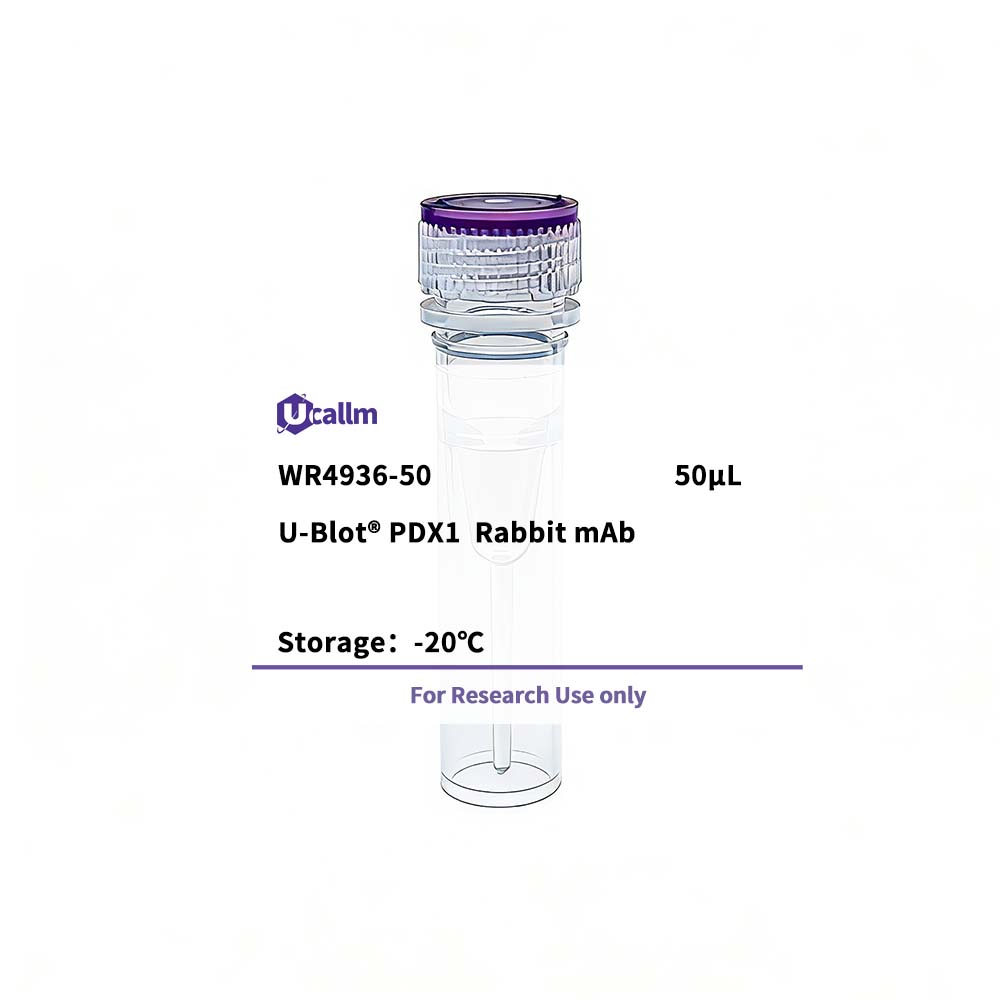
Ucallm_WR4936-50
Price range: $268.00 through $328.00
Product details
Background:The protein encoded by this gene is a transcriptional activator of several genes, including insulin, somatostatin, glucokinase, islet amyloid polypeptide, and glucose transporter type 2. The encoded nuclear protein is involved in the early development of the pancreas and plays a major role in glucose-dependent regulation of insulin gene expression. Defects in this gene are a cause of pancreatic agenesis, which can lead to early-onset insulin-dependent diabetes mellitus (NIDDM), as well as maturity onset diabetes of the young type 4 (MODY4). [provided by RefSeq, Jul 2008],
Specifications
| Size | 50μL/100μL |
| Target | PDX1 |
| Reactivity | Human, Mouse, Rat |
| Applications | WB, IHC, IF, IP, ELISA |
| MW(Calculated) | 31kD |
| MW(Observed) | 42kD |
| Host Species | Rabbit |
| Isotype | IgG,Kappa |
| Conjugate/Modification | Unmodified |
| Recommended Dilution Ratio | IHC 1:100-1:500; WB 1:500-1:20000; IF 1:200-1:1000; ELISA 1:5000-1:20000; IP 1:50-1:200; / Note: For IHC, we suggest antigen retrieval with TE buffer pH 9.0 (Cat#WT1004) |
| Formulation | PBS, 50% glycerol, 0.05% Proclin 300, 0.05%BSA |
| Purification | Recombinant Antibody expressed in animal component-free (ACF) media, purified via Protein A affinity chromatography. |
| Storage | -15°C to -25°C/1 year(Do not lower than -25°C) |
| Concentration | |
| Clonality | Monoclonal |
| Clone Number | RM1159R |
| Immunogen | The specific immunogen used to produce this antibody is proprietary information. |
| Specificity | Endogenous |
| Gene Name | PDX1 |
| Protein Name | Pancreas/duodenum homeobox protein 1 |
| Other Name | PDX1; / IPF1; / Pancreas/duodenum homeobox protein 1; / PDX-1; / Glucose-sensitive factor; / GSF; / Insulin promoter factor 1; / IPF-1; / Insulin upstream factor 1; / IUF-1; / Islet/duodenum homeobox-1; / IDX-1; / Somatostatin-transactivating factor 1; / STF-1 |
| Species | Human |
| Gene ID | 3651 |
| Uniprot | P52945, |
| Species.1 | Mouse |
| Gene ID.1 | 18609 |
| Uniprot.1 | P52946, |
| Species.2 | Rat |
| Gene ID.2 | 29535 |
| Uniprot.2 | P52947 |
| Cellular Localization | Nucleus. Cytoplasm, cytosol . |
| Tissue Expression | Duodenum and pancreas (Langerhans islet beta cells and small subsets of endocrine non-beta-cells, at low levels in acinar cells). |
| Signaling_pathway | Organismal Systems >> Endocrine system >> Insulin secretion |
| Research Areas | >>Insulin secretion; / >>Type II diabetes mellitus; / >>Maturity onset diabetes of the young |
| Function | Disease:Defects in PDX1 are a cause of pancreatic agenesis [MIM:260370]. This autosomal recessive disorder is characterized by absence or hypoplasia of pancreas, leading to early-onset insulin-dependent diabetes mellitus. This was found in a frameshift mutation that produces a truncated protein and results in a second initiation that produces a second protein that act as a dominant negative mutant.,Disease:Defects in PDX1 are the cause of maturity onset diabetes noninsulin-dependent diabetes mellitus (NIDDM) [MIM:125853]; also known as diabetes mellitus type II.,Disease:Defects in PDX1 are the cause of maturity onset diabetes of the young type 4 (MODY4) [MIM:606392]; also symbolized MODY-4. MODY [MIM:606391] is a form of diabetes mellitus characterized by an autosomal dominant mode of inheritance, age of onset of 25 years or younger and a primary defect in insulin secretion.,Domain:The Antp-type hexapeptide mediates heterodimerization with PBX on a regulatory element of the somatostatin promoter.,Domain:The homeodomain, which contains the nuclear localization signal, not only mediates DNA-binding, but also acts as a protein-protein interaction domain for TCF3(E47), NEUROD1 and HMG-I(Y).,Function:Activates insulin, somatostatin, glucokinase, islet amyloid polypeptide and glucose transporter type 2 gene transcription. Particularly involved in glucose-dependent regulation of insulin gene transcription. Binds preferentially the DNA motif 5'-[CT]TAAT[TG]-3'. During development, specifies the early pancreatic epithelium, permitting its proliferation, branching and subsequent differentiation. At adult stage, required for maintaining the hormone-producing phenotype of the beta-cell.,miscellaneous:According to PubMed:16141209, it may be methylated by SETD7 in vitro. However, the relevance of methylation is unsure in vivo.,PTM:Phosphorylated by the SAPK2 pathway at high intracellular glucose concentration.,similarity:Belongs to the Antp homeobox family. IPF1/XlHbox-8 subfamily.,similarity:Contains 1 homeobox DNA-binding domain.,subunit:Interacts with the basic helix-loop-helix domains of TCF3(E47) and NEUROD1 and with HMG-I(Y). Interacts with SPOP (By similarity). Interacts with the methyltransferase SETD7.,tissue specificity:Duodenum and pancreas (Langerhans islet beta cells and small subsets of endocrine non-beta-cells, at low levels in acinar cells)., |
Please login to post questions
Related products





