

U-Blot® Periostin Rabbit mAb
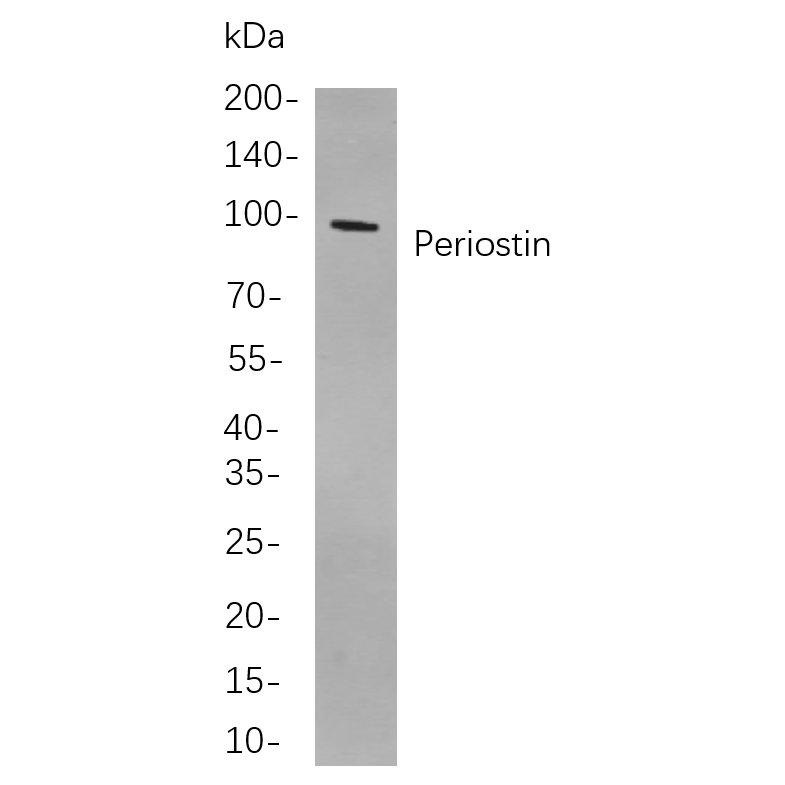
WR4239 Western blot analysis of lysates from T47D cells, using Periostin Rabbit mAb. The HRP-conjugated Goat anti-Rabbit IgG antibody (WS0002) was used to detect the antibody.
Price range: $268.00 through $328.00
Product details
Background:This gene encodes a secreted extracellular matrix protein that functions in tissue development and regeneration, including wound healing, and ventricular remodeling following myocardial infarction. The encoded protein binds to integrins to support adhesion and migration of epithelial cells. This protein plays a role in cancer stem cell maintenance and metastasis. Mice lacking this gene exhibit cardiac valve disease, and skeletal and dental defects. Alternative splicing results in multiple transcript variants encoding different isoforms. [provided by RefSeq, Sep 2015],
Specifications
| Size | 50μL/100μL |
| Target | POSTN |
| Reactivity | Human |
| Applications | WB, IHC, IF, IP, ELISA |
| MW(Calculated) | 93kD |
| MW(Observed) | 93kD |
| Host Species | Rabbit |
| Isotype | IgG,Kappa |
| Conjugate/Modification | Unmodified |
| Recommended Dilution Ratio | IHC 1:200-1:1000; WB 1:500-1:2000; IF 1:200-1:1000; ELISA 1:5000-1:20000; IP 1:50-1:200; / Note: For IHC, we suggest antigen retrieval with TE buffer pH 9.0 (Cat#WT1004) |
| Formulation | PBS, 50% glycerol, 0.05% Proclin 300, 0.05%BSA |
| Purification | Recombinant Antibody expressed in animal component-free (ACF) media, purified via Protein A affinity chromatography. |
| Storage | -15°C to -25°C/1 year(Do not lower than -25°C) |
| Concentration | |
| Clonality | Monoclonal |
| Clone Number | RM0423R |
| Immunogen | The specific immunogen used to produce this antibody is proprietary information. |
| Specificity | Endogenous |
| Gene Name | POSTN OSF2 |
| Protein Name | Periostin (PN) (Osteoblast-specific factor 2) (OSF-2) |
| Other Name | |
| Species | Human |
| Gene ID | 10631 |
| Uniprot | Q15063 |
| Species.1 | |
| Gene ID.1 | |
| Uniprot.1 | |
| Species.2 | |
| Gene ID.2 | |
| Uniprot.2 | |
| Cellular Localization | Secreted |
| Tissue Expression | Widely expressed with highest levels in aorta, stomach, lower gastrointestinal tract, placenta, uterus, thyroid tissue and breast. Up-regulated in epithelial ovarian tumors. Not expressed in normal ovaries. Also highly expressed at the tumor periphery of lung carcinoma tissue but not within the tumor. Overexpressed in breast cancers. |
| Signaling_pathway | |
| Research Areas | |
| Function | Function:Binds to heparin. Induces cell attachment and spreading and plays a role in cell adhesion. May play a role in extracellular matrix mineralization.,PTM:Gamma-carboxyglutamate residues are formed by vitamin K dependent carboxylation. These residues are essential for the binding of calcium.,similarity:Contains 1 EMI domain.,similarity:Contains 4 FAS1 domains.,tissue specificity:Widely expressed with highest levels in aorta, stomach, lower gastrointestinal tract, placenta, uterus and breast. Up-regulated in epithelial ovarian tumors. Not expressed in normal ovaries. Also highly expressed at the tumor periphery of lung carcinoma tissue but not within the tumor. Overexpressed in breast cancers., |
Please login to post questions
Related products


