SKU: WR4162 Categories: ,

U-Blot® PERK Rabbit mAb

Price range: $268.00 through $328.00

SKU: WR4162-50
Enter the quantity you would like, or drag the panel to find the quantity and price that best for you
Bulk QuoteAuthorize OEM & ODM

Product details

Background:The protein encoded by this gene phosphorylates the alpha subunit of eukaryotic translation-initiation factor 2, leading to its inactivation, and thus to a rapid reduction of translational initiation and repression of global protein synthesis. This protein is thought to modulate mitochondrial function. It is a type I membrane protein located in the endoplasmic reticulum (ER), where it is induced by ER stress caused by malfolded proteins. Mutations in this gene are associated with Wolcott-Rallison syndrome. [provided by RefSeq, Sep 2015],

Specifications

Size50μL/100μL
TargetPERK
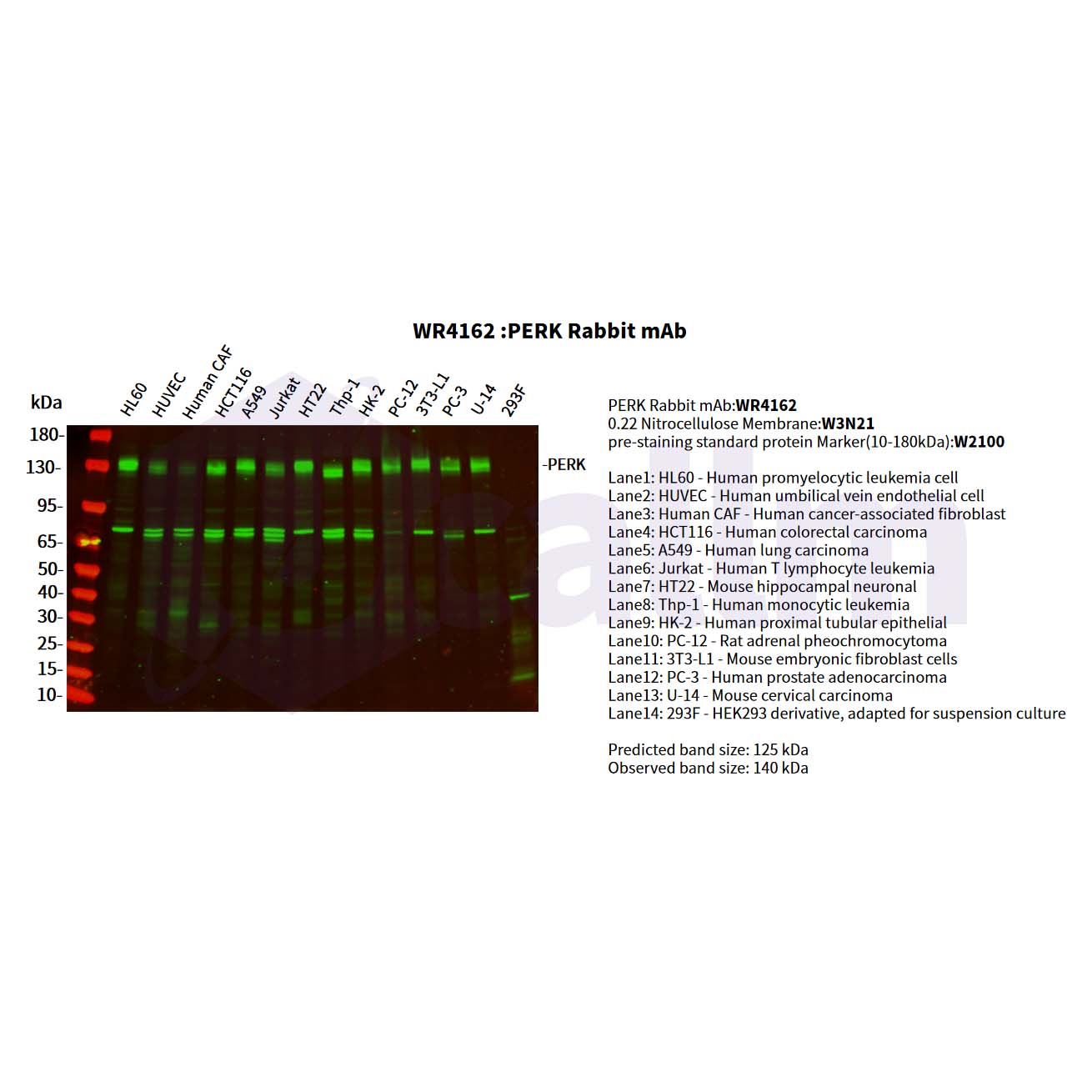
ReactivityHuman, Mouse, Rat
ApplicationsWB, IF, ELISA, IHC
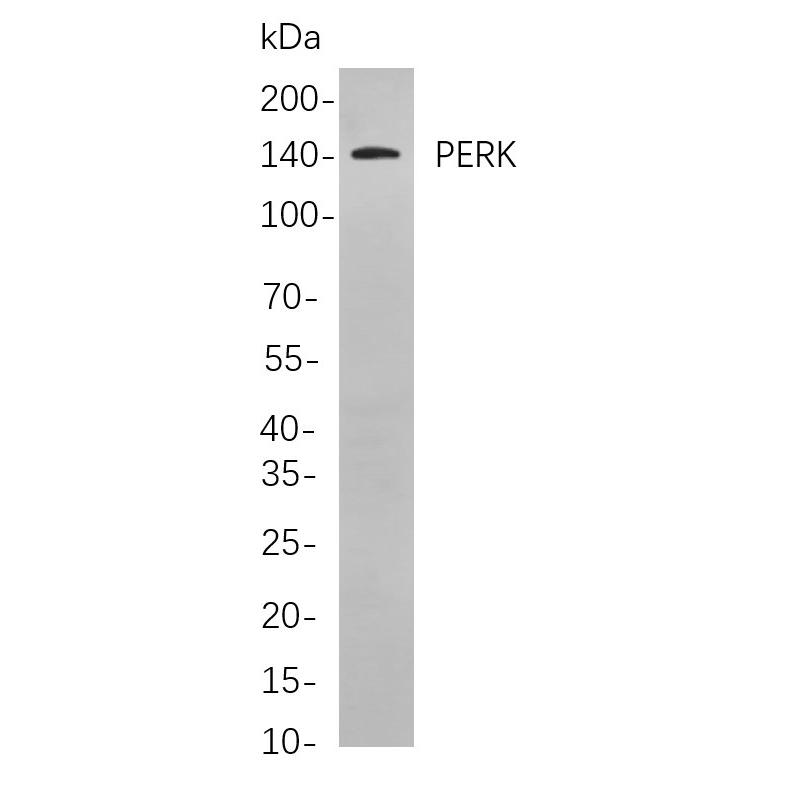
MW(Calculated)125kD
MW(Observed)140kD
Host SpeciesRabbit
IsotypeIgG,Kappa
Conjugate/ModificationUnmodified
Recommended Dilution RatioWB 1:1000-1:5000; IF 1:200-1:1000; ELISA 1:5000-1:20000; IHC 1:100-1:400 / Note: For IHC, we suggest antigen retrieval with TE buffer pH 9.0 (Cat#WT1004)
FormulationPBS, 50% glycerol, 0.05% Proclin 300, 0.05%BSA
PurificationRecombinant Antibody expressed in animal component-free (ACF) media, purified via Protein A affinity chromatography.
Storage-15°C to -25°C/1 year(Do not lower than -25°C)
Concentration
ClonalityMonoclonal
Clone NumberRM0310R
ImmunogenThe specific immunogen used to produce this antibody is proprietary information.
SpecificityEndogenous
Gene NameEIF2AK3
Protein NameEukaryotic translation initiation factor 2-alpha kinase 3 (PRKR-like endoplasmic reticulum kinase) (Pancreatic eIF2-alpha kinase) (HsPEK)
Other NameEIF2AK3; / PEK; / PERK; / Eukaryotic translation initiation factor 2-alpha kinase 3; / PRKR-like endoplasmic reticulum kinase; / Pancreatic eIF2-alpha kinase; / HsPEK
SpeciesHuman
Gene ID9451
UniprotQ9NZJ5,
Species.1Mouse
Gene ID.1
Uniprot.1Q9Z2B5,
Species.2Rat
Gene ID.229702
Uniprot.2Q9Z1Z1
Cellular LocalizationEndoplasmic reticulum membrane
Tissue ExpressionUbiquitous. A high level expression is seen in secretory tissues.
Signaling_pathwayCellular Processes >> Transport and catabolism >> Autophagy - animal;Cellular Processes >> Transport and catabolism >> Mitophagy - animal;Cellular Processes >> Cell growth and death >> Apoptosis;Human Diseases >> Neurodegenerative disease >> Alzheimer disease;Human Diseases >> Neurodegenerative disease >> Parkinson disease;Human Diseases >> Neurodegenerative disease >> Amyotrophic lateral sclerosis;Human Diseases >> Neurodegenerative disease >> Prion disease;Human Diseases >> Neurodegenerative disease >> Pathways of neurodegeneration - multiple diseases;Genetic Information Processing >> Folding, sorting and degradation >> Protein processing in endoplasmic reticulum
Research Areas
FunctionCatalytic activity:ATP + a protein = ADP + a phosphoprotein.,Disease:Defects in EIF2AK3 are the cause of Wolcott-Rallison syndrome (WRS) [MIM:226980]; also known as multiple epiphyseal dysplasia with early-onset diabetes mellitus. WRS is a rare autosomal recessive disorder, characterized by permanent neonatal or early infancy insulin-dependent diabetes and, at a later age, epiphyseal dysplasia, osteoporosis, growth retardation and other multisystem manifestations, such as hepatic and renal dysfunctions, mental retardation and cardiovascular abnormalities.,Domain:The lumenal domain senses perturbations in protein folding in the ER, probably through reversible interaction with HSPA5/BIP.,enzyme regulation:Perturbation in protein folding in the endoplasmic reticulum (ER) promotes reversible dissociation from HSPA5/BIP and oligomerization, resulting in transautophosphorylation and kinase activity induction.,Function:Phosphorylates the alpha subunit of eukaryotic translation-initiation factor 2 (EIF2), leading to its inactivation and thus to a rapid reduction of translational initiation and repression of global protein synthesis. Serves as a critical effector of unfolded protein response (UPR)-induced G1 growth arrest due to the loss of cyclin D1.,induction:By ER stress.,PTM:Autophosphorylated.,PTM:N-glycosylated.,similarity:Belongs to the protein kinase superfamily.,similarity:Belongs to the protein kinase superfamily. Ser/Thr protein kinase family. GCN2 subfamily.,similarity:Contains 1 protein kinase domain.,subunit:Forms dimers with HSPA5/BIP in resting cells. Oligomerizes in ER-stressed cells. Interacts with DNAJC3.,tissue specificity:Ubiquitous. A high level expression is seen in secretory tissues.,
Please login to post questions

Back to Top
Product has been added to your cart

