

PGC-1α Monoclonal Antibody
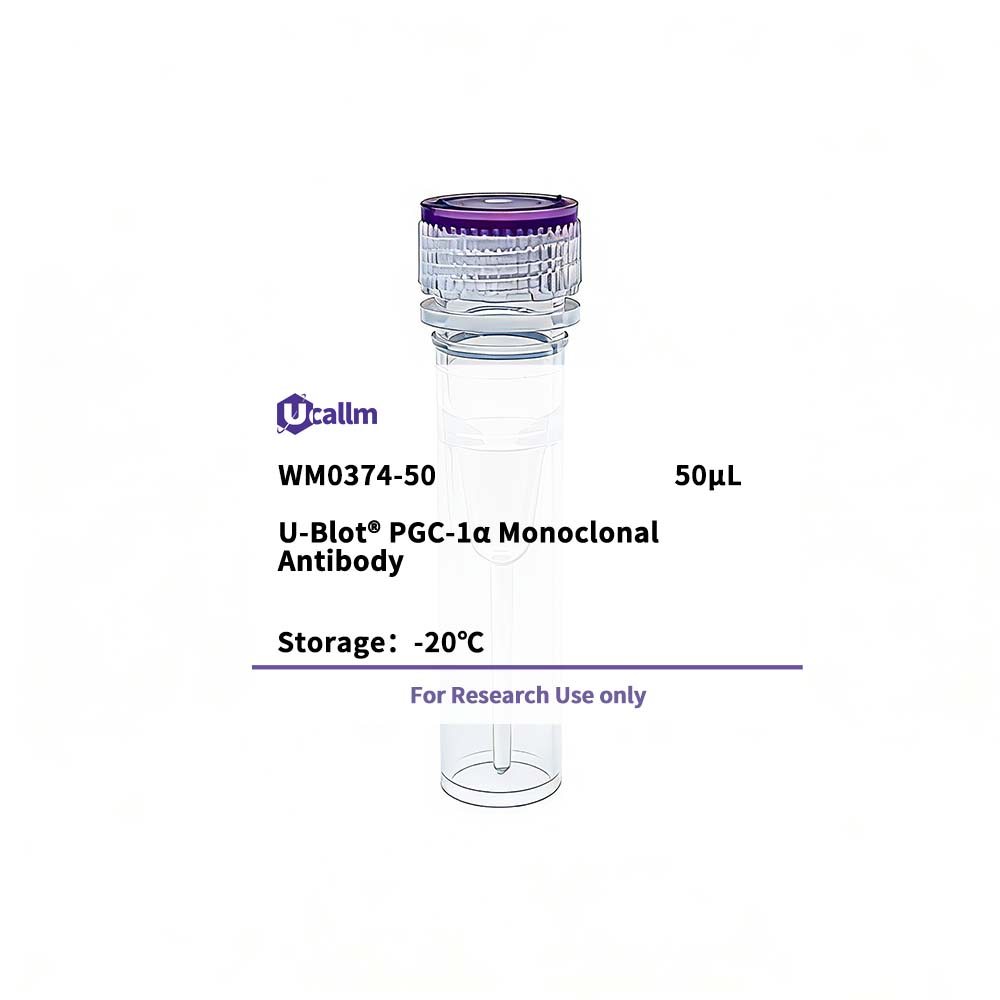
Ucallm_WM0374-50
Price range: $268.00 through $328.00
Product details
Background:
The protein encoded by this gene is a transcriptional coactivator that regulates the genes involved in energy metabolism. This protein interacts with PPARgamma, which permits the interaction of this protein with multiple transcription factors. This protein can interact with, and regulate the activities of, cAMP response element binding protein (CREB) and nuclear respiratory factors (NRFs). It provides a direct link between external physiological stimuli and the regulation of mitochondrial biogenesis, and is a major factor that regulates muscle fiber type determination. This protein may be also involved in controlling blood pressure, regulating cellular cholesterol homoeostasis, and the development of obesity. [provided by RefSeq, Jul 2008],
Specifications
| Size | 50μL/100μL |
| Target | PGC-1α |
| Reactivity | Human |
| Applications | WB, ELISA |
| MW(Calculated) | 91kD |
| MW(Observed) | |
| Host Species | Mouse |
| Isotype | |
| Conjugate/Modification | Unmodified |
| Recommended Dilution Ratio | WB 1:500-1:2000; ELISA 1:10000; Not yet tested in other applications. |
| Formulation | Liquid in PBS containing 50% glycerol, 0.5% BSA and 0.02% sodium azide. |
| Purification | Affinity purification |
| Storage | -15°C to -25°C/1 year(Do not lower than -25°C) |
| Concentration | |
| Clonality | Monoclonal |
| Clone Number | 7D6 |
| Immunogen | Purified recombinant fragment of human PGC-1α expressed in E. Coli. |
| Specificity | PGC-1α Monoclonal Antibody detects endogenous levels of PGC-1α protein. |
| Gene Name | PPARGC1A |
| Protein Name | Peroxisome proliferator-activated receptor gamma coactivator 1-alp |
| Other Name | PPARGC1A; / LEM6; / PGC1; / PGC1A; / PPARGC1; / Peroxisome proliferator-activated receptor gamma coactivator 1-alpha; / PGC-1-alpha; / PPAR-gamma coactivator 1-alpha; / PPARGC-1-alpha; / Ligand effect modulator 6 |
| Species | Human |
| Gene ID | 10891 |
| Uniprot | Q9UBK2, |
| Species.1 | Mouse |
| Gene ID.1 | |
| Uniprot.1 | O70343 |
| Species.2 | |
| Gene ID.2 | |
| Uniprot.2 | |
| Cellular Localization | [Isoform 1]: Nucleus . Nucleus, PML body .; [Isoform B4]: Nucleus .; [Isoform B4-8a]: Cytoplasm . Nucleus .; [Isoform B5]: Nucleus . Nucleus, PML body .; [Isoform 9]: Nucleus . |
| Tissue Expression | Heart, skeletal muscle, liver and kidney. Expressed at lower levels in brain and pancreas and at very low levels in the intestine and white adipose tissue. In skeletal muscle, levels were lower in obese than in lean subjects and fasting induced a 2-fold increase in levels in the skeletal muscle in obese subjects. |
| Signaling_pathway | Organismal Systems >> Endocrine system >> Insulin signaling pathway;Organismal Systems >> Endocrine system >> Glucagon signaling pathway;Organismal Systems >> Endocrine system >> Adipocytokine signaling pathway;Organismal Systems >> Aging >> Longevity regulating pathway;Human Diseases >> Neurodegenerative disease >> Huntington disease;Environmental Information Processing >> Signal transduction >> Apelin signaling pathway;Environmental Information Processing >> Signal transduction >> AMPK signaling pathway |
| Research Areas | >>AMPK signaling pathway; / >>Longevity regulating pathway; / >>Apelin signaling pathway; / >>Thermogenesis; / >>Insulin signaling pathway; / >>Adipocytokine signaling pathway; / >>Glucagon signaling pathway; / >>Insulin resistance; / >>Alcoholic liver disease; / >>Huntington disease |
| Function | Function:Transcriptional coactivator for steroid receptors and nuclear receptors. Greatly increases the transcriptional activity of PPARG and thyroid hormone receptor on the uncoupling protein promoter. Can regulate key mitochondrial genes that contribute to the program of adaptive thermogenesis.,similarity:Contains 1 RRM (RNA recognition motif) domain.,subunit:Binds MYBBP1A, which inhibits transcriptional activation by this protein (By similarity). Interacts with LRPPRC. Homooligomer.,tissue specificity:Heart, skeletal muscle, liver and kidney. Expressed at lower levels in brain and pancreas and at very low levels in the intestine and white adipose tissue. In skeletal muscle, levels were lower in obese than in lean subjects and fasting induced a 2-fold increase in levels in the skeletal muscle in obese subjects., |
Please login to post questions
Related products





