SKU: WR4197 Categories: ,

U-Blot® PGP9.5 Rabbit mAb

Price range: $268.00 through $328.00

SKU: WR4197-50
Enter the quantity you would like, or drag the panel to find the quantity and price that best for you
Bulk QuoteAuthorize OEM & ODM

Product details

Background:The protein encoded by this gene belongs to the peptidase C12 family. This enzyme is a thiol protease that hydrolyzes a peptide bond at the C-terminal glycine of ubiquitin. This gene is specifically expressed in the neurons and in cells of the diffuse neuroendocrine system. Mutations in this gene may be associated with Parkinson disease.[provided by RefSeq, Sep 2009],

Specifications

Size50μL/100μL
TargetPGP9.5
ReactivityHuman, Mouse, Rat
ApplicationsWB, IHC, IF, IP, ELISA
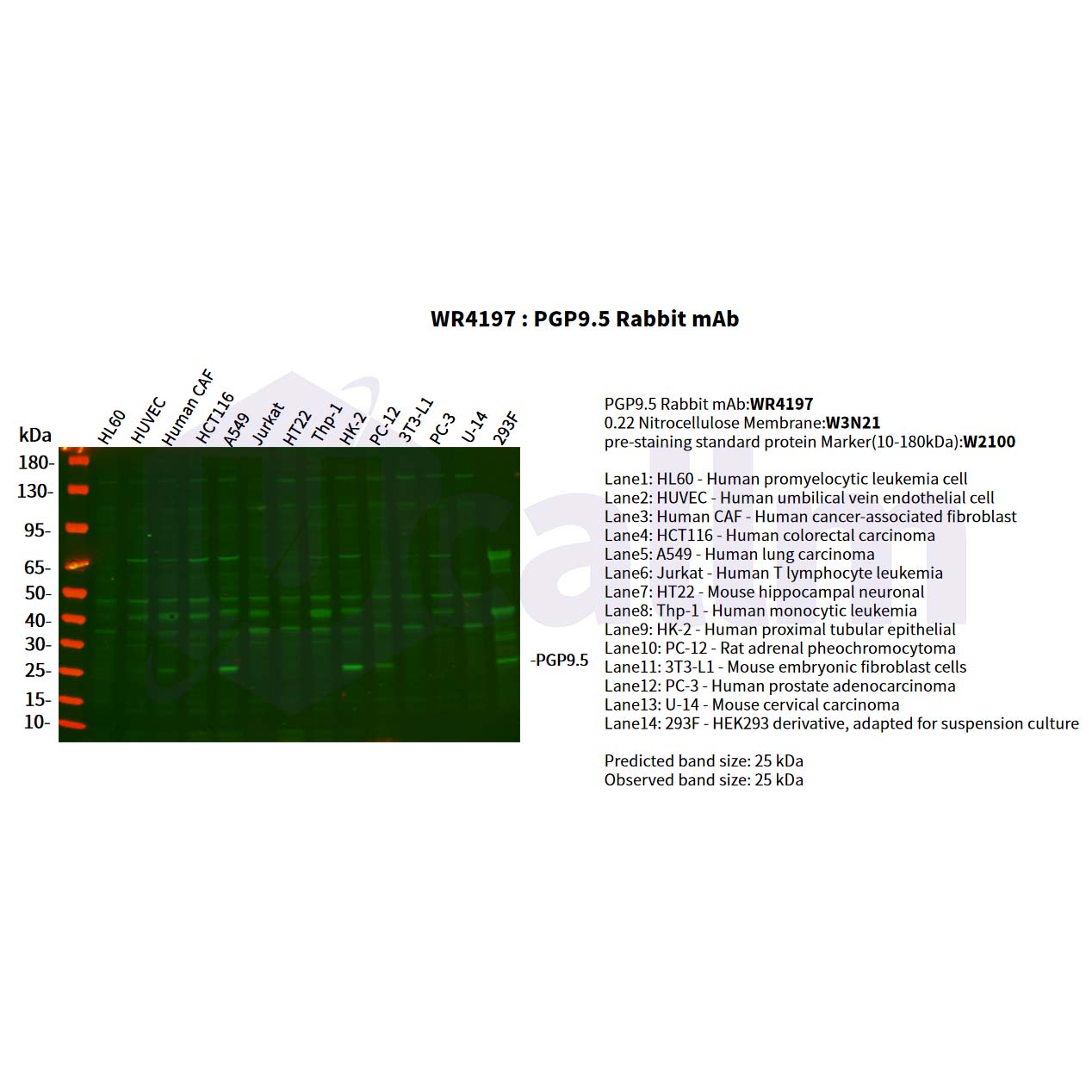
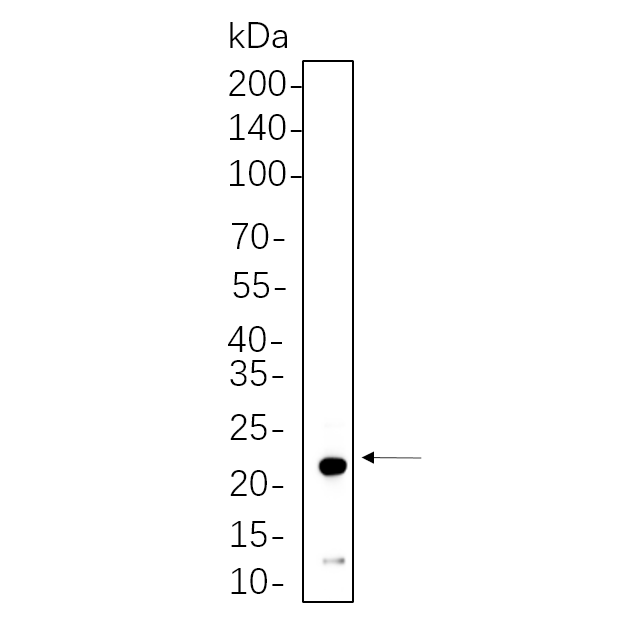
MW(Calculated)25kD
MW(Observed)25kD
Host SpeciesRabbit
IsotypeIgG,Kappa
Conjugate/ModificationUnmodified
Recommended Dilution RatioIHC 1:200-1:1000; WB 1:1000-1:5000; IF 1:200-1:1000; ELISA 1:5000-1:20000; IP 1:50-1:200, / Note: For IHC, we suggest antigen retrieval with TE buffer pH 9.0 (Cat#WT1004)
FormulationPBS, 50% glycerol, 0.05% Proclin 300, 0.05%BSA
PurificationRecombinant Antibody expressed in animal component-free (ACF) media, purified via Protein A affinity chromatography.
Storage-15°C to -25°C/1 year(Do not lower than -25°C)
Concentration
ClonalityMonoclonal
Clone NumberRM0425R
ImmunogenThe specific immunogen used to produce this antibody is proprietary information.
SpecificityEndogenous
Gene NameUCHL1
Protein NameUbiquitin carboxyl-terminal hydrolase isozyme L1 (UCH-L1) (Neuron cytoplasmic protein 9.5) (PGP 9.5) (PGP9.5) (Ubiquitin thioesterase L1)
Other Name
SpeciesHuman
Gene ID4714
UniprotP09936,
Species.1Mouse
Gene ID.1
Uniprot.1Q9D6J5
Species.2
Gene ID.2
Uniprot.2
Cellular LocalizationCytoplasm
Tissue ExpressionBlood,Brain,Lung,Umbilical cord blood,
Signaling_pathwayHuman Diseases >> Neurodegenerative disease >> Alzheimer disease;Human Diseases >> Neurodegenerative disease >> Parkinson disease;Human Diseases >> Neurodegenerative disease >> Amyotrophic lateral sclerosis;Human Diseases >> Neurodegenerative disease >> Huntington disease;Human Diseases >> Neurodegenerative disease >> Prion disease;Human Diseases >> Neurodegenerative disease >> Pathways of neurodegeneration - multiple diseases
Research Areas>>Oxidative phosphorylation; / >>Metabolic pathways; / >>Thermogenesis; / >>Retrograde endocannabinoid signaling; / >>Non-alcoholic fatty liver disease; / >>Alzheimer disease; / >>Parkinson disease; / >>Amyotrophic lateral sclerosis; / >>Huntington disease; / >>Prion disease; / >>Pathways of neurodegeneration - multiple diseases; / >>Chemical carcinogenesis - reactive oxygen species; / >>Diabetic cardiomyopathy
FunctionCatalytic activity:Thiol-dependent hydrolysis of ester, thioester, amide, peptide and isopeptide bonds formed by the C-terminal Gly of ubiquitin (a 76-residue protein attached to proteins as an intracellular targeting signal).,Disease:Oxidation of Met-1, Met-6, Met-12, Met-124 and Met-179 to methionine sulfoxide, and oxidation of Cys-220 to cysteine sulfonic acid have been observed in brains from Alzheimer disease (AD) and Parkinson disease (PD) patients. In AD, UCHL1 was found to be associated with neurofibrillary tangles.,Function:Ubiquitin-protein hydrolase involved both in the processing of ubiquitin precursors and of ubiquitinated proteins. This enzyme is a thiol protease that recognizes and hydrolyzes a peptide bond at the C-terminal glycine of ubiquitin. Also binds to free monoubiquitin and may prevent its degradation in lysosomes. The homodimer may have ATP-independent ubiquitin ligase activity.,miscellaneous:In contrast to UCHL3, does not hydrolyze a peptide bond at the C-terminal glycine of NEDD8.,online information:Ubiquitin carboxy-terminal hydrolase L1 entry,PTM:O-glycosylated.,similarity:Belongs to the peptidase C12 family.,subunit:Homodimer. Interacts with SNCA (By similarity). Interacts with COPS5.,tissue specificity:Found in neuronal cell bodies and processes throughout the neocortex (at protein level). Expressed in neurons and cells of the diffuse neuroendocrine system and their tumors. Weakly expressed in ovary.,
Please login to post questions

Back to Top
Product has been added to your cart