


Phospho-Protein(pP) Specific Antibody Conjugated Agarose Beads
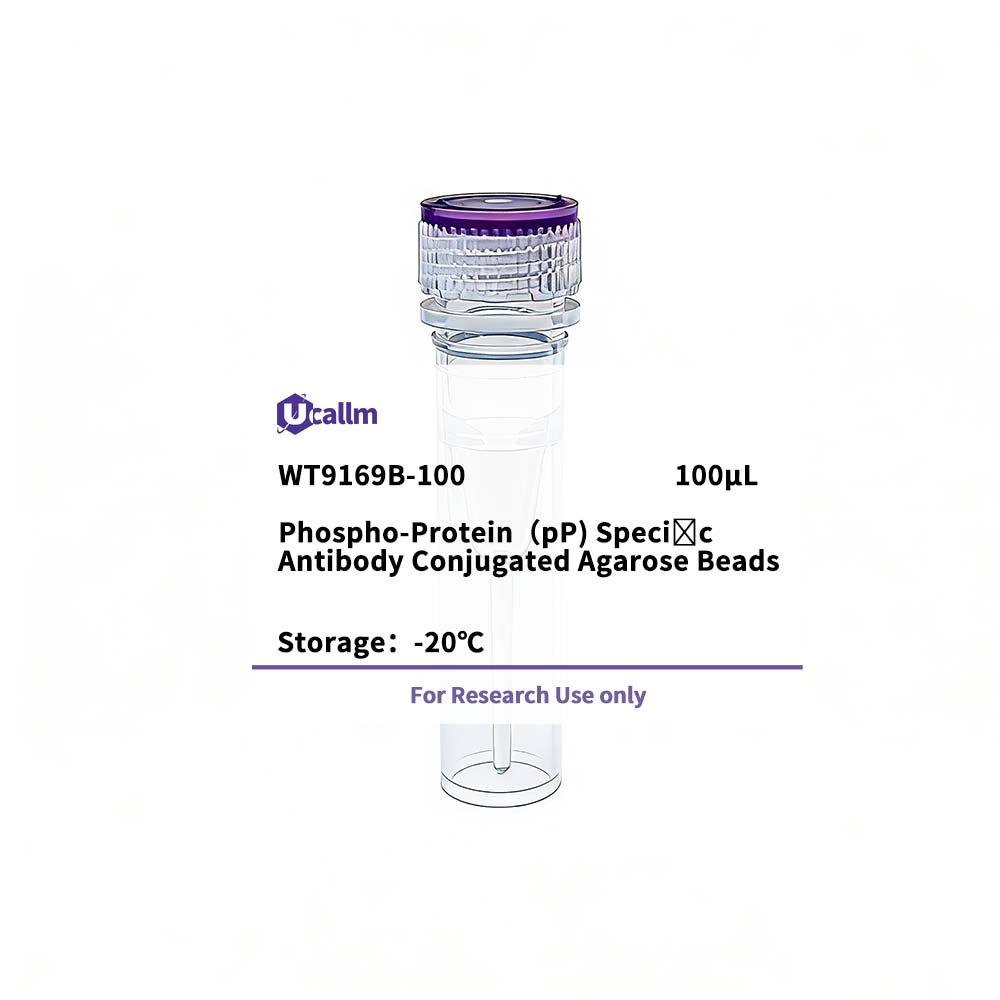
Ucallm_WT9169B-100
$999.00
Product details
Phospho-Protein(pP) Specific Antibody Conjugated Agarose Beads is produced using hyperphosphorylated proteins as the immunogen and affinity-purified on agarose with peptides containing phosphoserine, phosphothreonine, and phosphotyrosine residues. The purified antibody is immobilized onto beaded agarose via stable secondary amine linkages. This product serves as an affinity matrix for the rapid isolation, purification, and enrichment of proteins or peptides containing phosphotyrosine, phosphoserine, or phosphothreonine residues.
Specifications
| Target | Phosphorylated proteins/peptides |
| Reactivity | Species Independent |
| Application | IAC, IP |
| MW(Calculated) | |
| MW(Observed) | |
| Host Species | |
| Isotype | |
| Conjugate | Agarose Beads |
| Modification | Protein phosphorylation |
| Modified site | |
| Recommended dilution ratio | |
| Composition | 1 mL beaded agarose suspended in 2 mL of glycerol |
| Purification process | |
| Purity | |
| Storage | Product is stable for several weeks at room temperature. For extended storage, store product at -20°C. |
| Stability | Expiration date is one year from date of shipping if stored properly. |
| Clonal | Polyclonal |
| Clone Number | |
| Immunogen | Hyper-phosphorylated proteins |
| Sequence | |
| Specificity | |
| Gene name | |
| Protein Name | |
| Alternative name | |
| Organism-1 | |
| GeneID-1 | |
| SwissProt-1 | |
| Organism-2 | |
| GeneID-2 | |
| SwissProt-2 | |
| Organism-3 | |
| GeneID-3 | |
| SwissProt-3 | |
| Organism-4 | |
| GeneID-4 | |
| SwissProt-4 | |
| Background | Protein phosphorylation is one of the most essential and widespread reversible post-translational modifications in eukaryotic cells. It is dynamically modulated by protein kinases and phosphatases, which respectively add and remove phosphate groups on amino acid residues. This modification alters protein charge, spatial conformation and intermolecular interactions, acting as a core molecular switch to precisely regulate cell cycle, signal transduction, proliferation, differentiation, metabolism, immune response and other vital biological processes.Aberrant protein phosphorylation is a hallmark of numerous pathological conditions, including inflammation, autoimmune diseases, neurodegeneration and malignancies. |
| Cellular Localization |
Please login to post questions
Related products





