SKU: WR4419 Categories: ,

U-Blot® Podoplanin Rabbit mAb

Price range: $268.00 through $328.00

SKU: WR4419-50
Enter the quantity you would like, or drag the panel to find the quantity and price that best for you
Bulk QuoteAuthorize OEM & ODM

Product details

Background:This gene encodes a type-I integral membrane glycoprotein with diverse distribution in human tissues. The physiological function of this protein may be related to its mucin-type character. The homologous protein in other species has been described as a differentiation antigen and influenza-virus receptor. The specific function of this protein has not been determined but it has been proposed as a marker of lung injury. Alternatively spliced transcript variants encoding different isoforms have been identified. [provided by RefSeq, Jul 2008],

Specifications

Size50μL/100μL
TargetPodoplanin
ReactivityHuman, Mouse, Rat
ApplicationsWB, IHC, IF, ELISA
MW(Calculated)17kD
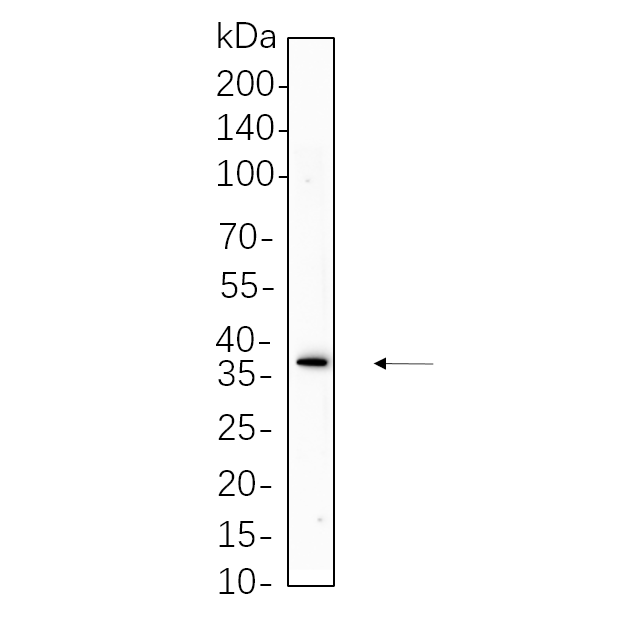
MW(Observed)36kD
Host SpeciesRabbit
IsotypeIgG,Kappa
Conjugate/ModificationUnmodified
Recommended Dilution RatioIHC 1:200-1:1000; WB 1:1000-1:5000; IF 1:200-1:1000; ELISA 1:5000-1:20000; / Note: For IHC, we suggest antigen retrieval with TE buffer pH 9.0 (Cat#WT1004)
FormulationPBS, 50% glycerol, 0.05% Proclin 300, 0.05%BSA
PurificationRecombinant Antibody expressed in animal component-free (ACF) media, purified via Protein A affinity chromatography.
Storage-15°C to -25°C/1 year(Do not lower than -25°C)
Concentration
ClonalityMonoclonal
Clone NumberRM0638R
ImmunogenThe specific immunogen used to produce this antibody is proprietary information.
SpecificityEndogenous
Gene NamePDPN GP36 PSEC0003 PSEC0025
Protein NameAggrus Glycoprotein 36 Gp36 PA2.26 antigen T1-alpha T1A
Other NamePodoplanin; / Aggrus; / Glycoprotein 36; / Gp36; / PA2.26 antigen; / T1-alpha; / T1A
SpeciesHuman
Gene ID10630
UniprotQ86YL7,
Species.1Mouse
Gene ID.114726
Uniprot.1Q62011,
Species.2Rat
Gene ID.254320
Uniprot.2Q64294
Cellular LocalizationMembrane, Cytoplasm
Tissue ExpressionTonsil/ Appendix
Signaling_pathway
Research Areas
FunctionCaution:The sequence shown here is derived from an Ensembl automatic analysis pipeline and should be considered as preliminary data.,Function:May be involved in cell migration and/or actin cytoskeleton organization. When expressed in keratinocytes, induces changes in cell morphology with transfected cells showing an elongated shape, numerous membrane protrusions, major reorganization of the actin cytoskeleton, increased motility and decreased cell adhesion. Required for normal lung cell proliferation and alveolus formation at birth. Induces platelet aggregation. Does not have any effect on folic acid or amino acid transport. Does not function as a water channel or as a regulator of aquaporin-type water channels.,PTM:Extensively O-glycosylated. Contains sialic acid residues. O-glycosylation is necessary for platelet aggregation activity.,PTM:The N-terminus is blocked.,similarity:Belongs to the podoplanin family.,subcellular location:Localized to actin-rich microvilli and plasma membrane projections such as filopodia, lamellipodia and ruffles.,tissue specificity:Highly expressed in placenta, lung, skeletal muscle and brain. Weakly expressed in brain, kidney and liver. In placenta, expressed on the apical plasma membrane of endothelium. In lung, expressed in alveolar epithelium. Up-regulated in colorectal tumors and expressed in 25% of early oral squamous cell carcinomas.,
Please login to post questions

Back to Top
Product has been added to your cart

