

Product details
Background:AKT1S1 is a proline-rich substrate of AKT (MIM 164730) that binds 14-3-3 protein (see YWHAH, MIM 113508) when phosphorylated (Kovacina et al., 2003 [PubMed 12524439]).[supplied by OMIM, Mar 2008],
Price range: $268.00 through $328.00
Background:AKT1S1 is a proline-rich substrate of AKT (MIM 164730) that binds 14-3-3 protein (see YWHAH, MIM 113508) when phosphorylated (Kovacina et al., 2003 [PubMed 12524439]).[supplied by OMIM, Mar 2008],
| Size | 50μL/100μL |
| Target | PRAS40 |
| Reactivity | Human, Mouse, Rat |
| Applications | WB, IF, IP, ELISA |
| MW(Calculated) | 27kD |
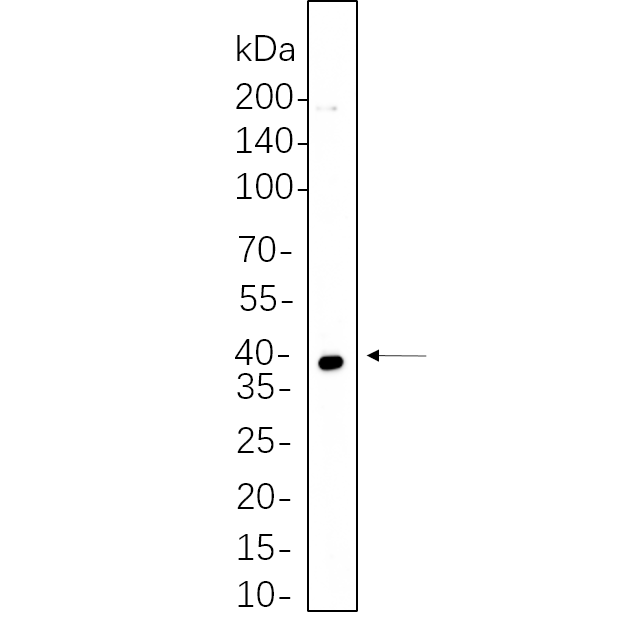
| MW(Observed) | 40kD |
| Host Species | Rabbit |
| Isotype | IgG,Kappa |
| Conjugate/Modification | Unmodified |
| Recommended Dilution Ratio | IHC 1:200-1:1000; WB 1:2000-1:10000; IF 1:200-1:1000; ELISA 1:5000-1:20000; IP 1:50-1:200; / Note: For IHC, we suggest antigen retrieval with TE buffer pH 9.0 (Cat#WT1004) |
| Formulation | PBS, 50% glycerol, 0.05% Proclin 300, 0.05%BSA |
| Purification | Recombinant Antibody expressed in animal component-free (ACF) media, purified via Protein A affinity chromatography. |
| Storage | -15°C to -25°C/1 year(Do not lower than -25°C) |
| Concentration | |
| Clonality | Monoclonal |
| Clone Number | RM0562R |
| Immunogen | The specific immunogen used to produce this antibody is proprietary information. |
| Specificity | Endogenous |
| Gene Name | AKT1S1 PRAS40 |
| Protein Name | Proline-rich AKT1 substrate 1 |
| Other Name | AKT1S1; / PRAS40; / Proline-rich AKT1 substrate 1; / 40 kDa proline-rich AKT substrate |
| Species | Human |
| Gene ID | 5606 |
| Uniprot | Q96B36, |
| Species.1 | Mouse |
| Gene ID.1 | 67605 |
| Uniprot.1 | Q9D1F4 |
| Species.2 | |
| Gene ID.2 | |
| Uniprot.2 | |
| Cellular Localization | Cytoplasm |
| Tissue Expression | Abundant expression is seen in the skeletal muscle. It is also widely expressed in other tissues. |
| Signaling_pathway | Cellular Processes >> Cell growth and death >> Cellular senescence;Organismal Systems >> Immune system >> Toll-like receptor signaling pathway;Organismal Systems >> Immune system >> Fc epsilon RI signaling pathway;Organismal Systems >> Endocrine system >> GnRH signaling pathway;Organismal Systems >> Endocrine system >> Growth hormone synthesis, secretion and action;Organismal Systems >> Sensory system >> Inflammatory mediator regulation of TRP channels;Human Diseases >> Cancer: overview >> PD-L1 expression and PD-1 checkpoint pathway in cancer;Human Diseases >> Neurodegenerative disease >> Amyotrophic lateral sclerosis;Human Diseases >> Neurodegenerative disease >> Pathways of neurodegeneration - multiple diseases;Environmental Information Processing >> Signal transduction >> MAPK signaling pathway;Environmental Information Processing >> Signal transduction >> Rap1 signaling pathway;Environmental Information Processing >> Signal transduction >> TNF signaling pathway |
| Research Areas | >>MAPK signaling pathway; / >>Rap1 signaling pathway; / >>Cellular senescence; / >>Toll-like receptor signaling pathway; / >>Fc epsilon RI signaling pathway; / >>TNF signaling pathway; / >>Thermogenesis; / >>Inflammatory mediator regulation of TRP channels; / >>GnRH signaling pathway; / >>Growth hormone synthesis, secretion and action; / >>Alcoholic liver disease; / >>Amyotrophic lateral sclerosis; / >>Pathways of neurodegeneration - multiple diseases; / >>Salmonella infection; / >>Yersinia infection; / >>Toxoplasmosis; / >>Hepatitis B; / >>Epstein-Barr virus infection; / >>Human immunodeficiency virus 1 infection; / >>PD-L1 expression and PD-1 checkpoint pathway in cancer; / >>Lipid and atherosclerosis |
| Function | Function:May play an important role in phosphatidylinositol 3-kinase (PI3K)-AKT1 survival signaling. Substrate for AKT1 phosphorylation, but can also be activated by AKT1-independent mechanisms. Its role in survival signaling pathways may be modulated by oxidative stress. May also play a role in nerve growth factor-mediated neuroprotection.,subcellular location:Found in the cytosolic fraction of the brain.,subunit:The phosphorylated form interacts with 14-3-3.,tissue specificity:Widely expressed with highest levels of expression in liver and heart. Expressed at higher levels in cancer cell lines (e.g. A549 and HeLa) than in normal cell lines (e.g. HEK293)., |





