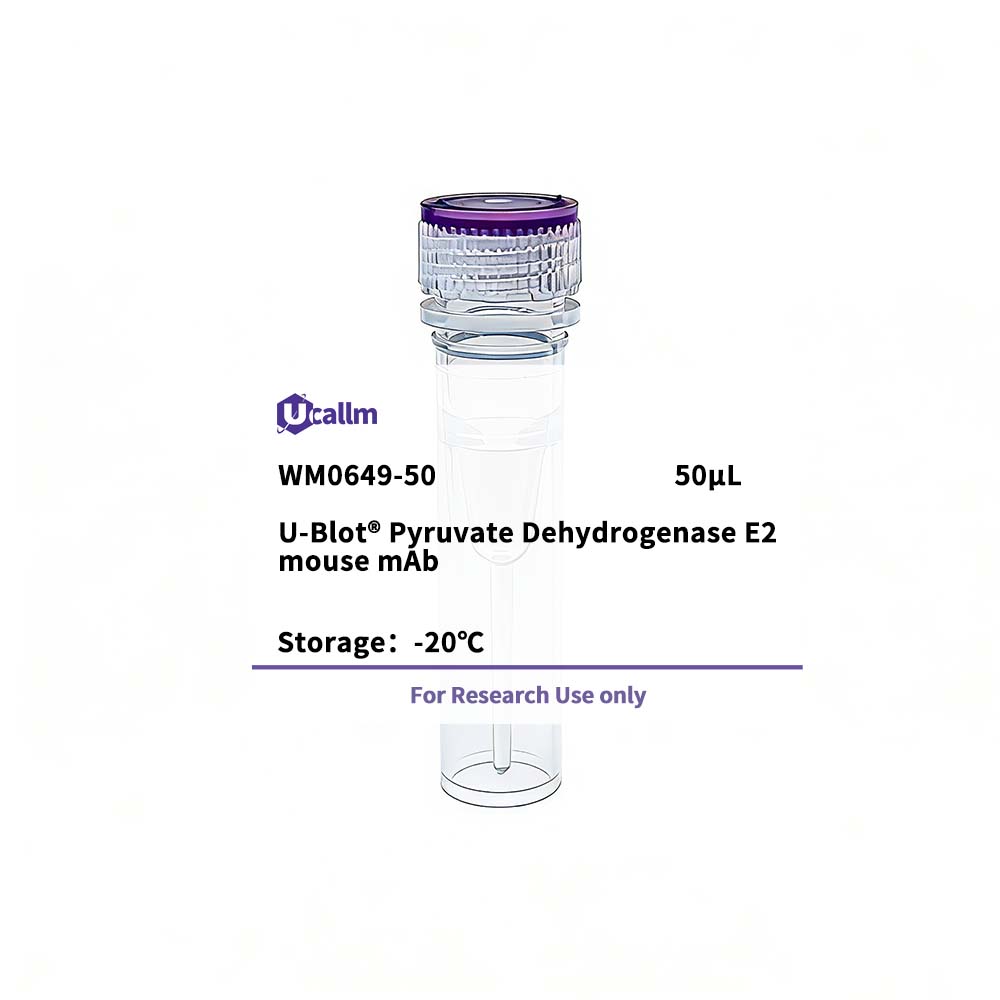
SKU: WM0649 Categories: ,

Pyruvate Dehydrogenase E2 mouse mAb

Price range: $268.00 through $328.00

SKU: WM0649-50
Enter the quantity you would like, or drag the panel to find the quantity and price that best for you
Bulk QuoteAuthorize OEM & ODM

Product details

Background:
This gene encodes component E2 of the multi-enzyme pyruvate dehydrogenase complex (PDC). PDC resides in the inner mitochondrial membrane and catalyzes the conversion of pyruvate to acetyl coenzyme A. The protein product of this gene, dihydrolipoamide acetyltransferase, accepts acetyl groups formed by the oxidative decarboxylation of pyruvate and transfers them to coenzyme A. Dihydrolipoamide acetyltransferase is the antigen for antimitochondrial antibodies. These autoantibodies are present in nearly 95% of patients with the autoimmune liver disease primary biliary cirrhosis (PBC). In PBC, activated T lymphocytes attack and destroy epithelial cells in the bile duct where this protein is abnormally distributed and overexpressed. PBC enventually leads to cirrhosis and liver failure. Mutations in this gene are also a cause of pyruvate dehydrogenase E2 deficiency which causes primary lact

Specifications

Size50μL/100μL
TargetPDC-E2
ReactivityHuman, Mouse
ApplicationsWB, ICC, IP
MW(Calculated)
MW(Observed)69kD
Host SpeciesMouse
Isotype
Conjugate/ModificationUnmodified
Recommended Dilution RatioWB 1:1000; ICC 1:300
FormulationLiquid in PBS containing 50% glycerol, 0.5% BSA and 0.02% sodium azide.
PurificationThe antibody was affinity-purified from mouse ascites by affinity-chromatography using epitope-specific immunogen.
Storage-15°C to -25°C/1 year(Do not lower than -25°C)
Concentration
ClonalityMonoclonal
Clone Number20B5
ImmunogenPurified recombinant human Pyruvate Dehydrogenase E2 protein fragments expressed in E.coli.
SpecificityThis antibody detects endogenous levels of Pyruvate Dehydrogenase E2 and does not cross-react with related proteins.
Gene NameDLAT
Protein Name
Other Name70 kDa mitochondrial autoantigen of primary biliary cirrhosis; / anti DLAT; / Dihydrolipoamide acetyltransferase component of pyruvate dehydrogenase complex; / Dihydrolipoamide; / Dihydrolipoamide S Acetyltransferase; / Dihydrolipoamide S-acetyltransferase; / E2 component of pyruvate dehydrogenase complex; / Dihydrolipoamide S-Acetyltransferase; / Dihydrolipoyllysine-residue acetyltransferase component of pyruvate dehydrogenase complex; / dihydrolipoyllysine-residue acetyltransferase component of pyruvate dehydrogenase complex mitochondrial; / DLAT; / DLAT; / DLTA; / E2; / E2 component of pyruvate dehydrogenase complex; / M2 antigen complex 70 kDa subunit; / M2 Antigen Complex 70kD Subunit; / mitochondrial; / ODP2_HUMAN; / PBC; / PDC E2; / PDC-E2; / PDCE2; / Pyruvate dehydrogenase complex component E2; / Pyruvate dehydrogenase complex E2 subunit; / S acetyltransferase component of pyruvate dehydrogenase complex.
SpeciesHuman
Gene ID1737
UniprotP10515,
Species.1Mouse
Gene ID.1
Uniprot.1Q8BMF4
Species.2
Gene ID.2
Uniprot.2
Cellular LocalizationMitochondrion matrix.
Tissue ExpressionHeart,Keratinocyte carcinoma,Kidney,Liver,Placenta,Testis,
Signaling_pathway
Research Areas>>Glycolysis / Gluconeogenesis; / >>Citrate cycle (TCA cycle); / >>Pyruvate metabolism; / >>Metabolic pathways; / >>Carbon metabolism
FunctionCatalytic activity:Acetyl-CoA + enzyme N(6)-(dihydrolipoyl)lysine = CoA + enzyme N(6)-(S-acetyldihydrolipoyl)lysine.,cofactor:Binds 2 lipoyl cofactors covalently.,Disease:Defects in DLAT are the cause of pyruvate dehydrogenase E2 deficiency [MIM:245348]; also known as lactic acidemia due to defect of E2 lipoyl transacetylase of the pyruvate dehydrogenase complex. Pyruvate dehydrogenase (PDH) deficiency is a major cause of primary lactic acidosis and neurological dysfunction in infancy and early childhood. In this form of PDH deficiency episodic dystonia is the major neurological manifestation, with other more common features of pyruvate dehydrogenase deficiency, such as hypotonia and ataxia, being less prominent.,Disease:Primary biliary cirrhosis is a chronic, progressive cholestatic liver disease characterized by the presence of antimitochondrial autoantibodies in patients' serum. It manifests with inflammatory obliteration of intra-hepatic bile duct, leading to liver cell damage and cirrhosis. Patients with primary biliary cirrhosis show autoantibodies against the E2 component of pyruvate dehydrogenase complex.,Function:The pyruvate dehydrogenase complex catalyzes the overall conversion of pyruvate to acetyl-CoA and CO(2). It contains multiple copies of three enzymatic components: pyruvate dehydrogenase (E1), dihydrolipoamide acetyltransferase (E2) and lipoamide dehydrogenase (E3).,sequence Caution:Contaminating sequence. Sequence of unknown origin in the N-terminal part.,similarity:Belongs to the 2-oxoacid dehydrogenase family.,similarity:Contains 1 lipoyl-binding domain.,similarity:Contains 2 lipoyl-binding domains.,subunit:20 to 30 alpha(2)-beta(2) tetramers of E1 + 6 homodimers of E3 + 60 copies of E2.,
Please login to post questions
Back to Top
Product has been added to your cart
