

U-Blot® Rad51 Rabbit mAb
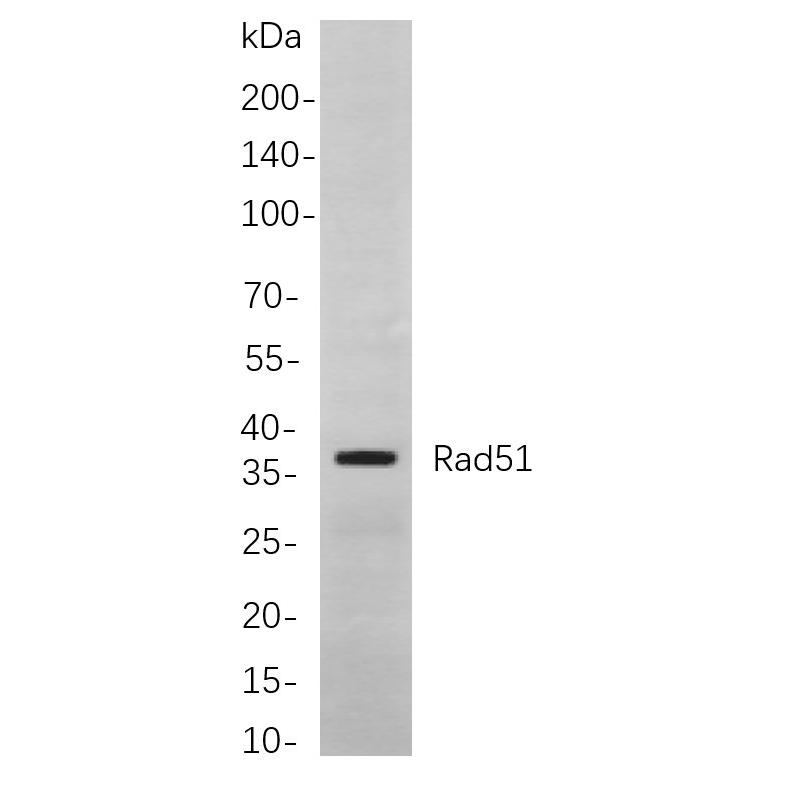
WR4027 Western blot analysis of lysates from C6 cells, using Rad51 Rabbit mAb. The HRP-conjugated Goat anti-Rabbit IgG antibody (WS0002) was used to detect the antibody.
Price range: $268.00 through $328.00
Product details
Background:The protein encoded by this gene is a member of the RAD51 protein family. RAD51 family members are highly similar to bacterial RecA and Saccharomyces cerevisiae Rad51, and are known to be involved in the homologous recombination and repair of DNA. This protein can interact with the ssDNA-binding protein RPA and RAD52, and it is thought to play roles in homologous pairing and strand transfer of DNA. This protein is also found to interact with BRCA1 and BRCA2, which may be important for the cellular response to DNA damage. BRCA2 is shown to regulate both the intracellular localization and DNA-binding ability of this protein. Loss of these controls following BRCA2 inactivation may be a key event leading to genomic instability and tumorigenesis. Multiple transcript variants encoding different isoforms have been found for this gene. [provided by RefSeq, Aug 2009],
Specifications
| Size | 50μL/100μL |
| Target | RAD51 |
| Reactivity | Human, Mouse, Rat |
| Applications | WB, IF, IP, ELISA |
| MW(Calculated) | 37kD |
| MW(Observed) | 37kD |
| Host Species | Rabbit |
| Isotype | IgG,Kappa |
| Conjugate/Modification | Unmodified |
| Recommended Dilution Ratio | WB 1:1000-1:5000; IF 1:200-1:1000; ELISA 1:5000-1:20000; IP 1:50-1:200; |
| Formulation | PBS, 50% glycerol, 0.05% Proclin 300, 0.05%BSA |
| Purification | Recombinant Antibody expressed in animal component-free (ACF) media, purified via Protein A affinity chromatography. |
| Storage | -15°C to -25°C/1 year(Do not lower than -25°C) |
| Concentration | |
| Clonality | Monoclonal |
| Clone Number | RM0083R |
| Immunogen | The specific immunogen used to produce this antibody is proprietary information. |
| Specificity | Endogenous |
| Gene Name | RAD51 |
| Protein Name | DNA repair protein RAD51 homolog 1 |
| Other Name | RAD51; / RAD51A; / RECA; / DNA repair protein RAD51 homolog 1; / HsRAD51; / hRAD51; / RAD51 homolog A |
| Species | Human |
| Gene ID | 5888 |
| Uniprot | Q06609, |
| Species.1 | Mouse |
| Gene ID.1 | 19361 |
| Uniprot.1 | Q08297 |
| Species.2 | |
| Gene ID.2 | |
| Uniprot.2 | |
| Cellular Localization | Cytoplasm, Nucleus |
| Tissue Expression | Highly expressed in testis and thymus, followed by small intestine, placenta, colon, pancreas and ovary. Weakly expressed in breast. |
| Signaling_pathway | Human Diseases >> Cancer: overview >> Pathways in cancer;Human Diseases >> Cancer: specific types >> Pancreatic cancer |
| Research Areas | >>Homologous recombination; / >>Fanconi anemia pathway; / >>Pathways in cancer; / >>Pancreatic cancer |
| Function | Disease:Defects in RAD51 are associated with breast cancer (BC) [MIM:114480].,Function:May participate in a common DNA damage response pathway associated with the activation of homologous recombination and double-strand break repair. Binds to single and double stranded DNA and exhibits DNA-dependent ATPase activity. Underwinds duplex DNA and forms helical nucleoprotein filaments.,PTM:Phosphorylated. Phosphorylation of Thr-309 by CHEK1/CHK1 may enhance association with chromatin at sites of DNA damage and promote DNA repair by homologous recombination.,similarity:Belongs to the recA family.,similarity:Belongs to the recA family. RAD51 subfamily.,similarity:Contains 1 HhH domain.,subcellular location:Colocalizes with RAD51AP1 to multiple nuclear foci upon induction of DNA damage.,subunit:Interacts with BRCA1, BRCA2 and either directly or indirectly with p53. Interacts with XRCC3, RAD54L and RAD54B. Part of a complex with RAD51C and RAD51B. Interacts with RAD51AP1 and RAD51AP2. Interacts with CHEK1/CHK1, and this may require prior phosphorylation of CHEK1. Interacts with the MND1-PSMC3IP heterodimer (By similarity). Interacts with OBFC2B.,tissue specificity:Highly expressed in testis and thymus, followed by small intestine, placenta, colon, pancreas and ovary. Weakly expressed in breast., |
Please login to post questions
Related products





