


RAD9A mouse mAb
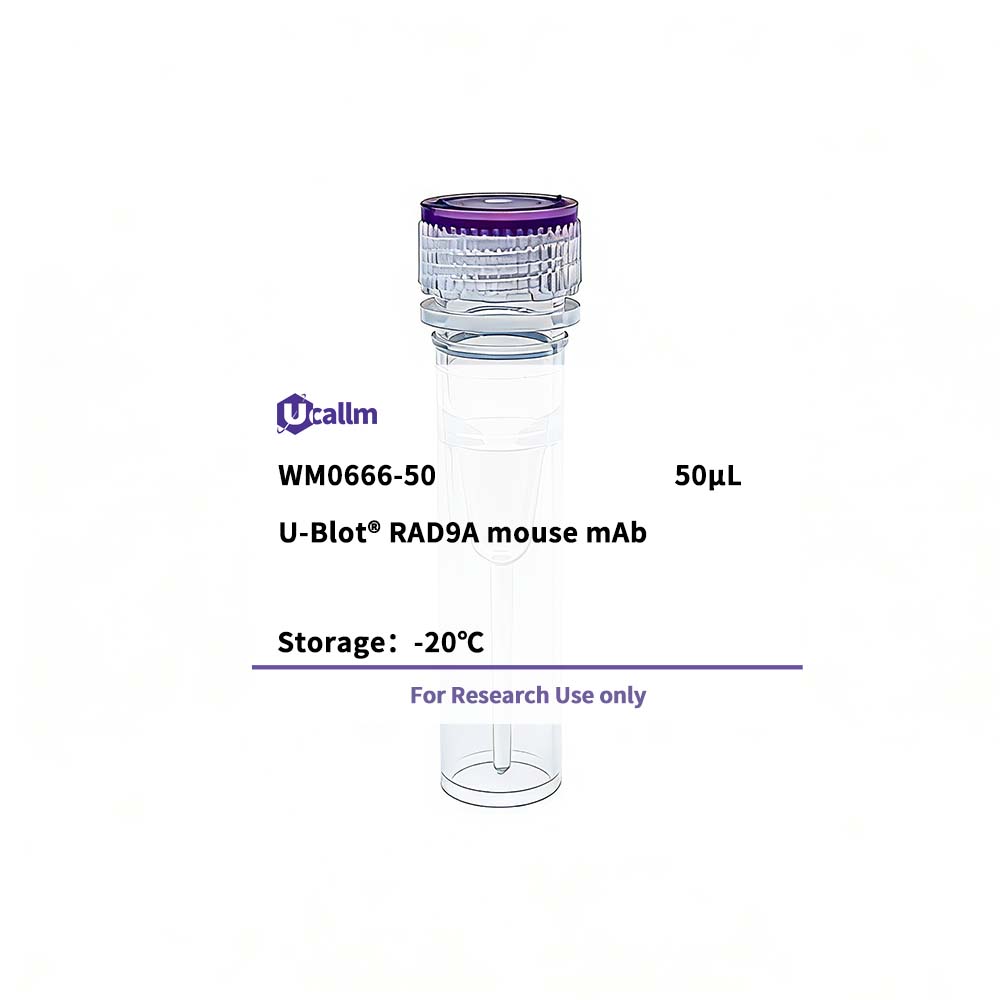
Ucallm_WM0666-50
Price range: $268.00 through $328.00
Specifications
| Size | 50μL/100μL |
| Target | RAD9A |
| Reactivity | Human, Mouse, Rat, Monkey |
| Applications | WB, IP |
| MW(Calculated) | |
| MW(Observed) | 55kD |
| Host Species | Mouse |
| Isotype | |
| Conjugate/Modification | Unmodified |
| Recommended Dilution Ratio | WB 1:500 |
| Formulation | Liquid in PBS containing 50% glycerol, 0.5% BSA and 0.02% sodium azide. |
| Purification | The antibody was affinity-purified from mouse ascites by affinity-chromatography using epitope-specific immunogen. |
| Storage | -15°C to -25°C/1 year(Do not lower than -25°C) |
| Concentration | |
| Clonality | Monoclonal |
| Clone Number | 14G8 |
| Immunogen | Purified recombinant human RAD9A protein fragments expressed in E.coli |
| Specificity | This antibody detects endogenous levels of RAD9A and does not cross-react with related proteins. |
| Gene Name | rad9a |
| Protein Name | |
| Other Name | Cell cycle checkpoint control protein; / Cell cycle checkpoint control protein RAD9A; / DNA repair exonuclease rad9 homolog A; / hRAD 9; / hRAD9; / Rad 9; / RAD 9A; / RAD9; / S pombe; / homolog; / RAD9 homolog A; / RAD9 homolog; / RAD9A; / RAD9A_HUMAN. |
| Species | Human |
| Gene ID | 5883 |
| Uniprot | Q99638, |
| Species.1 | Mouse |
| Gene ID.1 | |
| Uniprot.1 | Q9Z0F6 |
| Species.2 | |
| Gene ID.2 | |
| Uniprot.2 | |
| Cellular Localization | Nucleus . |
| Tissue Expression | |
| Signaling_pathway | Cellular Processes >> Cell growth and death >> Cellular senescence |
| Research Areas | >>Cellular senescence |
| Function | cell cycle checkpoint, DNA replication checkpoint, DNA damage checkpoint, DNA metabolic process, DNA replication,regulation of DNA replication, DNA repair, response to DNA damage stimulus, intracellular signaling cascade, negative regulation of DNA replication, negative regulation of biosynthetic process, negative regulation of macromolecule biosynthetic process, negative regulation of macromolecule metabolic process, regulation of cell death, positive regulation of cell death, regulation of DNA replication initiation, negative regulation of cellular biosynthetic process,DNA integrity checkpoint, negative regulation of DNA replication initiation, cellular response to stress, DNA damage response, signal transduction, regulation of apoptosis, positive regulation of apoptosis, regulation of programmed cell death, positive regulation of programmed cell death, negative regulation of nucleobase, nucleoside, nucleotide and nucleic acid metabolic process, regulation of DNA metabolic process, negative regulation of DNA metabolic process,negative regulation of nitrogen compound metabolic process, regulation of cell cycle, |
Please login to post questions
Related products


