SKU: WR4264 Categories: ,

U-Blot® Raptor Rabbit mAb

Price range: $268.00 through $328.00

SKU: WR4264-50
Enter the quantity you would like, or drag the panel to find the quantity and price that best for you
Bulk QuoteAuthorize OEM & ODM

Product details

Background:This gene encodes a component of a signaling pathway that regulates cell growth in response to nutrient and insulin levels. The encoded protein forms a stoichiometric complex with the mTOR kinase, and also associates with eukaryotic initiation factor 4E-binding protein-1 and ribosomal protein S6 kinase. The protein positively regulates the downstream effector ribosomal protein S6 kinase, and negatively regulates the mTOR kinase. Multiple transcript variants encoding different isoforms have been found for this gene. [provided by RefSeq, Sep 2009],

Specifications

Size50μL/100μL
TargetRaptor
ReactivityHuman, Mouse
ApplicationsWB, IHC, IF, ELISA
MW(Calculated)149kD
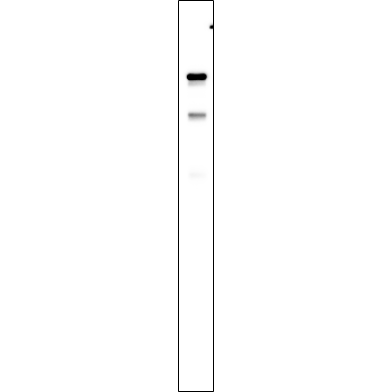
MW(Observed)149kD
Host SpeciesRabbit
IsotypeIgG,Kappa
Conjugate/ModificationUnmodified
Recommended Dilution RatioIHC 1:200-1:1000; WB 1:2000-1:10000; IF 1:200-1:1000; ELISA 1:5000-1:20000; / Note: For IHC, we suggest antigen retrieval with TE buffer pH 9.0 (Cat#WT1004)
FormulationPBS, 50% glycerol, 0.05% Proclin 300, 0.05%BSA
PurificationRecombinant Antibody expressed in animal component-free (ACF) media, purified via Protein A affinity chromatography.
Storage-15°C to -25°C/1 year(Do not lower than -25°C)
Concentration
ClonalityMonoclonal
Clone NumberRM0215R
ImmunogenThe specific immunogen used to produce this antibody is proprietary information.
SpecificityEndogenous
Gene NameRPTOR KIAA1303 RAPTOR
Protein NameRegulatory-associated protein of mTOR (Raptor) (p150 target of rapamycin (TOR)-scaffold protein)
Other NamePPP1R12A; / MBS; / MYPT1; / Protein phosphatase 1 regulatory subunit 12A; / Myosin phosphatase-targeting subunit 1; / Myosin phosphatase target subunit 1; / Protein phosphatase myosin-binding subunit
SpeciesHuman
Gene ID4659
UniprotQ8N122,
Species.1Mouse
Gene ID.1
Uniprot.1Q8K4Q0
Species.2
Gene ID.2
Uniprot.2
Cellular LocalizationCytoplasm
Tissue ExpressionExpressed in striated muscles, specifically in type 2a fibers (at protein level).
Signaling_pathwayCellular Processes >> Cellular community - eukaryotes >> Focal adhesion;Cellular Processes >> Cell motility >> Regulation of actin cytoskeleton;Organismal Systems >> Immune system >> Platelet activation;Organismal Systems >> Endocrine system >> Oxytocin signaling pathway;Organismal Systems >> Circulatory system >> Vascular smooth muscle contraction;Environmental Information Processing >> Signal transduction >> cAMP signaling pathway;Environmental Information Processing >> Signal transduction >> cGMP-PKG signaling pathway
Research Areas>>cGMP-PKG signaling pathway; / >>cAMP signaling pathway; / >>Vascular smooth muscle contraction; / >>Focal adhesion; / >>Platelet activation; / >>Regulation of actin cytoskeleton; / >>Oxytocin signaling pathway; / >>Proteoglycans in cancer
FunctionFunction:Participates in the FRAP1 pathway and associates in a near stoichiometric ratio with FRAP1 to form a nutrient-sensitive complex (NSC). Plays a pivotal role as a scaffold protein in the FRAP1-signaling pathway and this interaction is essential for the catalyzed phosphorylation of EIF4EBP1. Has a positive role in nutrient-stimulated signaling to the downstream effector RPS6KB1. Under nutrient-deprived conditions, serves as a negative regulator of FRAP1 kinase activity. Regulation of the interaction with FRAP1 is a critical mechanism by which cells coordinate the rate of cell growth and maintenance of cell size with different environmental conditions.,miscellaneous:Rapamycin destabilizes the interaction with FRAP1 regardless of nutrient availability, and its potency for dissociation is increased under nutrient-rich conditions. This action uncouples FRAP1 from its substrates, and inhibits FRAP1 signaling without altering its intrinsic catalytic activity.,similarity:Belongs to the WD repeat RAPTOR family.,similarity:Contains 7 WD repeats.,subunit:Binds directly 4EBP1 and RPS6KB1 independently of its association with FRAP1. Binds preferentially to poorly or non-phosphorylated form of EIF4EBP1, and this binding is critical to the ability of FRAP1 to catalyze phosphorylation. Complex with FRAP1 physically interacts under both leucine-rich and -poor conditions and therefore in at least two nutrient-determined states with different stability.,tissue specificity:Highly expressed in skeletal muscle, and in a lesser extent in brain, lung, small intestine, kidney and placenta.,
Please login to post questions

Back to Top
Product has been added to your cart


