

Recombinant CD142 Fc-Fused Nanobody (VF0282)
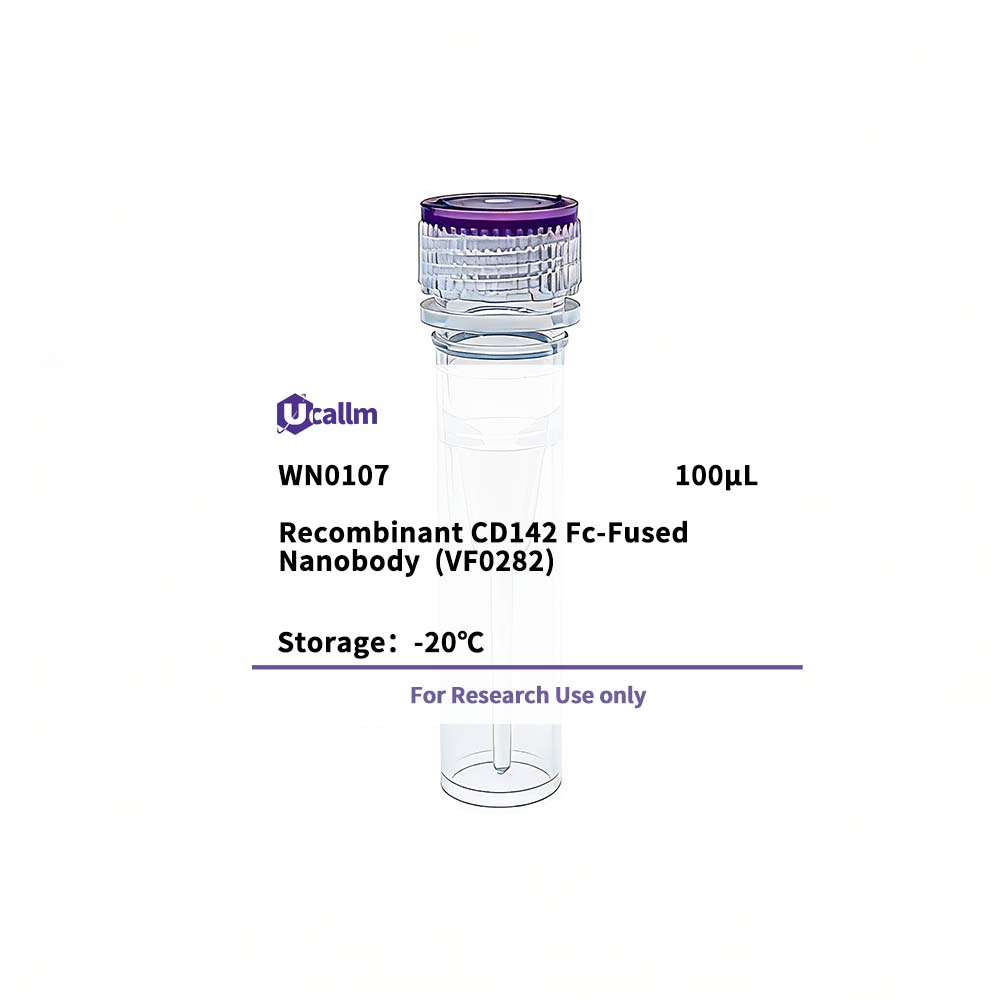
Ucallm_WN0107
$365.00
Product details
Background:CD142, also known as Tissue Factor (TF), Coagulation Factor III, and Thromboplastin, is a 45 kD type I transmembrane glycoprotein. It is expressed on the surface of a variety of cells that are physically separated from the circulating blood which include smooth muscle cells, fibroblasts, keratinocytes, glomerular epithelial cells (cytoplasmic inclusions), astrocytes, myocardium, liver stromal cells, pancreas cells, and is also expressed on activated monocytes and stimulated endothelial cells. CD142 is a high-affinity receptor for coagulation factor VII and initiates the extrinsic pathway of blood coagulation. CD142 also plays an important role in a variety of diseases such as sepsis, atherosclerosis, and cancer.
Specifications
| Size | 100μL |
| Target | CD142 |
| Reactivity | Human |
| Applications | ELISA |
| MW(Calculated) | |
| MW(Observed) | |
| Host Species | |
| Isotype | IgG2a,Kappa |
| Conjugate/Modification | Unmodified |
| Recommended Dilution Ratio | ELISA 1:5000-100000 |
| Formulation | Phosphate-buffered solution |
| Purification | Recombinant Expression and Affinity purified |
| Storage | -15°C to -25°C/1 year(Avoid freeze / thaw cycles) |
| Concentration | Please check the information on the tube |
| Clonality | |
| Clone Number | VF0132 |
| Immunogen | Purified recombinant Human CD142 |
| Specificity | This recombinant monoclonal antibody can detects endogenous levels of CD142 protein. |
| Gene Name | F3 |
| Protein Name | Tissue factor (TF) (Coagulation factor III) (Thromboplastin) (CD antigen CD142) |
| Other Name | Coagulation Factor III; / Tissue Factor; / TF; / Thromboplastin; / platelet tissue factor; / factor III; / factor 3; / F3; / F-3; / TFA |
| Species | Human |
| Gene ID | 2152 |
| Uniprot | P13726 |
| Species.1 | |
| Gene ID.1 | |
| Uniprot.1 | |
| Species.2 | |
| Gene ID.2 | |
| Uniprot.2 | |
| Cellular Localization | [Isoform 1]: Membrane; Single-pass type I membrane protein .; [Isoform 2]: Secreted . |
| Tissue Expression | Produced by skeletal muscle. |
| Signaling_pathway | Organismal Systems >> Immune system >> Complement and coagulation cascades |
| Research Areas | >>EGFR tyrosine kinase inhibitor resistance; / >>Antifolate resistance; / >>Cytokine-cytokine receptor interaction; / >>Viral protein interaction with cytokine and cytokine receptor; / >>HIF-1 signaling pathway; / >>FoxO signaling pathway; / >>PI3K-Akt signaling pathway; / >>Cellular senescence; / >>Toll-like receptor signaling pathway; / >>NOD-like receptor signaling pathway; / >>Cytosolic DNA-sensing pathway; / >>C-type lectin receptor signaling pathway; / >>JAK-STAT signaling pathway; / >>Hematopoietic cell lineage; / >>IL-17 signaling pathway; / >>Th17 cell differentiation; / >>TNF signaling pathway; / >>Intestinal immune network for IgA production; / >>Insulin resistance; / >>Non-alcoholic fatty liver disease; / >>AGE-RAGE signaling pathway in diabetic complications; / >>Alcoholic liver disease; / >>Alzheimer disease; / >>Prion disease; / >>Pathways of neurodegeneration - multiple diseases; / >>Pathogenic Escherichia coli infection; / >>Salmonella infection; / >>Pertussis; / >>Legionellosis; / >>Yersinia infection; / >>Chagas disease; / >>African trypanosomiasis; / >>Malaria; / >>Amoebiasis; / >>Tuberculosis; / >>Hepatitis B; / >>Measles; / >>Human cytomegalovirus infection; / >>Influenza A; / >>Human T-cell leukemia virus 1 infection; / >>Kaposi sarcoma-associated herpesvirus infection; / >>Herpes simplex virus 1 infection; / >>Epstein-Barr virus infection; / >>Coronavirus disease - COVID-19; / >>Pathways in cancer; / >>Transcriptional misregulation in cancer; / >>Inflammatory bowel disease; / >>Rheumatoid arthritis; / >>Graft-versus-host disease; / >>Hypertrophic cardiomyopathy; / >>Lipid and atherosclerosis |
| Function | Initiates blood coagulation by forming a complex with circulating factor VII or VIIa. The [TF:VIIa] complex activates factors IX or X by specific limited proteolysis. TF plays a role in normal hemostasis by initiating the cell-surface assembly and propagation of the coagulation protease cascade. |
Please login to post questions
Related products





