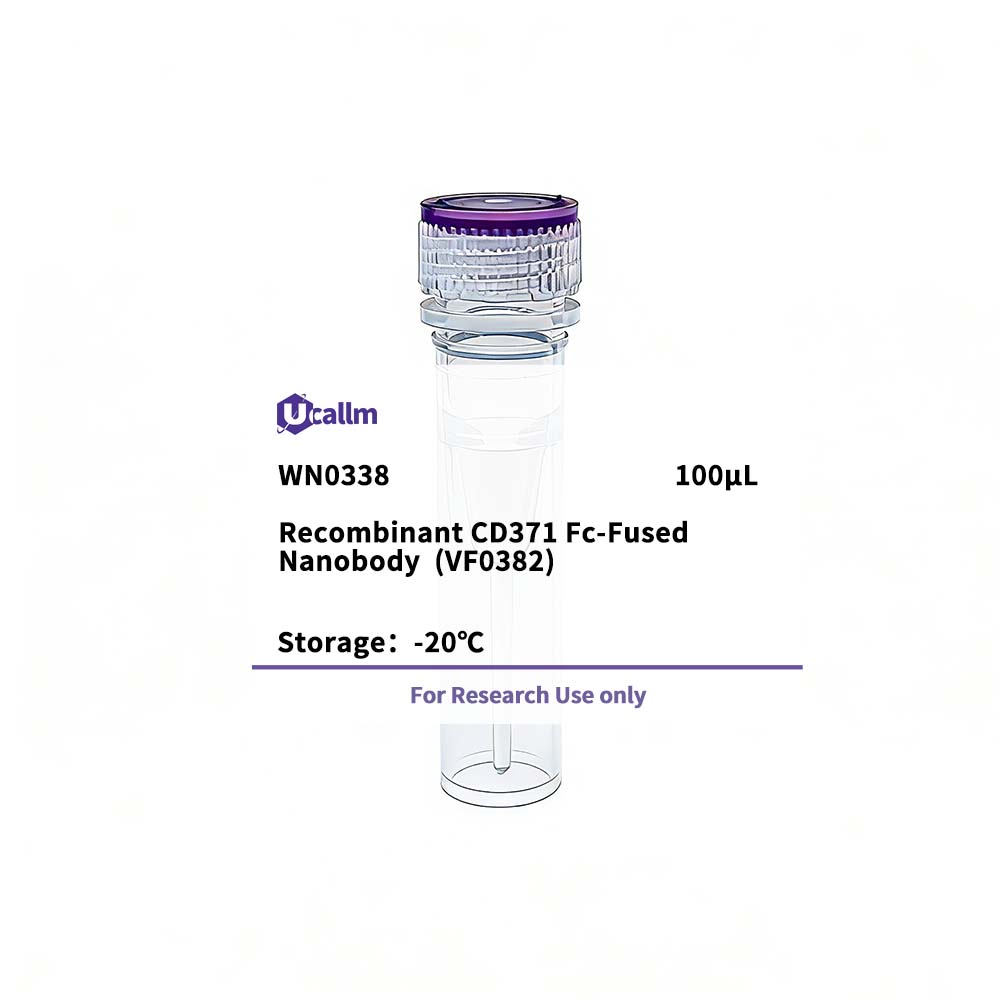
SKU: WN0338 Categories: ,

Recombinant CD371 Fc-Fused Nanobody (VF0382)

$365.00

SKU: WN0338
Enter the quantity you would like, or drag the panel to find the quantity and price that best for you
Bulk QuoteAuthorize OEM & ODM

Product details

Background:CD371 (CLEC12A), also known as DCAL-2, MICL or CLL-1, is a 30 kD type II transmembrane protein with extracellular C-type lectin domains, belonging to the C-type lectin family. It is expressed on monocytes, granulocytes, NK cells, and basophils. Its cytoplasmic ITIM motif modulates signaling cascades and is involved in phosphorylation of tyrosine residues in MAP kinases.


Specifications

Size100μL
TargetCD371
ReactivityHuman
ApplicationsELISA
MW(Calculated)
MW(Observed)
Host Species
IsotypeIgG2a,Kappa
Conjugate/ModificationUnmodified
Recommended Dilution RatioELISA 1:5000-100000; Flow Cyt 1-2μg/Test
FormulationPhosphate-buffered solution
PurificationRecombinant Expression and Affinity purified
Storage-15°C to -25°C/1 year(Avoid freeze / thaw cycles)
ConcentrationPlease check the information on the tube
Clonality
Clone NumberVF0590
ImmunogenPurified recombinant Human CD371
SpecificityThis recombinant monoclonal antibody can detects endogenous levels of CD371 protein.
Gene NameCLEC12A CLL1 DCAL2 MICL
Protein NameC-type lectin domain family 12 member A (C-type lectin-like molecule 1) (CLL-1) (Dendritic cell-associated lectin 2) (DCAL-2) (Myeloid inhibitory C-type lectin-like receptor) (MICL) (CD antigen CD371)
Other NameCLL1; / MICL; / CLL-1; / DCAL-2; / C-type lectin domain family 12 member A; / CD371; / CD371 nanobody
SpeciesHuman
Gene ID160364
UniprotQ5QGZ9
Species.1
Gene ID.1
Uniprot.1
Species.2
Gene ID.2
Uniprot.2
Cellular LocalizationCell membrane; Single-pass type II membrane protein . Ligand binding leads to internalization.
Tissue Expression[Isoform p41]: In B cells, represents 1% of total CD74 expression.; [Isoform p33]: In B cells, represents 7% of total CD74 expression.
Signaling_pathway
Research Areas
FunctionCell surface receptor that modulates signaling cascades and mediates tyrosine phosphorylation of target MAP kinases.
Please login to post questions
Back to Top
Product has been added to your cart
