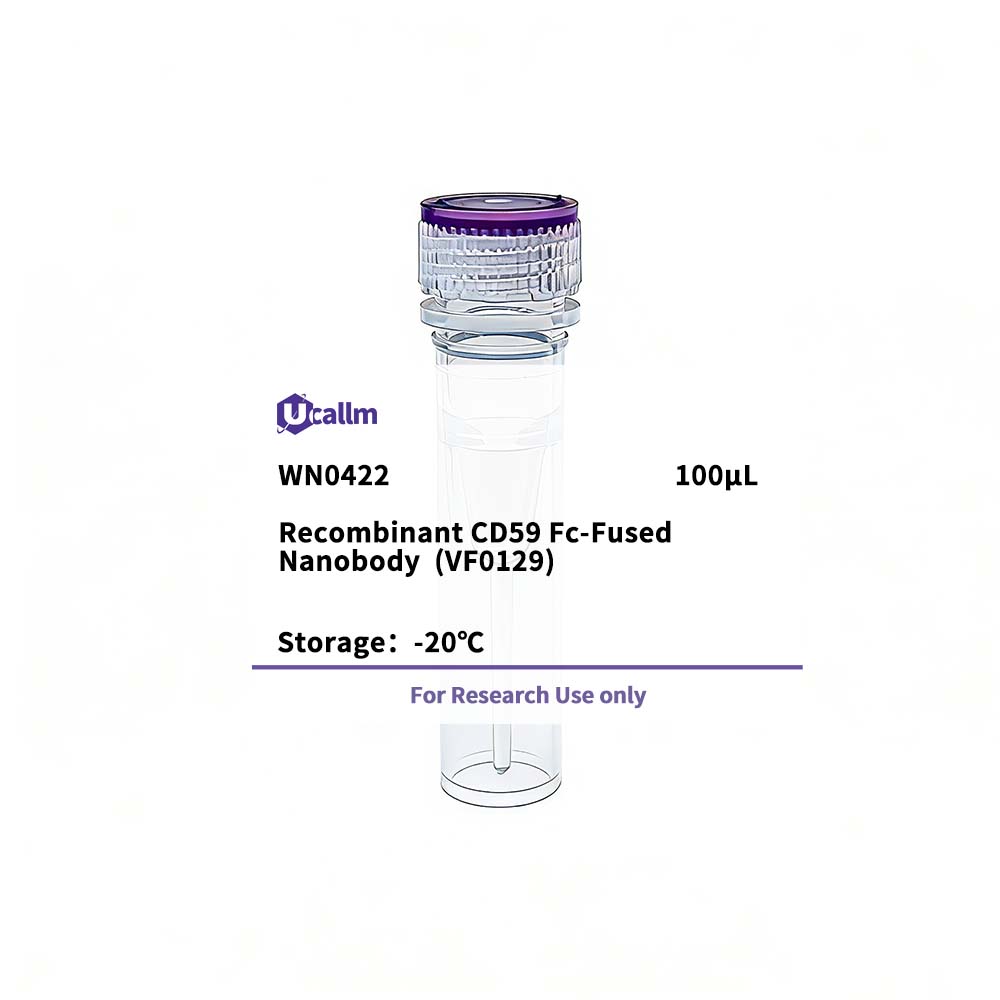
SKU: WN0422 Categories: ,

Recombinant CD59 Fc-Fused Nanobody (VF0129)

$365.00

SKU: WN0422
Enter the quantity you would like, or drag the panel to find the quantity and price that best for you
Bulk QuoteAuthorize OEM & ODM

Product details

Background:This gene encodes a cell surface glycoprotein that regulates complement-mediated cell lysis, and it is involved in lymphocyte signal transduction.This protein is a potent inhibitor of the complement membrane attack complex, whereby it binds complement C8 and/or C9 during the assembly ofThis complex, thereby inhibiting the incorporation of multiple copies of C9 into the complex, which is necessary for osmolytic pore formation.This protein also plays a role in signal transduction pathways in the activation of T cells. Mutations inThis gene cause CD59 deficiency, a disease resulting in hemolytic anemia and thrombosis, and which causes cerebral infarction. Multiple alternatively spliced transcript variants, which encode the same protein, have been identified forThis gene. [provided by RefSeq, Jul 2008]

Specifications

Size100μL
TargetCD59
ReactivityHuman
ApplicationsELISA
MW(Calculated)
MW(Observed)
Host Species
IsotypeIgG2a,Kappa
Conjugate/ModificationUnmodified
Recommended Dilution RatioELISA 1:5000-100000
FormulationPhosphate-buffered solution
PurificationRecombinant Expression and Affinity purified
Storage-15°C to -25°C/1 year(Avoid freeze / thaw cycles)
ConcentrationPlease check the information on the tube
Clonality
Clone NumberVF0119
ImmunogenPurified recombinant Human CD59
SpecificityThis recombinant monoclonal antibody can detects endogenous levels of CD59 protein.
Gene NameCD59 MIC11 MIN1 MIN2 MIN3 MSK21
Protein NameCD59 glycoprotein (1F5 antigen) (20 kDa homologous restriction factor) (HRF-20) (HRF20) (MAC-inhibitory protein) (MAC-IP) (MEM43 antigen) (Membrane attack complex inhibition factor) (MACIF) (Membrane inhibitor of reactive lysis) (MIRL) (Protectin) (CD antigen CD59)
Other NameCD59; / MIC11; / MIN1; / MIN2; / MIN3; / MSK21; / CD59 glycoprotein; / 1F5 antigen; / 20 kDa homologous restriction factor; / HRF-20; / HRF20; / MAC-inhibitory protein; / MAC-IP; / MEM43 antigen; / Membrane attack complex inhibition factor; / MACIF; / Membrane inhibitor of reactive lysis; / MIRL; / Protectin; / CD59; / CD59 nanobody
SpeciesHuman
Gene ID966
UniprotP13987
Species.1
Gene ID.1
Uniprot.1
Species.2
Gene ID.2
Uniprot.2
Cellular LocalizationCell membrane; Lipid-anchor, GPI-anchor. Secreted. Soluble form found in a number of tissues.
Tissue ExpressionDetected on umbilical veil endothelial cells (PubMed:162579). Detected in placenta (at protein level) (PubMed:169283). Detected on endothelial cells (PubMed:169283).
Signaling_pathwayOrganismal Systems >> Immune system >> Hematopoietic cell lineage;Organismal Systems >> Immune system >> Complement and coagulation cascades
Research Areas
FunctionDisease:Defects in CD59 are the cause of CD59 deficiency [MIM:612300].,Potent inhibitor of the complement membrane attack complex (MAC) action. Acts by binding to the C8 and/or C9 complements of the assembling MAC, thereby preventing incorporation of the multiple copies of C9 required for complete formation of the osmolytic pore. This inhibitor appears to be species-specific. Involved in signal transduction for T-cell activation complexed to a protein tyrosine kinase.,The soluble form from urine retains its specific complement binding activity, but exhibits greatly reduced ability to inhibit MAC assembly on cell membranes.,online information:CD59 mutation db,PTM:Glycated. Glycation is found in diabetic subjects, but only at minimal levels in nondiabetic subjects. Glycated CD59 lacks MAC-inhibitory function and confers to vascular complications of diabetes.,PTM:N- and O-glycosylated. The N-glycosylation mainly consists of a family of biantennary complex-type structures with and without lactosamine extensions and outer arm fucose residues. Also significant amounts of triantennary complexes (22%). Variable sialylation also present in the Asn-43 oligosaccharide. The predominant O-glycans are mono-sialylated forms of the disaccharide, Gal-beta-1,3GalNAc, and their sites of attachment are probably on Thr-76 and Thr-77. The GPI-anchor of soluble urinary CD59 has no inositol-associated phospholipid, but is composed of seven different GPI-anchor variants of one or more monosaccharide units. Major variants contain sialic acid, mannose and glucosamine Sialic acid linked to an N-acetylhexosamine-galactose arm is present in two variants.,similarity:Contains 1 UPAR/Ly6 domain.,subcellular location:Soluble form found in a number of tissues.,subunit:Interacts with T-cell surface antigen CD2.,
Please login to post questions
Back to Top
Product has been added to your cart

