

Recombinant GFP Fc-Fused Nanobody (VF0480)
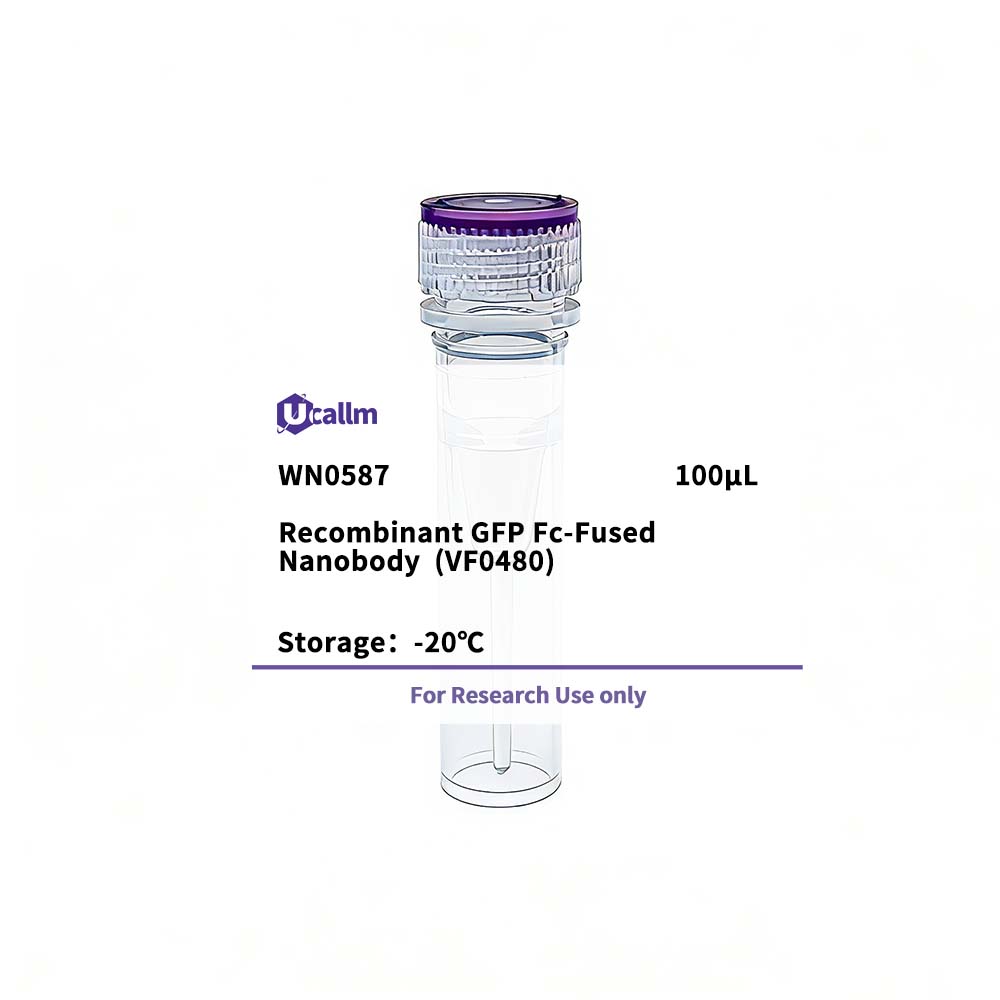
Ucallm_WN0587
$365.00
Product details
Background:Green Fluorescent Protein (GFP) has quickly become a powerful research tool for assessing gene expression and subcellular protein distribution in fixed or living cells. GFP is excited by and brightly fluoresces when exposed to UV or blue light. This feature makes it ideal as a marker for use in fluorescence microscopy, cytometry, tagging fusion proteins, and assaying transcriptional regulation from gene promoters in vivo. Numerous GFP variants with enhanced and shifted emission spectra (blue, green, and yellow) have been developed through amino acid substitutions at specific residues.
Specifications
| Size | 100μL |
| Target | GFP |
| Reactivity | Human |
| Applications | ELISA |
| MW(Calculated) | |
| MW(Observed) | |
| Host Species | |
| Isotype | IgG2a,Kappa |
| Conjugate/Modification | Unmodified |
| Recommended Dilution Ratio | ELISA 1:5000-100000 |
| Formulation | Phosphate-buffered solution |
| Purification | Recombinant Expression and Affinity purified |
| Storage | -15°C to -25°C/1 year(Avoid freeze / thaw cycles) |
| Concentration | Please check the information on the tube |
| Clonality | |
| Clone Number | VF0091 |
| Immunogen | Purified recombinant GFP |
| Specificity | This recombinant monoclonal antibody can detects endogenous levels of GFP protein. |
| Gene Name | F3 |
| Protein Name | Tissue factor (TF) (Coagulation factor III) (Thromboplastin) (CD antigen CD142) |
| Other Name | GFP nanobody |
| Species | Human |
| Gene ID | |
| Uniprot | |
| Species.1 | |
| Gene ID.1 | |
| Uniprot.1 | |
| Species.2 | |
| Gene ID.2 | |
| Uniprot.2 | |
| Cellular Localization | [Isoform 1]: Membrane; Single-pass type I membrane protein .; [Isoform 2]: Secreted . |
| Tissue Expression | Lung, placenta and pancreas. |
| Signaling_pathway | |
| Research Areas | |
| Function | Initiates blood coagulation by forming a complex with circulating factor VII or VIIa. The [TF:VIIa] complex activates factors IX or X by specific limited proteolysis. TF plays a role in normal hemostasis by initiating the cell-surface assembly and propagation of the coagulation protease cascade. |
Please login to post questions
Related products




