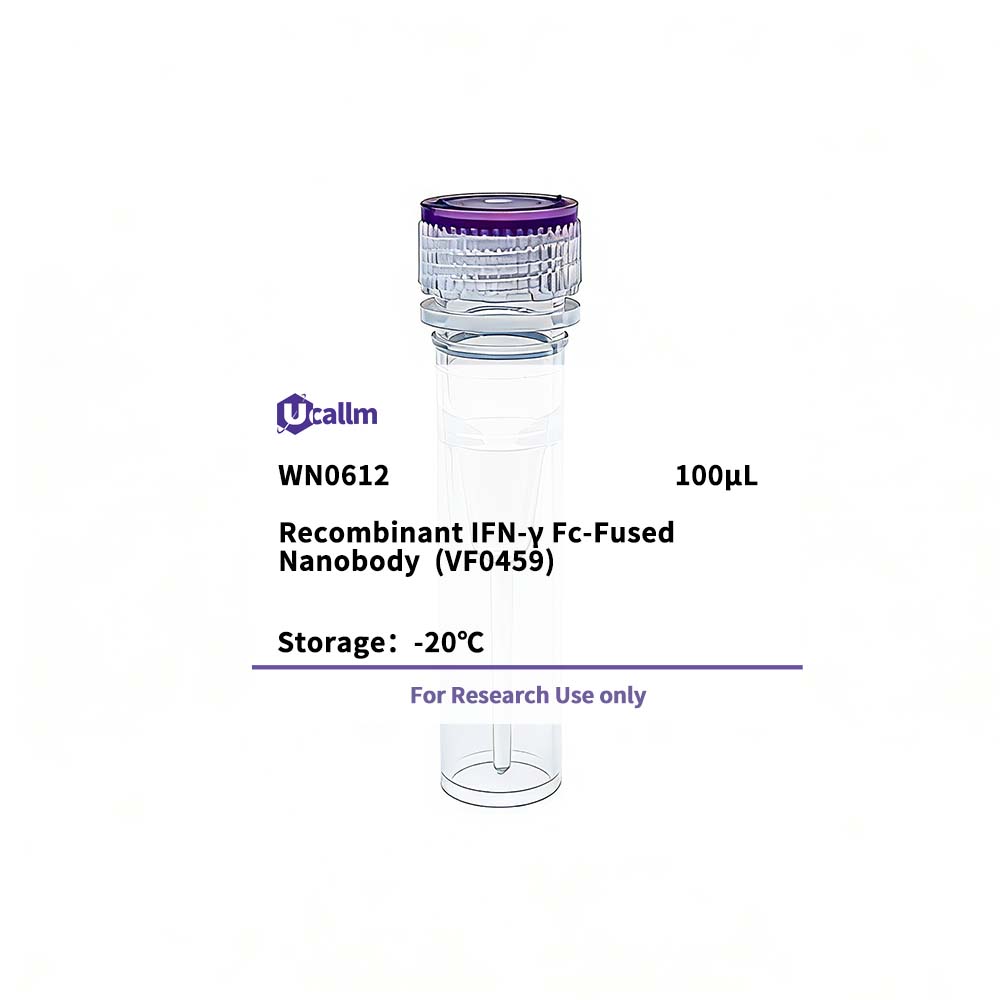
SKU: WN0612 Categories: ,

Recombinant IFN-γ Fc-Fused Nanobody (VF0459)

$365.00

SKU: WN0612
Enter the quantity you would like, or drag the panel to find the quantity and price that best for you
Bulk QuoteAuthorize OEM & ODM

Product details

Background:This gene encodes a soluble cytokine that is a member of the type II interferon class. The encoded protein is secreted by cells of both the innate and adaptive immune systems. The active protein is a homodimer that binds to the interferon gamma receptor which triggers a cellular response to viral and microbial infections. Mutations in this gene are associated with an increased susceptibility to viral, bacterial and parasitic infections and to several autoimmune diseases. [provided by RefSeq, Dec 2015],


Specifications

Size100μL
TargetIFN-γ
ReactivityHuman
ApplicationsELISA
MW(Calculated)
MW(Observed)
Host Species
IsotypeIgG2a,Kappa
Conjugate/ModificationUnmodified
Recommended Dilution RatioELISA 1:5000-100000; Flow Cyt 1-2μg/Test
FormulationPhosphate-buffered solution
PurificationRecombinant Expression and Affinity purified
Storage-15°C to -25°C/1 year(Avoid freeze / thaw cycles)
ConcentrationPlease check the information on the tube
Clonality
Clone NumberVF0525
ImmunogenPurified recombinant Human IFNγ
SpecificityThis recombinant monoclonal antibody can detects endogenous levels of IFN-γ protein.
Gene NameIFNG
Protein NameInterferon gamma
Other NameIFNG; / Interferon gamma; / IFN-gamma; / Immune interferon; / IFNγ nanobody
SpeciesHuman
Gene ID3458
UniprotP01579
Species.1
Gene ID.1
Uniprot.1
Species.2
Gene ID.2
Uniprot.2
Cellular LocalizationSecreted.
Tissue Expression[Isoform p41]: In B cells, represents 1% of total CD74 expression.; [Isoform p33]: In B cells, represents 7% of total CD74 expression.
Signaling_pathwayCellular Processes >> Cell growth and death >> Necroptosis;Organismal Systems >> Immune system >> Natural killer cell mediated cytotoxicity;Organismal Systems >> Immune system >> Antigen processing and presentation;Organismal Systems >> Immune system >> T cell receptor signaling pathway;Organismal Systems >> Immune system >> Th1 and Th2 cell differentiation;Organismal Systems >> Immune system >> Th17 cell differentiation;Organismal Systems >> Immune system >> IL-17 signaling pathway;Organismal Systems >> Development and regeneration >> Osteoclast differentiation;Human Diseases >> Cancer: overview >> Pathways in cancer;Human Diseases >> Cancer: overview >> PD-L1 expression and PD-1 checkpoint pathway in cancer;Human Diseases >> Immune disease >> Systemic lupus erythematosus;Human Diseases >> Immune disease >> Rheumatoid arthritis;Human Diseases >> Immune disease >> Inflammatory bowel disease;Human Diseases >> Immune disease >> Allograft rejection;Human Diseases >> Immune disease >> Graft-versus-host disease;Environmental Information Processing >> Signal transduction >> TGF-beta signaling pathway;Environmental Information Processing >> Signal transduction >> JAK-STAT signaling pathway;Environmental Information Processing >> Signal transduction >> HIF-1 signaling pathway;Environmental Information Processing >> Signaling molecules and interaction >> Cytokine-cytokine receptor interaction;Genetic Information Processing >> Folding, sorting and degradation >> Proteasome
Research Areas
FunctionDisease:In Caucasians, genetic variation in IFNG is associated with the risk of aplastic anemia (AA) [MIM:609135]. AA is a rare disease in which the reduction of the circulating blood cells results from damage to the stem cell pool in bone marrow. In most patients, the stem cell lesion is caused by an autoimmune attack. T-lymphocytes, activated by an endogenous or exogenous, and most often unknown antigenic stimulus, secrete cytokines, including IFN-gamma, which would in turn be able to suppress hematopoiesis.,Function:Produced by lymphocytes activated by specific antigens or mitogens. IFN-gamma, in addition to having antiviral activity, has important immunoregulatory functions. It is a potent activator of macrophages, it has antiproliferative effects on transformed cells and it can potentiate the antiviral and antitumor effects of the type I interferons.,online information:Interferon gamma entry,pharmaceutical:Available under the name Actimmune (Genentech). Used for reducing the frequency and severity of serious infections associated with chronic granulomatous disease (CGD).,PTM:Proteolytic processing produces C-terminal heterogeneity, with proteins ending alternatively at Gly-150, Met-157 or Gly-161.,similarity:Belongs to the type II (or gamma) interferon family.,subunit:Homodimer.,tissue specificity:Released primarily from activated T lymphocytes.,
Please login to post questions
Back to Top
Product has been added to your cart
