


Recombinant IL-4 Fc-Fused Nanobody (VF0178)
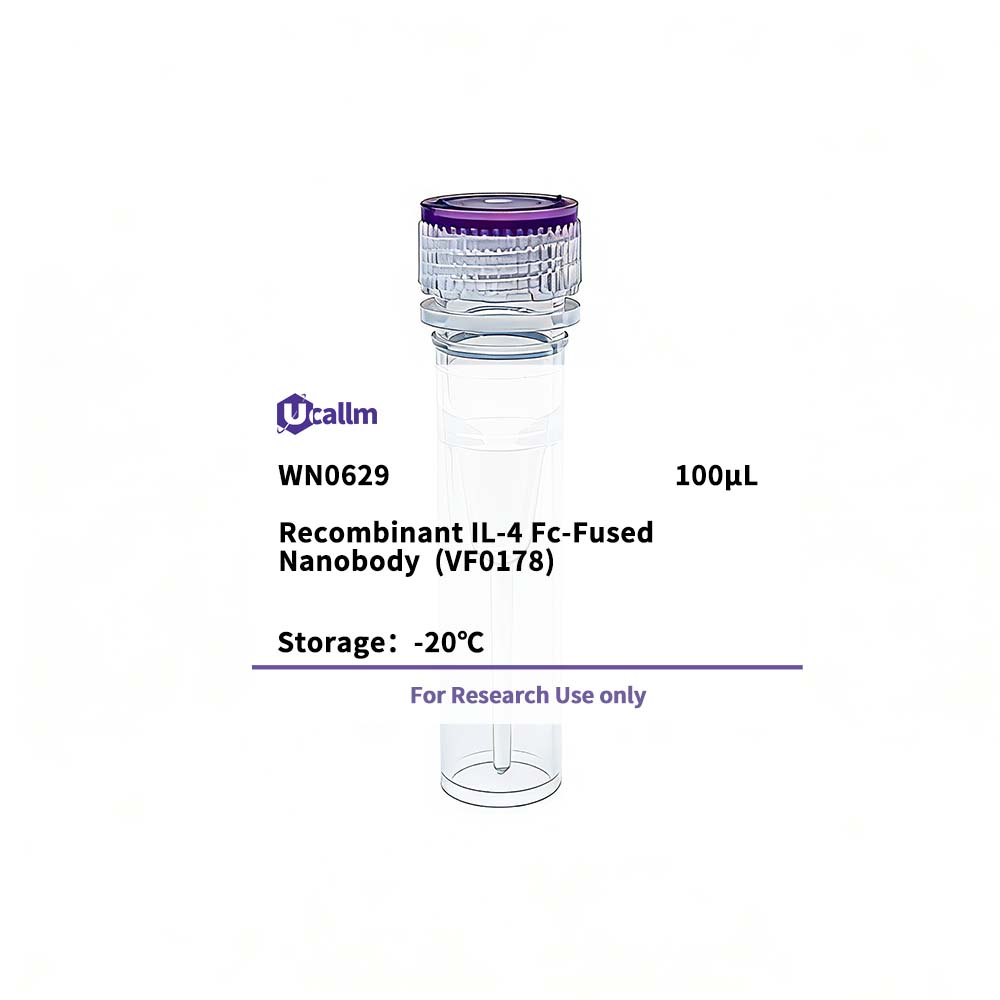
Ucallm_WN0629
$365.00
Product details
Background:The protein encoded byThis gene is a pleiotropic cytokine produced by activated T cells.This cytokine is a ligand for interleukin 4 receptor. The interleukin 4 receptor also binds to IL13, which may contribute to many overlapping functions ofThis cytokine and IL13. STAT6, a signal transducer and activator of transcription, has been shown to play a central role in mediating the immune regulatory signal ofThis cytokine.This gene, IL3, IL5, IL13, and CSF2 form a cytokine gene cluster on chromosome 5q, withThis gene particularly close to IL13.This gene, IL13 and IL5 are found to be regulated coordinately by several long-range regulatory elements in an over 120 kilobase range on the chromosome. Two alternatively spliced transcript variants ofThis gene encoding distinct isoforms have been reported. [provided by RefSeq, Jul 2008]
Specifications
| Size | 100μL |
| Target | IL-4 |
| Reactivity | Human |
| Applications | ELISA |
| MW(Calculated) | |
| MW(Observed) | |
| Host Species | |
| Isotype | IgG2a,Kappa |
| Conjugate/Modification | Unmodified |
| Recommended Dilution Ratio | ELISA 1:5000-100000 |
| Formulation | Phosphate-buffered solution |
| Purification | Recombinant Expression and Affinity purified |
| Storage | -15°C to -25°C/1 year(Avoid freeze / thaw cycles) |
| Concentration | Please check the information on the tube |
| Clonality | |
| Clone Number | VF0340 |
| Immunogen | Purified recombinant Human IL-4 |
| Specificity | This recombinant monoclonal antibody can detects endogenous levels of IL-4 protein. |
| Gene Name | IL4 |
| Protein Name | Interleukin-4 (IL-4) (B-cell stimulatory factor 1) (BSF-1) (Binetrakin) (Lymphocyte stimulatory factor 1) (Pitrakinra) |
| Other Name | IL4; / Interleukin-4; / IL-4; / B-cell stimulatory factor 1; / BSF-1; / Binetrakin; / Lymphocyte stimulatory factor 1; / Pitrakinra; / IL-4 nanobody |
| Species | Human |
| Gene ID | 3565 |
| Uniprot | P05112 |
| Species.1 | |
| Gene ID.1 | |
| Uniprot.1 | |
| Species.2 | |
| Gene ID.2 | |
| Uniprot.2 | |
| Cellular Localization | Secreted. |
| Tissue Expression | Detected on macrophages (at protein level) (PubMed:1698311). Expressed strongly on the surface of monocytes and weakly on the surface of granulocytes; also expressed by most tissue macrophages. |
| Signaling_pathway | Organismal Systems >> Immune system >> Hematopoietic cell lineage;Organismal Systems >> Immune system >> T cell receptor signaling pathway;Organismal Systems >> Immune system >> Th1 and Th2 cell differentiation;Organismal Systems >> Immune system >> Th17 cell differentiation;Organismal Systems >> Immune system >> IL-17 signaling pathway;Organismal Systems >> Immune system >> Fc epsilon RI signaling pathway;Organismal Systems >> Immune system >> Intestinal immune network for IgA production;Human Diseases >> Cancer: overview >> Pathways in cancer;Human Diseases >> Immune disease >> Asthma;Human Diseases >> Immune disease >> Autoimmune thyroid disease;Human Diseases >> Immune disease >> Inflammatory bowel disease;Human Diseases >> Immune disease >> Allograft rejection;Environmental Information Processing >> Signal transduction >> JAK-STAT signaling pathway;Environmental Information Processing >> Signal transduction >> PI3K-Akt signaling pathway;Environmental Information Processing >> Signaling molecules and interaction >> Cytokine-cytokine receptor interaction |
| Research Areas | |
| Function | Disease:Genetic variations in IL4 may be a cause of susceptibility to ischemic stroke [MIM:601367]; also known as cerebrovascular accident or cerebral infarction. A stroke is an acute neurologic event leading to death of neural tissue of the brain and resulting in loss of motor, sensory and/or cognitive function. Ischemic strokes, resulting from vascular occlusion, is considered to be a highly complex disease consisting of a group of heterogeneous disorders with multiple genetic and environmental risk factors.,Participates in at least several B-cell activation processes as well as of other cell types. It is a costimulator of DNA-synthesis. It induces the expression of class II MHC molecules on resting B-cells. It enhances both secretion and cell surface expression of IgE and IgG1. It also regulates the expression of the low affinity Fc receptor for IgE (CD23) on both lymphocytes and monocytes.,similarity:Belongs to the IL-4/IL-13 family., |
Please login to post questions
Related products




