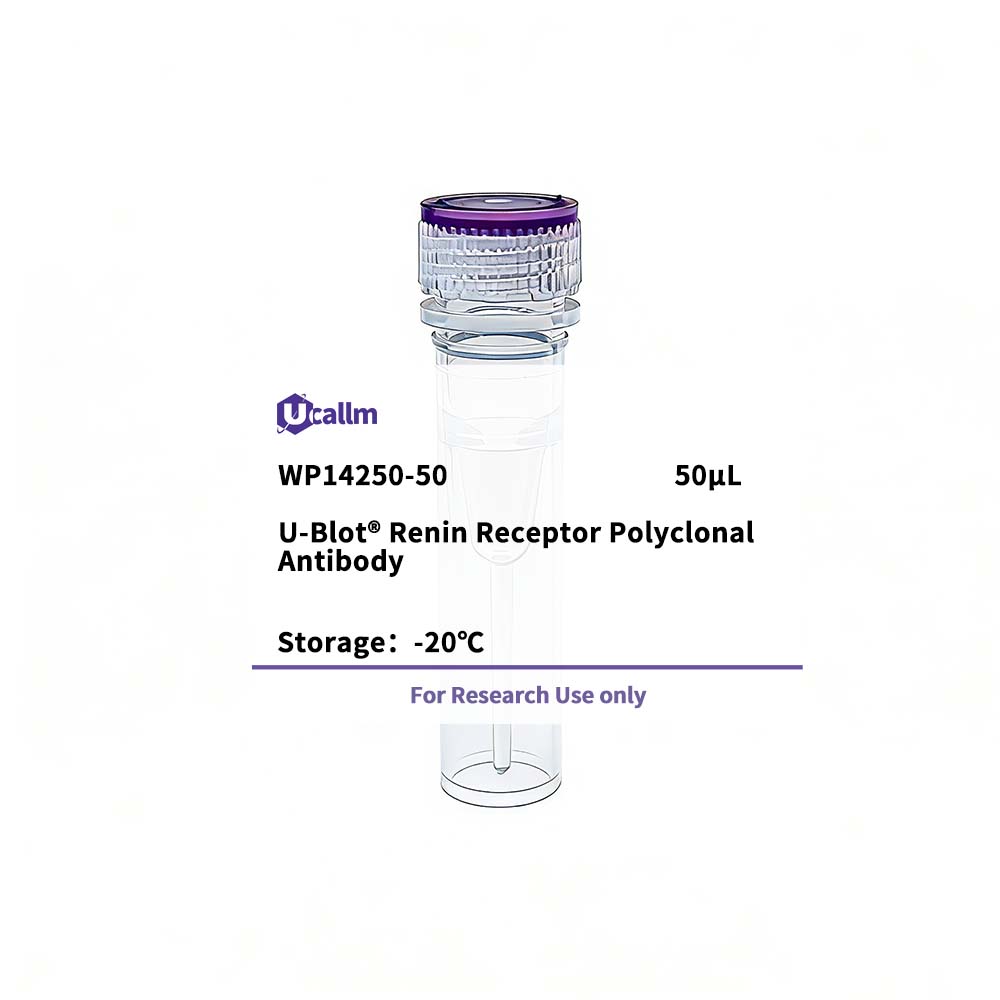
SKU: WP14250 Categories: ,

Renin Receptor Polyclonal Antibody

Price range: $268.00 through $328.00

SKU: WP14250-100
Enter the quantity you would like, or drag the panel to find the quantity and price that best for you
Bulk QuoteAuthorize OEM & ODM

Product details

Background:

This gene encodes a protein that is associated with adenosine triphosphatases (ATPases). Proton-translocating ATPases have fundamental roles in energy conservation, secondary active transport, acidification of intracellular compartments, and cellular pH homeostasis. There are three classes of ATPases- F, P, and V. The vacuolar (V-type) ATPases have a transmembrane proton-conducting sector and an extramembrane catalytic sector. The encoded protein has been found associated with the transmembrane sector of the V-type ATPases. [provided by RefSeq, Jul 2008],


Specifications

Size50μL/100μL
TargetRenin Receptor
ReactivityHuman, Mouse, Rat
ApplicationsWB, IHC, IF, ELISA
MW(Calculated)
MW(Observed)39kD
Host SpeciesRabbit
IsotypeIgG
Conjugate/ModificationUnmodified
Recommended Dilution RatioWB 1:500-1:2000; IHC 1:100-1:300; IF 1:200-1:1000; ELISA 1:20000; Not yet tested in other applications. / Note: For IHC, we suggest antigen retrieval with TE buffer pH 9.0 (Cat#WT1004)
FormulationLiquid in PBS containing 50% glycerol, 0.5% BSA and 0.02% sodium azide.
PurificationThe antibody was affinity-purified from rabbit antiserum by affinity-chromatography using epitope-specific immunogen.
Storage-15°C to -25°C/1 year(Do not lower than -25°C)
Concentration1 mg/ml
ClonalityPolyclonal
Clone Number
ImmunogenThe antiserum was produced against synthesized peptide derived from human Caper. AA range:171-220
SpecificityRenin Receptor Polyclonal Antibody detects endogenous levels of Renin Receptor protein.
Gene NameATP6AP2
Protein NameRenin receptor
Other NameATP6AP2; / ATP6IP2; / CAPER; / ELDF10; / HT028; / MSTP009; / PSEC0072; / Renin receptor; / ATPase H; / +; / -transporting lysosomal accessory protein 2; / ATPase H; / +; / -transporting lysosomal-interacting protein 2; / ER-localized type I transmembrane adaptor; / Embryoni
SpeciesHuman
Gene ID10159
UniprotO75787,
Species.1Mouse
Gene ID.170495
Uniprot.1Q9CYN9,
Species.2Rat
Gene ID.2302526
Uniprot.2Q6AXS4
Cellular LocalizationEndoplasmic reticulum membrane; Single-pass type I membrane protein . Lysosome membrane; Single-pass type I membrane protein . Cytoplasmic vesicle, autophagosome membrane; Single-pass type I membrane protein . Cell projection, dendritic spine membrane; Single-pass type I membrane protein . Cell projection, axon . Endosome membrane; Single-pass type I membrane protein . Cytoplasmic vesicle, clathrin-coated vesicle membrane; Single-pass type I membrane protein . Cytoplasmic vesicle, secretory vesicle, synaptic vesicle membrane; Single-pass type I membrane protein .
Tissue ExpressionExpressed in brain, heart, placenta, liver, kidney and pancreas. Barely detectable in lung and skeletal muscles. In the kidney cortex it is restricted to the mesangium of glomeruli. In the coronary and kidney artery it is expressed in the subendothelium, associated to smooth muscles where it colocalizes with REN. Expressed in vascular structures and by syncytiotrophoblast cells in the mature fetal placenta.
Signaling_pathwayOrganismal Systems >> Endocrine system >> Renin-angiotensin system
Research Areas>>Renin-angiotensin system
FunctionDisease:Defects in ATP6AP2 are a cause of mental retardation X-linked with epilepsy (MRXE) [MIM:300423]. MRXE is a syndromic mental retardation. Patients manifest mild to moderate mental retardation associated with epilepsy, delays in motor milestones and speech acquisition in infancy.,Function:Functions as a renin and prorenin cellular receptor. May mediate renin-dependent cellular responses by activating ERK1 and ERK2. By increasing the catalytic efficiency of renin in AGT/angiotensinogen conversion to angiotensin I, it may also play a role in the renin-angiotensin system (RAS).,PTM:Phosphorylated.,subunit:Interacts with renin and the vacuolar proton-ATPase.,tissue specificity:Expressed in brain, heart, placenta, liver, kidney and pancreas. Barely detectable in lung and skeletal muscles. In the kidney cortex it is restricted to the mesangium of glomeruli. In the coronary and kidney artery it is expressed in the subendothelium, associated to smooth muscles where it colocalizes with REN. Expressed in vascular structures and by syncitiotrophoblast cells in the mature fetal placenta.,
Please login to post questions
Back to Top
Product has been added to your cart