


RNF6 Polyclonal Antibody
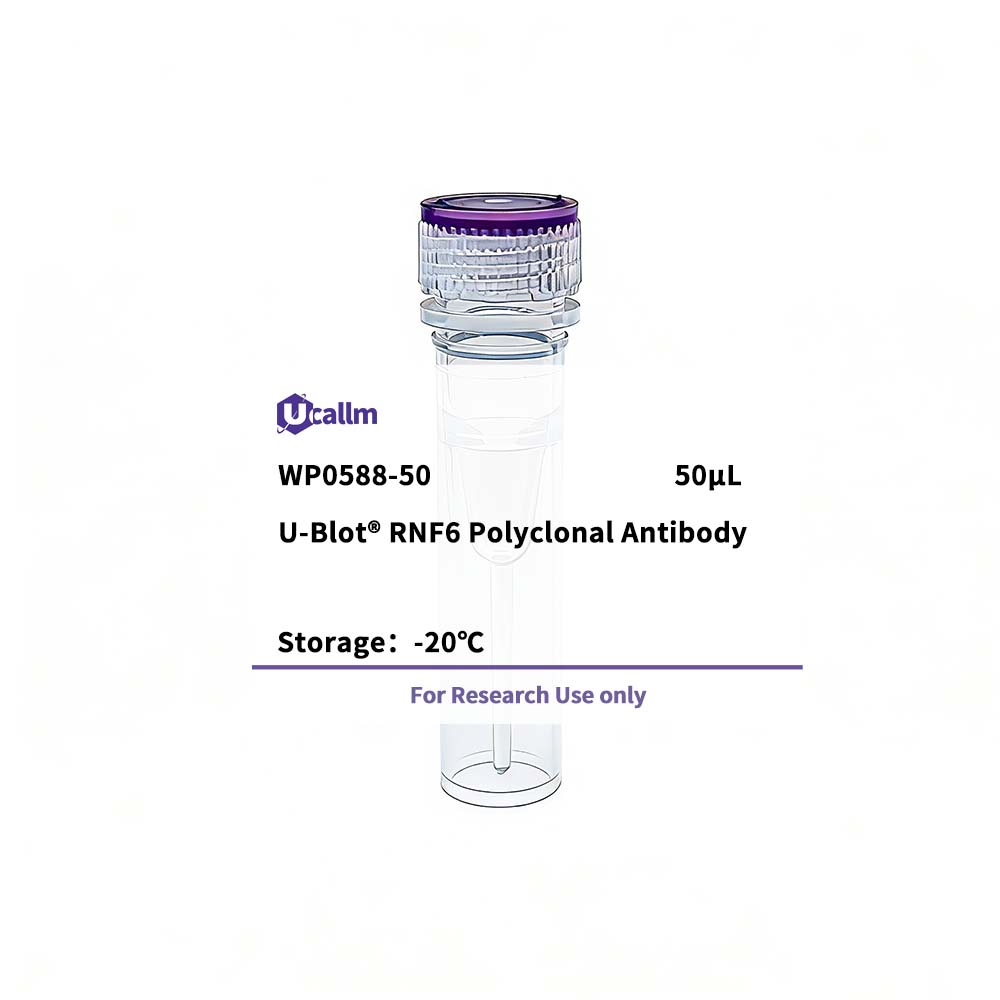
Ucallm_WP0588-50
Price range: $268.00 through $328.00
Product details
Background:
The protein encoded by this gene contains a RING-H2 finger motif. Deletions and mutations in this gene were detected in esophageal squamous cell carcinoma (ESCC), suggesting that this protein may be a potential tumor suppressor. Studies of the mouse counterpart suggested a role of this protein in the transcription regulation that controls germinal differentiation. Multiple alternatively spliced transcript variants encoding the same protein are observed. [provided by RefSeq, Jul 2008],
Specifications
| Size | 50μL/100μL |
| Target | RNF6 |
| Reactivity | Human, Mouse |
| Applications | WB, ELISA |
| MW(Calculated) | |
| MW(Observed) | 75kD |
| Host Species | Rabbit |
| Isotype | IgG |
| Conjugate/Modification | Unmodified |
| Recommended Dilution Ratio | WB 1:500-2000; ELISA 1:5000-20000 |
| Formulation | Liquid in PBS containing 50% glycerol,0.5% BSA and 0.02% sodium azide. |
| Purification | The antibody was affinity-purified from rabbit antiserum by affinity-chromatography using epitope-specific immunogen. |
| Storage | -15°C to -25°C/1 year(Do not lower than -25°C) |
| Concentration | 1 mg/ml |
| Clonality | Polyclonal |
| Clone Number | |
| Immunogen | Synthesized peptide derived from human protein . at AA range: 470-550 |
| Specificity | RNF6 Polyclonal Antibody detects endogenous levels of protein. |
| Gene Name | RNF6 SPG2 |
| Protein Name | E3 ubiquitin-protein ligase RNF6 (EC 6.3.2.-) |
| Other Name | |
| Species | Human |
| Gene ID | 6049 |
| Uniprot | Q9Y252, |
| Species.1 | Mouse |
| Gene ID.1 | |
| Uniprot.1 | Q9DBU5 |
| Species.2 | |
| Gene ID.2 | |
| Uniprot.2 | |
| Cellular Localization | Nucleus . Cytoplasm . Cell projection, axon . Nucleus, PML body . Localizes to the PML nuclear bodies in Sertoli cells. . |
| Tissue Expression | Weakly expressed in peripheral blood, spleen, prostate, testis and ovary. According to PubMed:18368307, it is preferentially expressed in testis and ovary and hardly detected in other tissues. |
| Signaling_pathway | |
| Research Areas | |
| Function | similarity:Contains 1 RING-type zinc finger.,tissue specificity:Weakly expressed in peripheral blood, spleen, prostate, testis and ovary., |
Please login to post questions
Related products





