


ROR1 Monoclonal Antibody
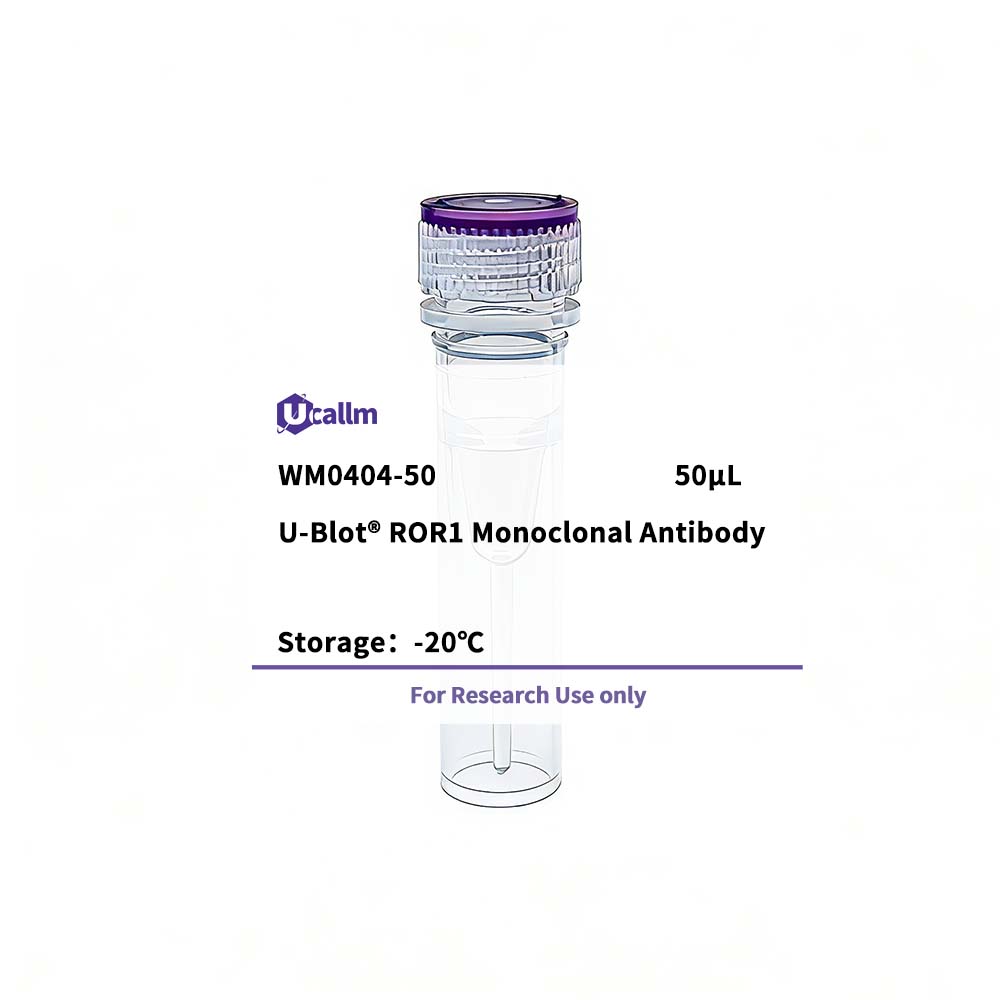
Ucallm_WM0404-50
Price range: $268.00 through $328.00
Product details
Background:
This gene encodes a receptor tyrosine kinase-like orphan receptor that modulates neurite growth in the central nervous system. The encoded protein is a glycosylated type I membrane protein that belongs to the ROR subfamily of cell surface receptors. It is a pseudokinase that lacks catalytic activity and may interact with the non-canonical Wnt signalling pathway. This gene is highly expressed during early embryonic development but expressed at very low levels in adult tissues. Increased expression of this gene is associated with B-cell chronic lymphocytic leukaemia. Alternative splicing results in multiple transcript variants encoding different isoforms. [provided by RefSeq, Jun 2012],
Specifications
| Size | 50μL/100μL |
| Target | ROR1 |
| Reactivity | Human |
| Applications | WB, IF, ELISA |
| MW(Calculated) | 104kD |
| MW(Observed) | |
| Host Species | Mouse |
| Isotype | |
| Conjugate/Modification | Unmodified |
| Recommended Dilution Ratio | WB 1:500-1:2000; IF 1:200-1:1000; ELISA 1:10000; Not yet tested in other applications. |
| Formulation | Liquid in PBS containing 50% glycerol, 0.5% BSA and 0.02% sodium azide. |
| Purification | Affinity purification |
| Storage | -15°C to -25°C/1 year(Do not lower than -25°C) |
| Concentration | |
| Clonality | Monoclonal |
| Clone Number | 2D1 |
| Immunogen | Recombinant extracellular fragment of human ROR1 (aa30-406) fused with hIgGFc tag, expressed in HEK293 cells |
| Specificity | ROR1 Monoclonal Antibody detects endogenous levels of ROR1 protein. |
| Gene Name | ROR1 |
| Protein Name | Tyrosine-protein kinase transmembrane receptor ROR1 |
| Other Name | ROR1; / NTRKR1; / Tyrosine-protein kinase transmembrane receptor ROR1; / Neurotrophic tyrosine kinase; / receptor-related 1 |
| Species | Human |
| Gene ID | 4919 |
| Uniprot | Q01973, |
| Species.1 | Mouse |
| Gene ID.1 | |
| Uniprot.1 | Q9Z139 |
| Species.2 | |
| Gene ID.2 | |
| Uniprot.2 | |
| Cellular Localization | Membrane; Single-pass type I membrane protein. Cell projection, axon . |
| Tissue Expression | Expressed strongly in human heart, lung and kidney, but weakly in the CNS. Isoform Short is strongly expressed in fetal and adult CNS and in a variety of human cancers, including those originating from CNS or PNS neuroectoderm. |
| Signaling_pathway | Environmental Information Processing >> Signal transduction >> Wnt signaling pathway |
| Research Areas | >>Wnt signaling pathway |
| Function | Catalytic activity:ATP + a [protein]-L-tyrosine = ADP + a [protein]-L-tyrosine phosphate.,developmental stage:Expressed at high levels during early embryonic development. The expression levels drop strongly around day 16 and there are only very low levels in adult tissues.,Function:Tyrosine-protein kinase receptor whose role is not yet clear.,similarity:Belongs to the protein kinase superfamily. Tyr protein kinase family. ROR subfamily.,similarity:Contains 1 FZ (frizzled) domain.,similarity:Contains 1 Ig-like C2-type (immunoglobulin-like) domain.,similarity:Contains 1 kringle domain.,similarity:Contains 1 protein kinase domain.,tissue specificity:Expressed strongly in human heart, lung, and kidney, but weakly in the CNS. The short isoform is strongly expressed in fetal and adult CNS and in a variety of human cancers, including those originating from CNS or PNS neuroectoderm., |
Please login to post questions
Related products





