

RWDD3 rabbit pAb
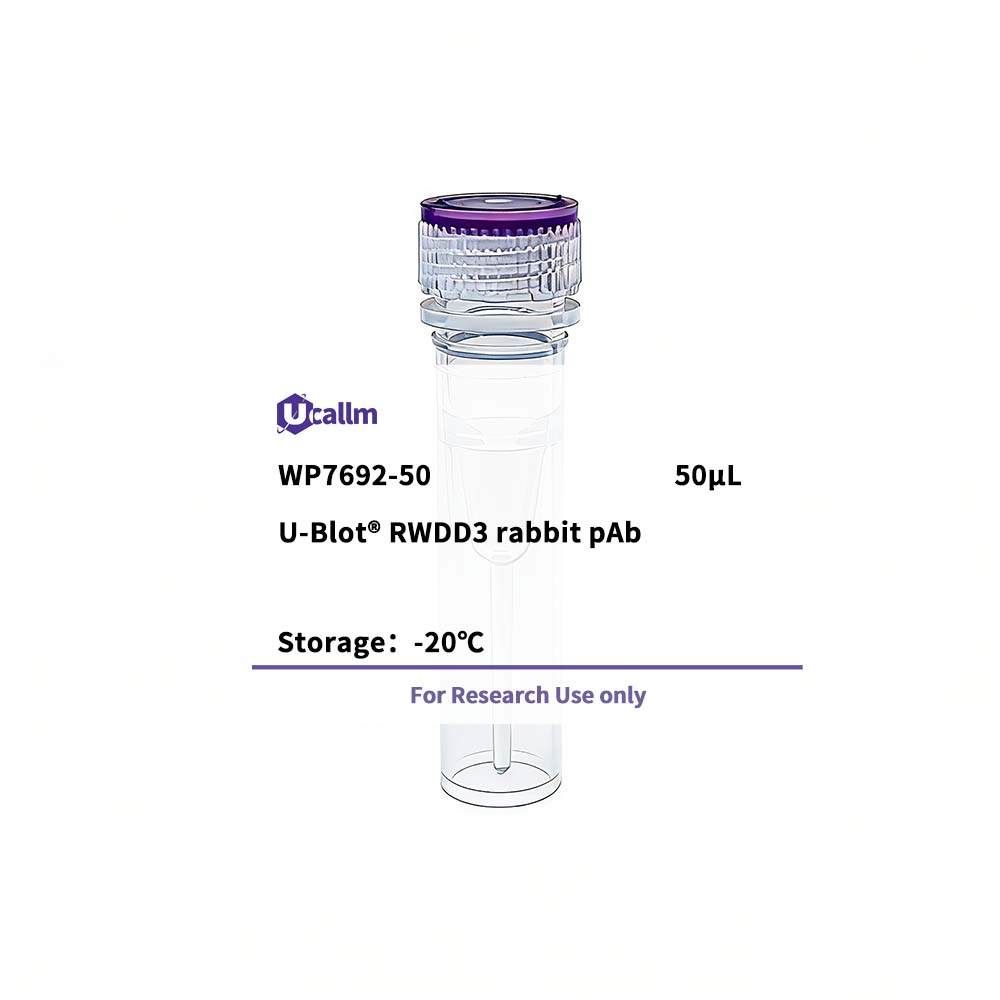
Ucallm_WP7692-50
Price range: $268.00 through $328.00
Product details
Background:
Specifications
| Size | 50μL/100μL |
| Target | RWDD3 |
| Reactivity | Human, Rat |
| Applications | WB |
| MW(Calculated) | 29kD |
| MW(Observed) | |
| Host Species | Rabbit |
| Isotype | IgG |
| Conjugate/Modification | Unmodified |
| Recommended Dilution Ratio | WB 1:500-2000 |
| Formulation | Liquid in PBS containing 50% glycerol, 0.5% BSA and 0.02% sodium azide. |
| Purification | The antibody was affinity-purified from rabbit antiserum by affinity-chromatography using epitope-specific immunogen. |
| Storage | -15°C to -25°C/1 year(Do not lower than -25°C) |
| Concentration | 1 mg/ml |
| Clonality | Polyclonal |
| Clone Number | |
| Immunogen | Synthesized peptide derived from human RWDD3 |
| Specificity | This antibody detects endogenous levels of RWDD3 at Human,Rat |
| Gene Name | RWDD3 RSUME |
| Protein Name | RWD domain-containing protein 3 (RWD-containing sumoylation enhancer) |
| Other Name | |
| Species | Human |
| Gene ID | 25950 |
| Uniprot | Q9Y3V2, |
| Species.1 | Mouse |
| Gene ID.1 | |
| Uniprot.1 | Q8VIL2, |
| Species.2 | Rat |
| Gene ID.2 | 65026 |
| Uniprot.2 | P0C7N0 |
| Cellular Localization | Nucleus . Cytoplasm . Colocalizes with UBC9/UBE2I in nuclear spots. . |
| Tissue Expression | Isoform 1 and isoform 2 are expressed in glioma tumors (at protein level). Expressed in a wide number of tissues with highest expression in cerebellum, pituitary, heart, kidney, liver, stomach, pancreas, prostate and spleen. Low levels in thalamus, spinal cord, esophagus, thymus, lung and peripheral blood leukocytes. A higher level expression seen in pituitary tumors as compared to the pituitary gland. |
| Signaling_pathway | |
| Research Areas | |
| Function | Enhancer of SUMO conjugation. Via its interaction with UBE2I/UBC9, increases SUMO conjugation to proteins by promoting the binding of E1 and E2 enzymes, thioester linkage between SUMO and UBE2I/UBC9 and transfer of SUMO to specific target proteins which include HIF1A, PIAS, NFKBIA, NR3C1 and TOP1. Isoform 1 and isoform 2 positively regulate the NF-kappa-B signaling pathway by enhancing the sumoylation of NF-kappa-B inhibitor alpha (NFKBIA), promoting its stabilization which consequently leads to an increased inhibition of NF-kappa-B transcriptional activity. Isoform 1 and isoform 2 negatively regulate the hypoxia-inducible factor-1 alpha (HIF1A) signaling pathway by increasing the sumoylation of HIF1A, promoting its stabilization, transcriptional activity and the expression of its target gene VEGFA during hypoxia. Isoform 2 promotes the sumoylation and transcriptional activity of the glucocorticoid receptor NR3C1 and enhances the interaction of SUMO1 and NR3C1 with UBE2I/UBC9. Has no effect on ubiquitination. |
Please login to post questions
Related products





