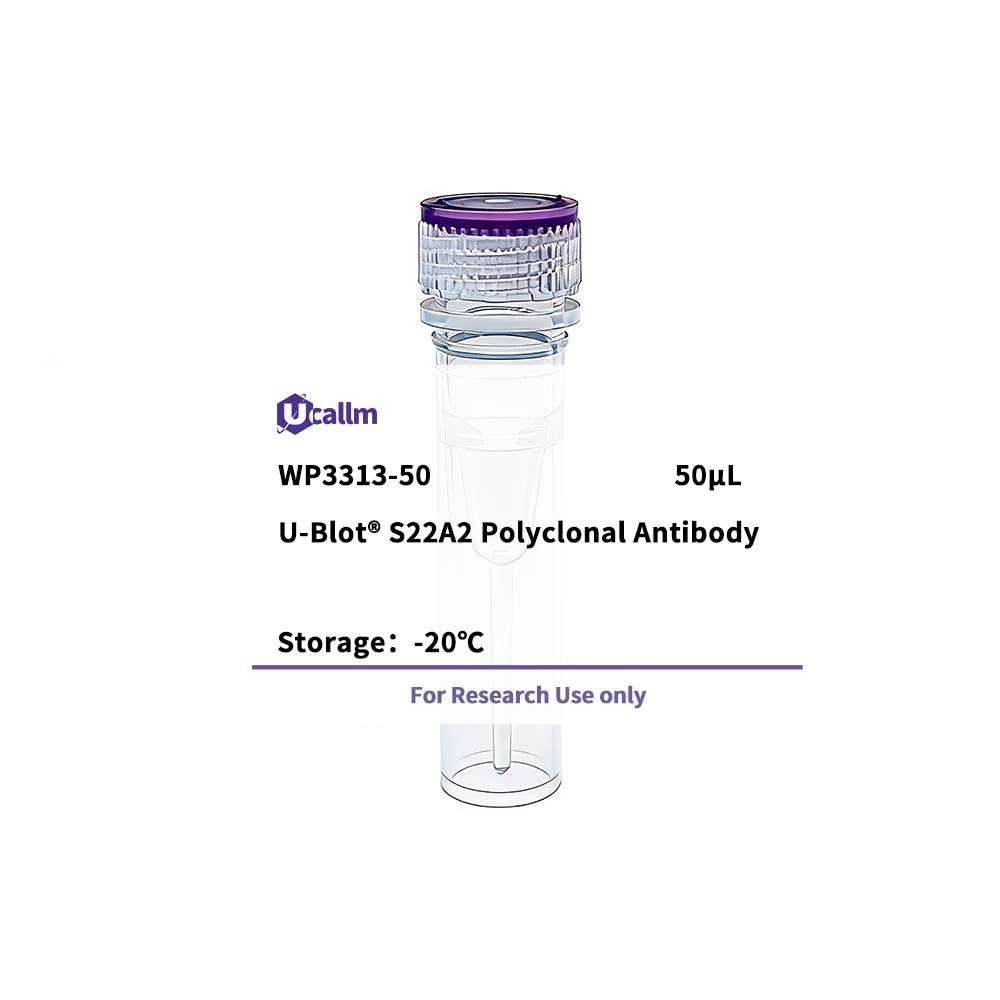
SKU: WP3313 Categories: ,

S22A2 Polyclonal Antibody

Price range: $268.00 through $328.00

SKU: WP3313-100
Enter the quantity you would like, or drag the panel to find the quantity and price that best for you
Bulk QuoteAuthorize OEM & ODM

Product details

Background:

Polyspecific organic cation transporters in the liver, kidney, intestine, and other organs are critical for elimination of many endogenous small organic cations as well as a wide array of drugs and environmental toxins. This gene is one of three similar cation transporter genes located in a cluster on chromosome 6. The encoded protein contains twelve putative transmembrane domains and is a plasma integral membrane protein. It is found primarily in the kidney, where it may mediate the first step in cation reabsorption. [provided by RefSeq, Jul 2008],

Specifications

Size50μL/100μL
TargetS22A2
ReactivityHuman, Mouse, Rat
ApplicationsWB, ELISA
MW(Calculated)
MW(Observed)61kD
Host SpeciesRabbit
IsotypeIgG
Conjugate/ModificationUnmodified
Recommended Dilution RatioWB 1:500-2000; ELISA 1:5000-20000
FormulationLiquid in PBS containing 50% glycerol,0.5% BSA and 0.02% sodium azide.
PurificationThe antibody was affinity-purified from rabbit antiserum by affinity-chromatography using epitope-specific immunogen.
Storage-15°C to -25°C/1 year(Do not lower than -25°C)
Concentration1 mg/ml
ClonalityPolyclonal
Clone Number
ImmunogenSynthesized peptide derived from part region of human protein
SpecificityS22A2 Polyclonal Antibody detects endogenous levels of protein.
Gene NameSLC22A2 OCT2
Protein NameSolute carrier family 22 member 2 (Organic cation transporter 2) (hOCT2)
Other Name
SpeciesHuman
Gene ID6582
UniprotO15244,
Species.1Mouse
Gene ID.1
Uniprot.1O70577,
Species.2Rat
Gene ID.2
Uniprot.2Q9R0W2
Cellular LocalizationMembrane; Multi-pass membrane protein .
Tissue ExpressionMainly expressed in kidney. Localized at the luminal membrane and basolateral membrane of kidney distal tubule and proximal tubules. To a lower extent, expressed in neurons of the cerebral cortex and in various subcortical nuclei (at protein levels). Also detected in secretory phase endometrium; in scattered cells in the stroma.
Signaling_pathway
Research Areas>>Choline metabolism in cancer
FunctionFunction:Mediates tubular uptake of organic compounds from circulation. Mediates the influx of agmatine, dopamine, noradrenaline (norepinephrine), serotonin, choline, famotidine, ranitidine, histamin, creatinine, amantadine, memantine, acriflavine, 4-[4-(dimethylamino)-styryl]-N-methylpyridinium ASP, amiloride, metformin, N-1-methylnicotinamide (NMN), tetraethylammonium (TEA), 1-methyl-4-phenylpyridinium (MPP), cimetidine, cisplatin and oxaliplatin. Cisplatin may develop a nephrotoxic action. Transport of creatinine is inhibited by fluoroquinolones such as DX-619 and LVFX. This transporter is a major determinant of the anticancer activity of oxaliplatin and may contribute to antitumor specificity.,induction:May be down-regulated in diabetic patients.,similarity:Belongs to the major facilitator superfamily. Organic cation transporter family.,tissue specificity:Mainly expressed in kidney. Localized at the luminal membrane and basolateral membrane of kidney distal tubule and proximal tubules. To a lower extent, expressed in neurons of the cerebral cortex and in various subcortical nuclei (at protein levels). Also detected in secretory phase endometrium; in scattered cells in the stroma.,
Please login to post questions
Back to Top
Product has been added to your cart
