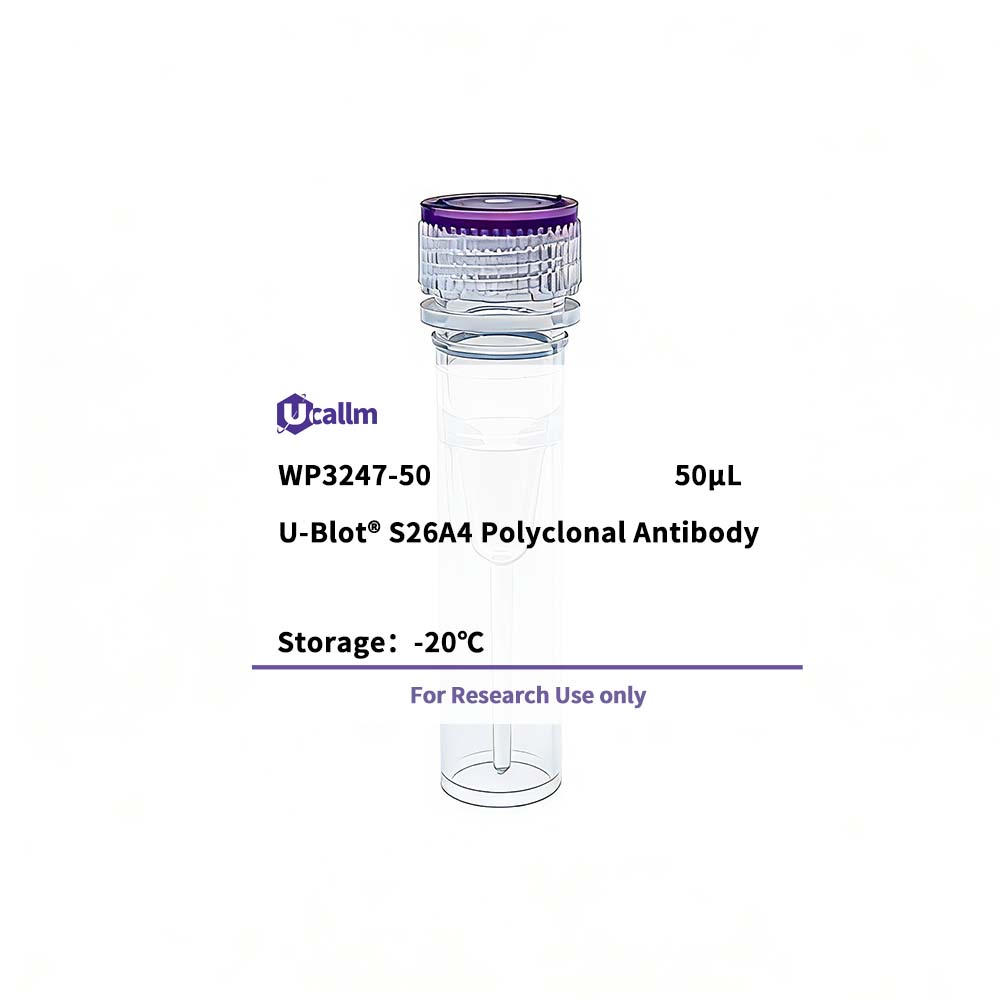
SKU: WP3247 Categories: ,

S26A4 Polyclonal Antibody

Price range: $268.00 through $328.00

SKU: WP3247-100
Enter the quantity you would like, or drag the panel to find the quantity and price that best for you
Bulk QuoteAuthorize OEM & ODM

Product details

Background:

Mutations in this gene are associated with Pendred syndrome, the most common form of syndromic deafness, an autosomal-recessive disease. It is highly homologous to the SLC26A3 gene; they have similar genomic structures and this gene is located 3' of the SLC26A3 gene. The encoded protein has homology to sulfate transporters. [provided by RefSeq, Jul 2008],


Specifications

Size50μL/100μL
TargetS26A4
ReactivityHuman, Mouse, Rat
ApplicationsWB, ELISA
MW(Calculated)
MW(Observed)85kD
Host SpeciesRabbit
IsotypeIgG
Conjugate/ModificationUnmodified
Recommended Dilution RatioWB 1:500-2000; ELISA 1:5000-20000
FormulationLiquid in PBS containing 50% glycerol,0.5% BSA and 0.02% sodium azide.
PurificationThe antibody was affinity-purified from rabbit antiserum by affinity-chromatography using epitope-specific immunogen.
Storage-15°C to -25°C/1 year(Do not lower than -25°C)
Concentration1 mg/ml
ClonalityPolyclonal
Clone Number
ImmunogenSynthesized peptide derived from part region of human protein
SpecificityS26A4 Polyclonal Antibody detects endogenous levels of protein.
Gene NameSLC26A4 PDS
Protein NamePendrin (Sodium-independent chloride/iodide transporter) (Solute carrier family 26 member 4)
Other Name
SpeciesHuman
Gene ID5172
UniprotO43511,
Species.1Mouse
Gene ID.1
Uniprot.1Q9R155,
Species.2Rat
Gene ID.2
Uniprot.2Q9R154
Cellular LocalizationMembrane; Multi-pass membrane protein . Cell membrane; Multi-pass membrane protein. Localizes to the apical brush border of cells in the cortical collecting ducts of the kidney. .
Tissue ExpressionHigh expression in adult thyroid, lower expression in adult and fetal kidney and fetal brain. Not expressed in other tissues.
Signaling_pathway
Research Areas>>Thyroid hormone synthesis
FunctionDisease:Defects in SLC26A4 are a cause of Pendred syndrome (PDS) [MIM:274600]. PDS is an autosomal recessive disorder characterized by congenital sensorineural hearing loss combined with thyroid goiter. The disorder may account for up to 10% of the cases of hereditary deafness. The deafness is most often associated with a Mondini cochlear defect.,Disease:Defects in SLC26A4 are the cause of non-syndromic sensorineural deafness autosomal recessive type 4 (DFNB4) [MIM:600791]; also known as vestibular aqueduct syndrome (EVA). DFNB4 is a form of sensorineural hearing loss. Sensorineural deafness results from damage to the neural receptors of the inner ear, the nerve pathways to the brain, or the area of the brain that receives sound information. DFNB4 is associated with an enlarged vestibular aqueduct.,Function:Sodium-independent transporter of chloride and iodide.,online information:Gene page,online information:Pendrin entry,online information:The Singapore human mutation and polymorphism database,similarity:Belongs to the SLC26A/SulP transporter (TC 2.A.53) family.,similarity:Contains 1 STAS domain.,tissue specificity:High expression in adult thyroid, lower expression in adult and fetal kidney and fetal brain. Not expressed in other tissues.,
Please login to post questions
Back to Top
Product has been added to your cart
