


SAA1 Polyclonal Antibody
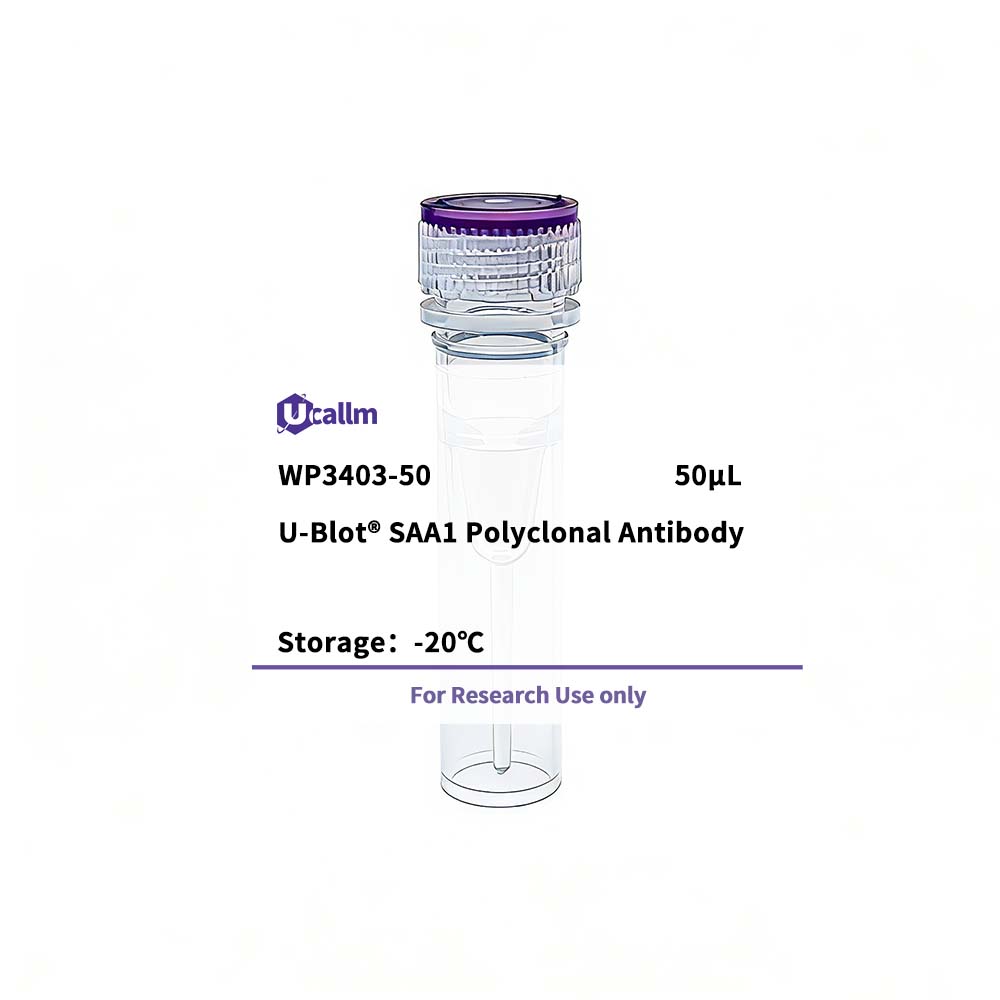
Ucallm_WP3403-50
Price range: $268.00 through $328.00
Product details
Background:
This gene encodes a member of the serum amyloid A family of apolipoproteins. The encoded preproprotein is proteolytically processed to generate the mature protein. This protein is a major acute phase protein that is highly expressed in response to inflammation and tissue injury. This protein also plays an important role in HDL metabolism and cholesterol homeostasis. High levels of this protein are associated with chronic inflammatory diseases including atherosclerosis, rheumatoid arthritis, Alzheimer's disease and Crohn's disease. This protein may also be a potential biomarker for certain tumors. Alternate splicing results in multiple transcript variants that encode the same protein. A pseudogene of this gene is found on chromosome 11. [provided by RefSeq, Feb 2016],
Specifications
| Size | 50μL/100μL |
| Target | SAA1/2 |
| Reactivity | Human, Mouse |
| Applications | WB, ELISA |
| MW(Calculated) | |
| MW(Observed) | 13kD |
| Host Species | Rabbit |
| Isotype | IgG |
| Conjugate/Modification | Unmodified |
| Recommended Dilution Ratio | WB 1:500-2000; ELISA 1:5000-20000 |
| Formulation | Liquid in PBS containing 50% glycerol, 0.5% BSA and 0.02% sodium azide. |
| Purification | The antibody was affinity-purified from rabbit antiserum by affinity-chromatography using epitope-specific immunogen. |
| Storage | -15°C to -25°C/1 year(Do not lower than -25°C) |
| Concentration | 1 mg/ml |
| Clonality | Polyclonal |
| Clone Number | |
| Immunogen | Synthesized peptide derived from part region of human protein AA range: 38-88 |
| Specificity | SAA1/2 Polyclonal Antibody detects endogenous levels of protein. |
| Gene Name | SAA1/2 |
| Protein Name | Serum amyloid A-1 protein/Serum amyloid A-2 protein |
| Other Name | SAA1/2; / SAA; / Amyloid A2 protein; / AA2; / Amyloid protein A |
| Species | Human |
| Gene ID | 6288;6289 |
| Uniprot | P0DJI8;P0DJI9, |
| Species.1 | Mouse |
| Gene ID.1 | 20209 |
| Uniprot.1 | P05366;P05367 |
| Species.2 | |
| Gene ID.2 | |
| Uniprot.2 | |
| Cellular Localization | Secreted . |
| Tissue Expression | Expressed by the liver; secreted in plasma (at protein level). |
| Signaling_pathway | |
| Research Areas | |
| Function | Disease:BOL is from a patient with Waldenstrom macroglobulinemia.,Disease:JL is from a patient with ankylosing spondylitis.,Disease:Reactive, secondary amyloidosis is characterized by the extracellular accumulation in various tissues of the SAA protein. These deposits are highly insoluble and resistant to proteolysis; they disrupt tissue structure and compromise function.,Disease:TH is from a patient with juvenile rheumatoid arthritis.,Function:Major acute phase reactant. Apolipoprotein of the HDL complex.,induction:Upon cytokine stimulation.,mass spectrometry: PubMed:12606051,mass spectrometry: PubMed:12973732,mass spectrometry:With variant Ala-70 PubMed:1463770,mass spectrometry:With variants Ala-70, Val-75, Asn-78 and 86-Leu-Thr-87 PubMed:1463770,miscellaneous:Elevated serum SSA protein levels may be associated with lung cancer.,polymorphism:Both SAA1 and SAA2 have a number of alleles. We use here the nomenclature of PubMed:1546977. The sequence shown is that of 1-alpha.,PTM:This protein is the precursor of amyloid protein A, which is formed by the removal of approximately 24 residues from the C-terminal end.,similarity:Belongs to the SAA family.,tissue specificity:Expressed by the liver; secreted in plasma., |
Please login to post questions
Related products




