

U-Blot® SMC3 Rabbit mAb
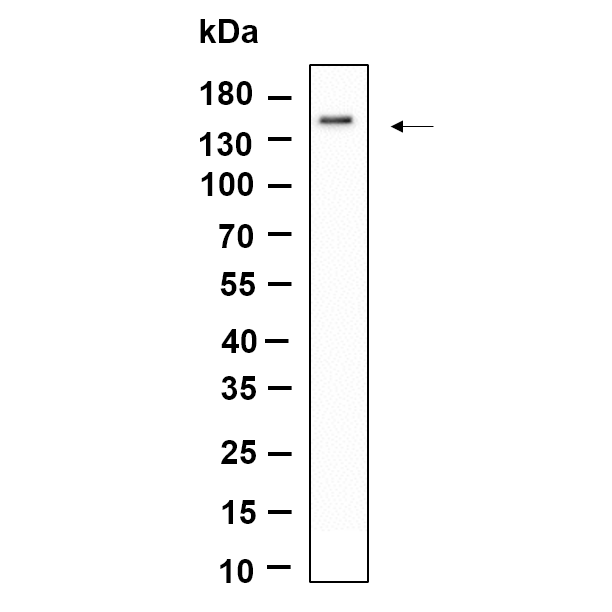
WR4688 Western Blot analysis using Jurkat lysates,primary antibody was diluted at 1:1000, 4°over night, Dylight 800 secondary antibody(WS0446)was diluted at 1:10000, 37° 1hour.
Price range: $268.00 through $328.00
Product details
Background:This gene belongs to the SMC3 subfamily of SMC proteins. The encoded protein occurs in certain cell types as either an intracellular, nuclear protein or a secreted protein. The nuclear form, known as structural maintenance of chromosomes 3, is a component of the multimeric cohesin complex that holds together sister chromatids during mitosis, enabling proper chromosome segregation. Post-translational modification of the encoded protein by the addition of chondroitin sulfate chains gives rise to the secreted proteoglycan bamacan, an abundant basement membrane protein. [provided by RefSeq, Jul 2008],
Specifications
| Size | 50μL/100μL |
| Target | SMC3 |
| Reactivity | Human, Mouse, Rat |
| Applications | WB, IHC, IF, ELISA |
| MW(Calculated) | 142kD |
| MW(Observed) | 142kD |
| Host Species | Rabbit |
| Isotype | IgG,Kappa |
| Conjugate/Modification | Unmodified |
| Recommended Dilution Ratio | IHC 1:200-1:1000; WB 1:2000-1:10000; IF 1:200-1:1000; ELISA 1:5000-1:20000; / Note: For IHC, we suggest antigen retrieval with TE buffer pH 9.0 (Cat#WT1004) |
| Formulation | PBS, 50% glycerol, 0.05% Proclin 300, 0.05%BSA |
| Purification | Recombinant Antibody expressed in animal component-free (ACF) media, purified via Protein A affinity chromatography. |
| Storage | -15°C to -25°C/1 year(Do not lower than -25°C) |
| Concentration | |
| Clonality | Monoclonal |
| Clone Number | RM0946R |
| Immunogen | The specific immunogen used to produce this antibody is proprietary information. |
| Specificity | Endogenous |
| Gene Name | SMC3 BAM BMH CSPG6 SMC3L1 |
| Protein Name | Structural maintenance of chromosomes protein 3 (SMC protein 3) (SMC-3) (Basement membrane-associated chondroitin proteoglycan) (Bamacan) (Chondroitin sulfate proteoglycan 6) (Chromosome-associated polypeptide) (hCAP) |
| Other Name | Structural maintenance of chromosomes protein 3; / SMC protein 3; / SMC-3; / Basement membrane-associated chondroitin proteoglycan; / Bamacan; / Chondroitin sulfate proteoglycan 6; / Chromosome-associated polypeptide; / hCAP |
| Species | Human |
| Gene ID | 9126 |
| Uniprot | Q9UQE7, |
| Species.1 | Mouse |
| Gene ID.1 | |
| Uniprot.1 | Q9CW03, |
| Species.2 | Rat |
| Gene ID.2 | |
| Uniprot.2 | P97690 |
| Cellular Localization | Nucleus . Chromosome . Chromosome, centromere . Associates with chromatin. Before prophase it is scattered along chromosome arms. During prophase, most of cohesin complexes dissociate from chromatin probably because of phosphorylation by PLK, except at centromeres, where cohesin complexes remain. At anaphase, the RAD21 subunit of the cohesin complex is cleaved, leading to the dissociation of the complex from chromosomes, allowing chromosome separation. The phosphorylated form at Ser-1083 is preferentially associated with unsynapsed chromosomal regions (By similarity). . |
| Tissue Expression | B-cell,Epithelium,Eye,Neuron,Umbilical cord blood, |
| Signaling_pathway | Cellular Processes >> Cell growth and death >> Cell cycle |
| Research Areas | >>Cell cycle; / >>Oocyte meiosis |
| Function | Caution:Was originally isolated as a proteoglycan protein (explaining its name). Although not excluded, such secreted function is not clear.,Disease:Defects in SMC3 are the cause of Cornelia de Lange syndrome type 3 (CDLS3) [MIM:610759]. CDLS is a dominantly inherited multisystem developmental disorder characterized by growth and cognitive retardation, abnormalities of the upper limbs, gastroesophageal dysfunction, cardiac, ophthalmologic and genitourinary anomalies, hirsutism, and characteristic facial features. CDSL3 is a mild form with absence of major structural anomalies typically associated with CDLS. The phenotype in some instances approaches that of apparently non-syndromic mental retardation.,Domain:The flexible hinge domain, which separates the large intramolecular coiled coil regions, allows the heterotypic interaction with the corresponding domain of SMC1A or SMC1B, forming a V-shaped heterodimer. The two heads of the heterodimer are then connected by different ends of the cleavable RAD21 protein, forming a ring structure.,Function:Involved in chromosome cohesion during cell cycle and in DNA repair. Central component of cohesin complex. The cohesin complex is required for the cohesion of sister chromatids after DNA replication. The cohesin complex apparently forms a large proteinaceous ring within which sister chromatids can be trapped. At anaphase, the complex is cleaved and dissociates from chromatin, allowing sister chromatids to segregate. The cohesin complex may also play a role in spindle pole assembly during mitosis and in chromosome movement.,PTM:Phosphorylated upon DNA damage, probably by ATM or ATR.,similarity:Belongs to the SMC family. SMC3 subfamily.,subcellular location:Associates with chromatin. Before prophase it is scattered along chromosome arms. During prophase, most of cohesin complexes dissociate from chromatin probably because of phosphorylation by PLK, except at centromeres, where cohesin complexes remain. At anaphase, the RAD21 subunit of the cohesin complex is cleaved, leading to the dissociation of the complex from chromosomes, allowing chromosome separation.,subunit:Interacts with MXI1, MXD3 and MXD4. Interacts with SYCP2. Found in a complex with SMC1A, CDCA5 and RAD21, PDS5A/APRIN and PDS5B/SCC-112 (By similarity). Forms a heterodimer with SMC1A or SMC1B in cohesin complexes. Cohesin complexes are composed of the SMC1 (SMC1A or SMC1B) and SMC3 heterodimer attached via their hinge domain, RAD21 which link them, and one STAG protein (STAG1, STAG2 or STAG3), which interacts with RAD21. Also found in meiosis-specific cohesin complexes. Interacts with NUMA1, and forms a ternary complex with KIF3B and KIFAP3, suggesting a function in tethering the chromosomes to the spindle pole and in chromosome movement., |
Please login to post questions
Related products





