SKU: WM0426 Categories: ,

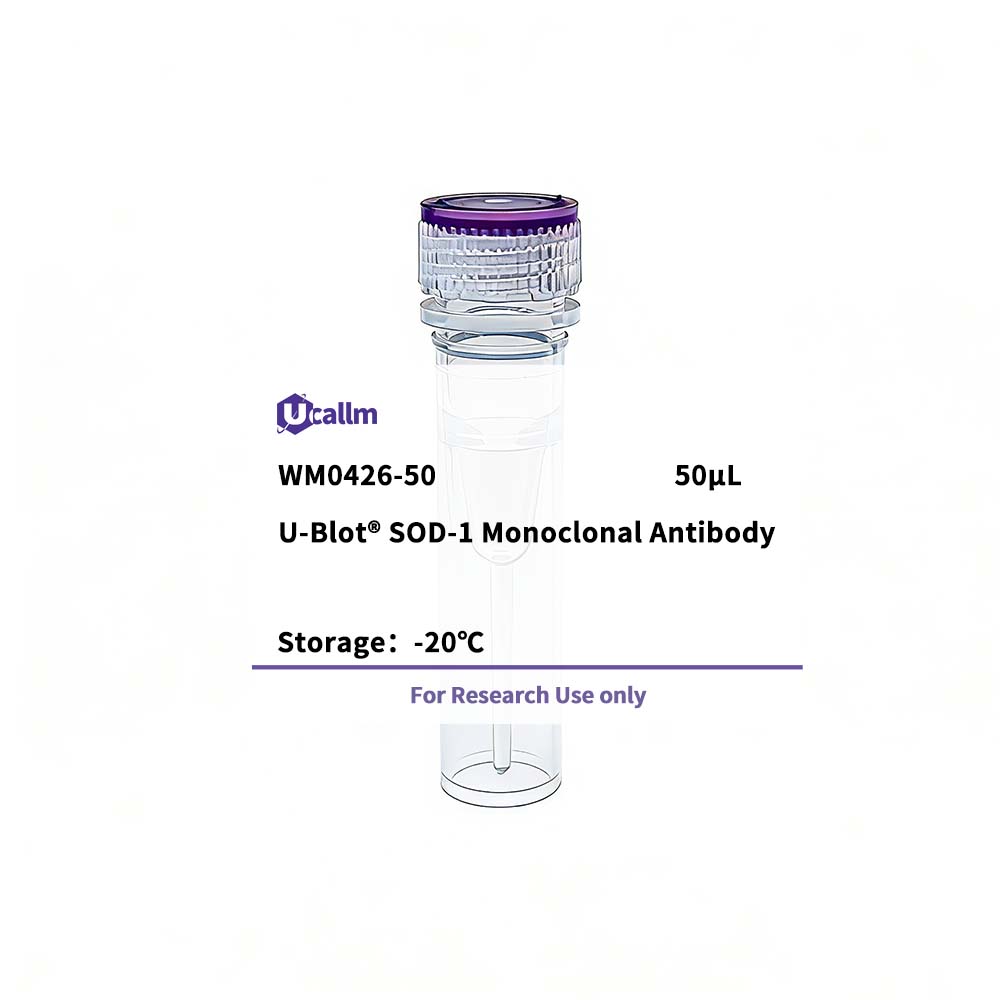
SOD-1 Monoclonal Antibody

Price range: $268.00 through $328.00

SKU: WM0426-50
Enter the quantity you would like, or drag the panel to find the quantity and price that best for you
Bulk QuoteAuthorize OEM & ODM

Product details

Background:
The protein encoded by this gene binds copper and zinc ions and is one of two isozymes responsible for destroying free superoxide radicals in the body. The encoded isozyme is a soluble cytoplasmic protein, acting as a homodimer to convert naturally-occuring but harmful superoxide radicals to molecular oxygen and hydrogen peroxide. The other isozyme is a mitochondrial protein. Mutations in this gene have been implicated as causes of familial amyotrophic lateral sclerosis. Rare transcript variants have been reported for this gene. [provided by RefSeq, Jul 2008],
Specifications

TargetSOD-1
ReactivityHuman, Mouse
ApplicationsWB, IF, FC, ELISA
MW(Calculated)16kD
MW(Observed)
Host SpeciesMouse
Isotype
Conjugate/ModificationUnmodified
Modification
Recommended Dilution RatioWB 1:500-1:2000; IF 1:200-1:1000; Flow Cyt 1:200-1:400; ELISA 1:10000; Not yet tested in other applications.
FormulationLiquid in PBS containing 50% glycerol, 0.5% BSA and 0.02% sodium azide.
Source
PurificationAffinity purification
Purity
Storage-15°C to -25°C/1 year(Do not lower than -25°C)
Concentration
ClonalityMonoclonal
Clone Number5D12
ImmunogenPurified recombinant fragment of human SOD1 expressed in E. Coli.
Sequence
SpecificitySOD1 Monoclonal Antibody detects endogenous levels of SOD1 protein.
Gene NameSOD1
Protein NameSuperoxide dismutase [Cu-Zn]
Other NameSOD1; / Superoxide dismutase [Cu-Zn]; / Superoxide dismutase 1; / hSod1
SpeciesHuman
Gene ID-16647
UniprotP00441,
Species.1Mouse
Gene ID-220655
Uniprot.1P08228
Species.2
Gene ID-3
Uniprot.2
Organism-4
Gene ID-4
SwissProt-4
BackgroundThe protein encoded by this gene binds copper and zinc ions and is one of two isozymes responsible for destroying free superoxide radicals in the body. The encoded isozyme is a soluble cytoplasmic protein, acting as a homodimer to convert naturally-occuring but harmful superoxide radicals to molecular oxygen and hydrogen peroxide. The other isozyme is a mitochondrial protein. Mutations in this gene have been implicated as causes of familial amyotrophic lateral sclerosis. Rare transcript variants have been reported for this gene. [provided by RefSeq, Jul 2008],
Cellular LocalizationCytoplasm . Mitochondrion . Nucleus . Predominantly cytoplasmic; the pathogenic variants ALS1 Arg-86 and Ala-94 gradually aggregates and accumulates in mitochondria. .
Tissue ExpressionColon,Fetal brain cortex,Placenta,
Signaling_pathwayCellular Processes >> Transport and catabolism >> Peroxisome;Organismal Systems >> Aging >> Longevity regulating pathway - multiple species;Human Diseases >> Neurodegenerative disease >> Parkinson disease;Human Diseases >> Neurodegenerative disease >> Amyotrophic lateral sclerosis;Human Diseases >> Neurodegenerative disease >> Huntington disease;Human Diseases >> Neurodegenerative disease >> Prion disease;Human Diseases >> Neurodegenerative disease >> Pathways of neurodegeneration - multiple diseases
Research Areas>>Peroxisome; / >>Longevity regulating pathway - multiple species; / >>Parkinson disease; / >>Amyotrophic lateral sclerosis; / >>Huntington disease; / >>Prion disease; / >>Pathways of neurodegeneration - multiple diseases; / >>Chemical carcinogenesis - reactive oxygen species
FunctionCatalytic activity:2 superoxide + 2 H(+) = O(2) + H(2)O(2).,cofactor:Binds 1 copper ion per subunit.,cofactor:Binds 1 zinc ion per subunit.,Disease:Defects in SOD1 are the cause of amyotrophic lateral sclerosis type 1 (ALS1) [MIM:105400]. ALS1 is a familial form of amyotrophic lateral sclerosis, a neurodegenerative disorder affecting upper and lower motor neurons and resulting in fatal paralysis. Sensory abnormalities are absent. Death usually occurs within 2 to 5 years. The etiology of amyotrophic lateral sclerosis is likely to be multifactorial, involving both genetic and environmental factors. The disease is inherited in 5-10% of cases leading to familial forms.,Function:Destroys radicals which are normally produced within the cells and which are toxic to biological systems.,miscellaneous:The protein (both wild-type and ALS1 variants) has a tendency to form fibrillar aggregates in the absence of the intramolecular disulfide bond or of bound zinc ions. These aggregates may have cytotoxic effects. Zinc binding promotes dimerization and stabilizes the native form.,online information:ALS genetic mutations db,online information:Superoxide dismutase entry,PTM:Unlike wild-type protein, the pathogenics variants ALS1 Arg-38, Arg-47, Arg-86 and Ala-94 are polyubiquitinated by RNF19A; which leads to their proteasomal degradation.,similarity:Belongs to the Cu-Zn superoxide dismutase family.,subunit:Homodimer. The pathogenics variants ALS1 Arg-38, Arg-47, Arg-86 and Ala-94 interact with RNF19A, whereas wild-type protein does not.,
RRID
Please login to post questions
Back to Top
Product has been added to your cart