SOX10 Polyclonal Antibody
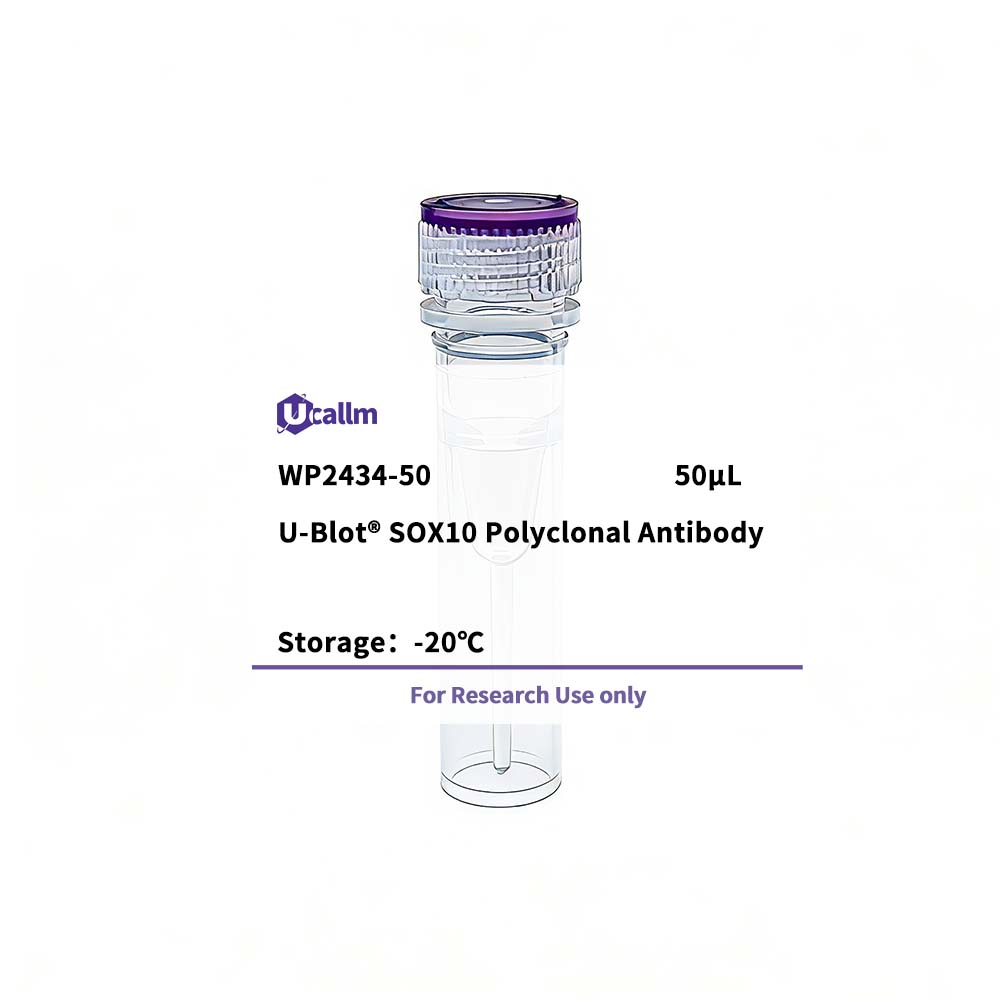
Ucallm_WP2434-50
Price range: $268.00 through $328.00
Product details
Background:
This gene encodes a member of the SOX (SRY-related HMG-box) family of transcription factors involved in the regulation of embryonic development and in the determination of the cell fate. The encoded protein may act as a transcriptional activator after forming a protein complex with other proteins. This protein acts as a nucleocytoplasmic shuttle protein and is important for neural crest and peripheral nervous system development. Mutations in this gene are associated with Waardenburg-Shah and Waardenburg-Hirschsprung disease. [provided by RefSeq, Jul 2008],
Specifications
| Size | 50μL/100μL |
| Target | SOX10 |
| Reactivity | Human, Mouse, Rat |
| Applications | WB, ELISA |
| MW(Calculated) | |
| MW(Observed) | 51kD |
| Host Species | Rabbit |
| Isotype | IgG |
| Conjugate/Modification | Unmodified |
| Recommended Dilution Ratio | WB 1:500-2000; ELISA 1:5000-20000 |
| Formulation | Liquid in PBS containing 50% glycerol,0.5% BSA and 0.02% sodium azide. |
| Purification | The antibody was affinity-purified from rabbit antiserum by affinity-chromatography using epitope-specific immunogen. |
| Storage | -15°C to -25°C/1 year(Do not lower than -25°C) |
| Concentration | 1 mg/ml |
| Clonality | Polyclonal |
| Clone Number | |
| Immunogen | Synthesized peptide derived from part region of human protein |
| Specificity | SOX10 Polyclonal Antibody detects endogenous levels of protein. |
| Gene Name | SOX10 |
| Protein Name | Transcription factor SOX-10 |
| Other Name | |
| Species | Human |
| Gene ID | 6663 |
| Uniprot | P56693, |
| Species.1 | Mouse |
| Gene ID.1 | |
| Uniprot.1 | Q04888, |
| Species.2 | Rat |
| Gene ID.2 | |
| Uniprot.2 | O55170 |
| Cellular Localization | Cytoplasm . Nucleus . Mitochondrion outer membrane; Peripheral membrane protein; Cytoplasmic side . |
| Tissue Expression | Expressed in fetal brain and in adult brain, heart, small intestine and colon. |
| Signaling_pathway | |
| Research Areas | |
| Function | Disease:Defects in SOX10 are a cause of Waardenburg syndrome type 4 (WS4) [MIM:277580]; also known as Waardenburg-Shah syndrome. WS4 is characterized by the association of Waardenburg features (depigmentation and deafness) and the absence of enteric ganglia in the distal part of the intestine (Hirschsprung disease).,Disease:Defects in SOX10 are a cause of Yemenite deaf-blind hypopigmentation syndrome [MIM:601706]. The disorder consists of cutaneous hypopigmented and hyperpigmented spots and patches, microcornea, coloboma and severe hearing loss. Another case observed in a girl with similar skin symptoms and hearing loss but without microcornea or coloboma is reported as a mild form of this syndrome.,Disease:Defects in SOX10 are the cause of peripheral demyelinating neuropathy, central dysmyelinating leukodystrophy, Waardenburg syndrome, and Hirschsprung disease (PCWH) [MIM:609136]; also called neurologic variant of Waardenburg-Shah syndrome. PCWH is a rare, complex and more severe neurocristopathy that includes features of 4 distinct syndromes: peripheral demyelinating neuropathy, central dysmyelinating leukodystrophy, Waardenburg syndrome, and Hirschsprung disease.,Disease:Defects in SOX10 are the cause of Waardenburg syndrome type 2E (WS2E) [MIM:611584]. WS2 is a genetically heterogeneous, autosomal dominant disorder characterized by sensorineural deafness, pigmentary disturbances, and absence of dystopia canthorum. The frequency of deafness is higher in WS2 than in WS1.,Function:Transcription factor that seems to function synergistically with the POU domain protein TST-1/OCT6/SCIP. Could confer cell specificity to the function of other transcription factors in developing and mature glia.,similarity:Contains 1 HMG box DNA-binding domain.,tissue specificity:Expressed in fetal brain and in adult brain, heart, small intestine and colon., |
Please login to post questions
Related products