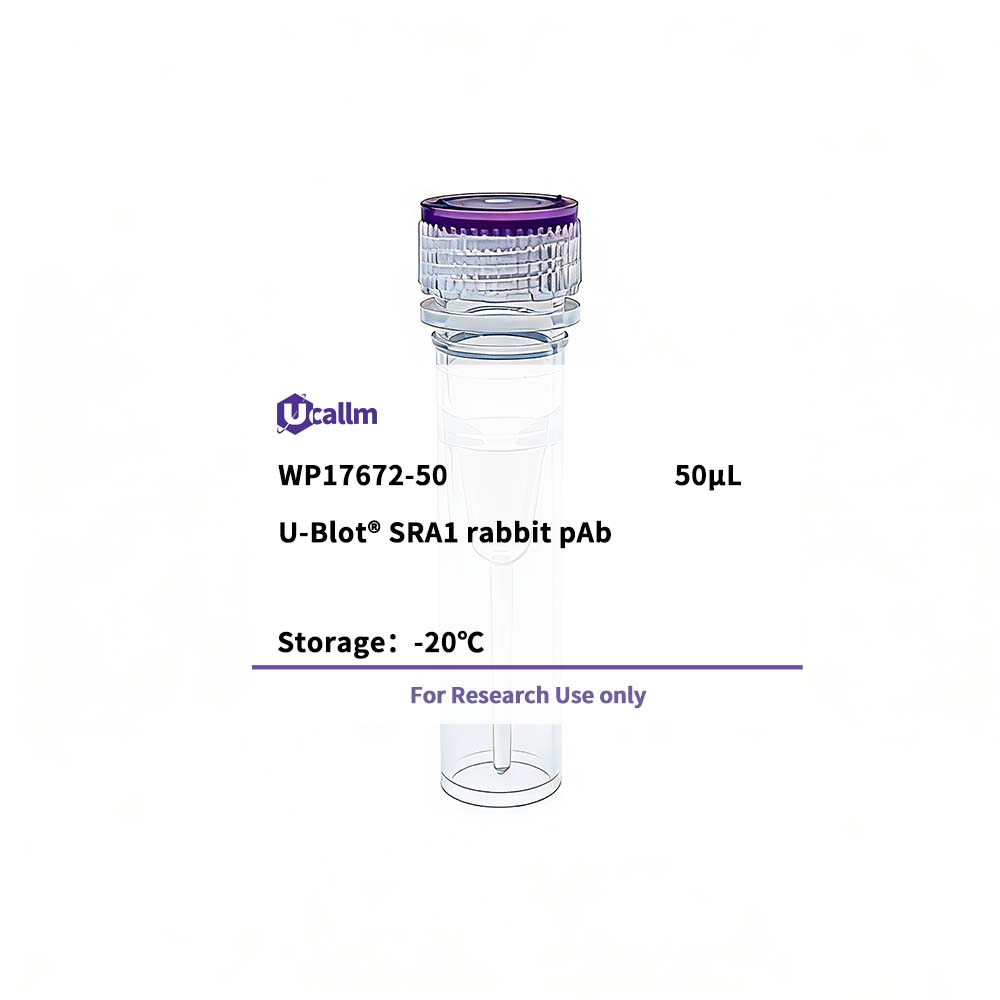
SKU: WP17672 Categories: ,

SRA1 rabbit pAb

Price range: $268.00 through $328.00

SKU: WP17672-100
Enter the quantity you would like, or drag the panel to find the quantity and price that best for you
Bulk QuoteAuthorize OEM & ODM

Product details

Background:

Both long non-coding and protein-coding RNAs are transcribed from this gene, and they represent alternatively spliced transcript variants. This gene was initially defined as a non-coding RNA, which is a coactivator for several nuclear receptors (NRs) and is associated with breast cancer. It has now been found that this gene is involved in the regulation of many NR and non-NR activities, including metabolism, adipogenesis and chromatin organization. The long non-coding RNA transcripts interact with a variety of proteins, including the protein encoded by this gene. The encoded protein acts as a transcriptional repressor by binding to the non-coding RNA. [provided by RefSeq, Mar 2012],


Specifications

Size50μL/100μL
TargetSRA1
ReactivityHuman, Mouse, Rat
ApplicationsWB, ELISA
MW(Calculated)26kD
MW(Observed)
Host SpeciesRabbit
IsotypeIgG
Conjugate/ModificationUnmodified
Recommended Dilution RatioWB 1:1000-2000; ELISA 1:5000-20000
FormulationLiquid in PBS containing 50% glycerol, 0.5% BSA and 0.02% sodium azide.
PurificationThe antibody was affinity-purified from rabbit antiserum by affinity-chromatography using epitope-specific immunogen.
Storage-15°C to -25°C/1 year(Do not lower than -25°C)
Concentration1 mg/ml
ClonalityPolyclonal
Clone Number
ImmunogenSynthesized peptide derived from human SRA1
SpecificityThis antibody detects endogenous levels of Human SRA1
Gene NameSRA1 PP7684
Protein NameSteroid receptor RNA activator 1
Other NameSRA1; / PP7684; / Steroid receptor RNA activator 1; / Steroid receptor RNA activator protein; / SRAP
SpeciesHuman
Gene ID10011
UniprotQ9HD15,
Species.1Mouse
Gene ID.124068
Uniprot.1Q80VJ2,
Species.2Rat
Gene ID.2252891
Uniprot.2Q6QGW5
Cellular LocalizationNucleus . Cytoplasm .
Tissue ExpressionHighly expressed in liver and skeletal muscle and to a lesser extent in brain. Also expressed in both normal and tumorigenic breast epithelial cell lines. Significantly up-regulated in human tumors of the breast, ovary, and uterus.
Signaling_pathway
Research Areas
FunctionFunction:Functional RNA which acts as a transcriptional coactivator that selectively enhances steroid receptor-mediated transactivation ligand-independently through a mechanism involving the modulating N-terminal domain (AF-1) of steroid receptors. Also mediates transcriptional coactivation of steroid receptors ligand-dependently through the steroid-binding domain (AF-2). Enhances cellular proliferation and differentiation and promotes apoptosis in vivo. May play a role in tumorigenesis.,miscellaneous:Appears to be the first example of a new class of functional RNAs also able to encode a protein.,similarity:Belongs to the SRA1 family.,subunit:SRA1 RNA exists in a ribonucleoprotein complex containing NCOA1. The RNA also forms a complex with PUS1 and RARG in the nucleus. Interacts with AR.,tissue specificity:Highly expressed in liver and skeletal muscle and to a lesser extent in brain. Also expressed in both normal and tumorigenic breast epithelial cell lines. Significantly up-regulated in human tumors of the breast, ovary, and uterus.,
Please login to post questions
Back to Top
Product has been added to your cart
