

Stat1 Polyclonal Antibody
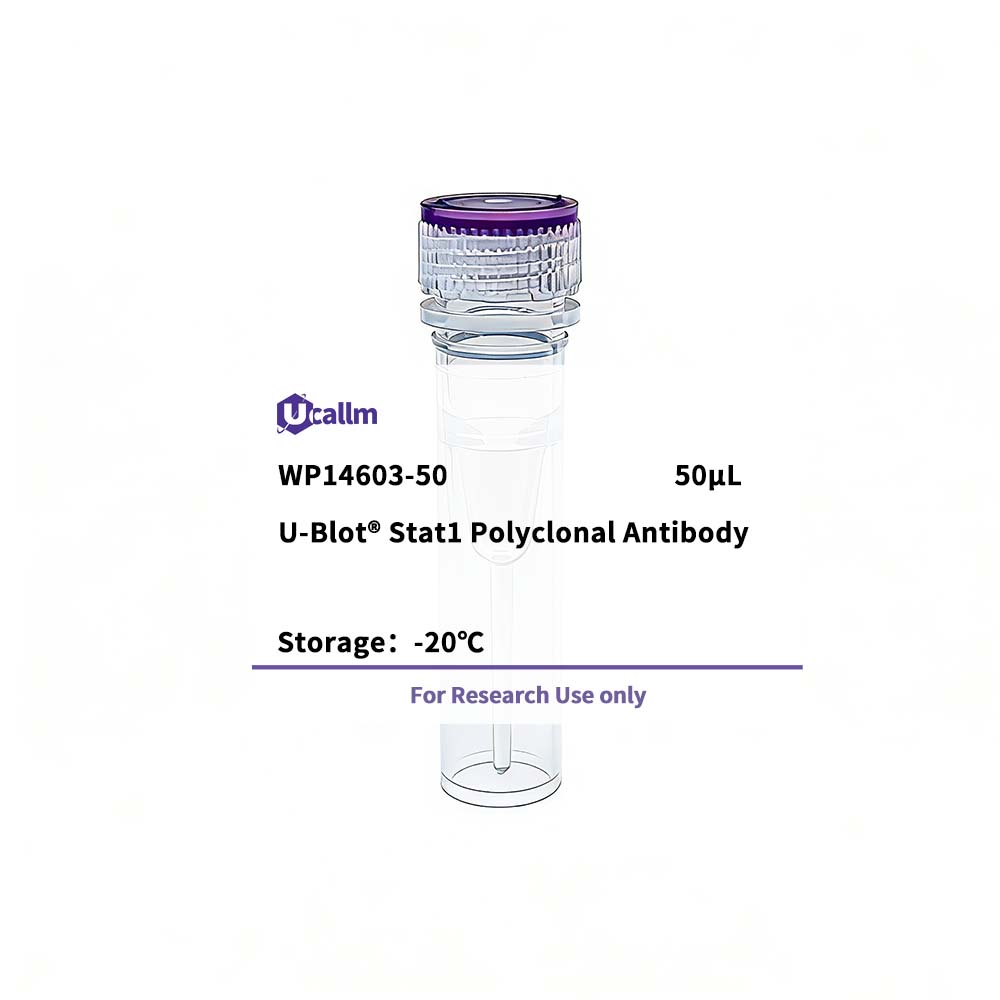
Ucallm_WP14603-50
Price range: $268.00 through $328.00
Product details
Background:
The protein encoded by this gene is a member of the STAT protein family. In response to cytokines and growth factors, STAT family members are phosphorylated by the receptor associated kinases, and then form homo- or heterodimers that translocate to the cell nucleus where they act as transcription activators. This protein can be activated by various ligands including interferon-alpha, interferon-gamma, EGF, PDGF and IL6. This protein mediates the expression of a variety of genes, which is thought to be important for cell viability in response to different cell stimuli and pathogens. Two alternatively spliced transcript variants encoding distinct isoforms have been described. [provided by RefSeq, Jul 2008],
Specifications
| Size | 50μL/100μL |
| Target | STAT1 |
| Reactivity | Human, Mouse, Rat, Chicken |
| Applications | IF, WB, IHC, IP, ELISA |
| MW(Calculated) | |
| MW(Observed) | 87kD |
| Host Species | Rabbit |
| Isotype | IgG |
| Conjugate/Modification | Unmodified |
| Recommended Dilution Ratio | IF 1:50-200; WB 1:500-1:2000; IHC 1:100-1:300; IP 1:200; ELISA 1:10000; Not yet tested in other applications; / Note: For IHC, we suggest antigen retrieval with TE buffer pH 9.0 (Cat#WT1004) |
| Formulation | Liquid in PBS containing 50% glycerol, 0.5% BSA and 0.02% sodium azide. |
| Purification | The antibody was affinity-purified from rabbit antiserum by affinity-chromatography using epitope-specific immunogen. |
| Storage | -15°C to -25°C/1 year(Do not lower than -25°C) |
| Concentration | 1 mg/ml |
| Clonality | Polyclonal |
| Clone Number | |
| Immunogen | The antiserum was produced against synthesized peptide derived from human STAT1. AA range:694-743 |
| Specificity | Stat1 Polyclonal Antibody detects endogenous levels of Stat1 protein. |
| Gene Name | STAT1 |
| Protein Name | Signal transducer and activator of transcription 1-alpha/beta |
| Other Name | STAT1; / Signal transducer and activator of transcription 1-alpha/beta; / Transcription factor ISGF-3 components p91/p84 |
| Species | Human |
| Gene ID | 6772 |
| Uniprot | P42224, |
| Species.1 | Mouse |
| Gene ID.1 | |
| Uniprot.1 | P42225 |
| Species.2 | |
| Gene ID.2 | |
| Uniprot.2 | |
| Cellular Localization | Cytoplasm . Nucleus . Translocated into the nucleus upon tyrosine phosphorylation and dimerization, in response to IFN-gamma and signaling by activated FGFR1, FGFR2, FGFR3 or FGFR4 (PubMed:15322115). Monomethylation at Lys-525 is required for phosphorylation at Tyr-701 and translocation into the nucleus (PubMed:28753426). Translocates into the nucleus in response to interferon-beta stimulation (PubMed:26479788). . |
| Tissue Expression | B-cell,Brain,Retina,Testis, |
| Signaling_pathway | Cellular Processes >> Cell growth and death >> Necroptosis;Organismal Systems >> Immune system >> Toll-like receptor signaling pathway;Organismal Systems >> Immune system >> NOD-like receptor signaling pathway;Organismal Systems >> Immune system >> Th1 and Th2 cell differentiation;Organismal Systems >> Immune system >> Th17 cell differentiation;Organismal Systems >> Immune system >> Chemokine signaling pathway;Organismal Systems >> Endocrine system >> Prolactin signaling pathway;Organismal Systems >> Endocrine system >> Growth hormone synthesis, secretion and action;Organismal Systems >> Endocrine system >> Thyroid hormone signaling pathway;Organismal Systems >> Development and regeneration >> Osteoclast differentiation;Human Diseases >> Cancer: overview >> Pathways in cancer;Human Diseases >> Cancer: overview >> PD-L1 expression and PD-1 checkpoint pathway in cancer;Human Diseases >> Cancer: specific types >> Pancreatic cancer;Human Diseases >> Immune disease >> Inflammatory bowel disease;Environmental Information Processing >> Signal transduction >> JAK-STAT signaling pathway |
| Research Areas | >>Chemokine signaling pathway; / >>Necroptosis; / >>Osteoclast differentiation; / >>Toll-like receptor signaling pathway; / >>NOD-like receptor signaling pathway; / >>C-type lectin receptor signaling pathway; / >>JAK-STAT signaling pathway; / >>Th1 and Th2 cell differentiation; / >>Th17 cell differentiation; / >>Prolactin signaling pathway; / >>Thyroid hormone signaling pathway; / >>AGE-RAGE signaling pathway in diabetic complications; / >>Growth hormone synthesis, secretion and action; / >>Leishmaniasis; / >>Toxoplasmosis; / >>Tuberculosis; / >>Hepatitis C; / >>Hepatitis B; / >>Measles; / >>Influenza A; / >>Human papillomavirus infection; / >>Kaposi sarcoma-associated herpesvirus infection; / >>Herpes simplex virus 1 infection; / >>Epstein-Barr virus infection; / >>Coronavirus disease - COVID-19; / >>Pathways in cancer; / >>Pancreatic cancer; / >>PD-L1 expression and PD-1 checkpoint pathway in cancer; / >>Inflammatory bowel disease |
| Function | Disease:Defects in STAT1 are a cause of mendelian susceptibility to mycobacterial disease (MSMD) [MIM:209950]; also known as familial disseminated atypical mycobacterial infection. This rare condition confers predisposition to illness caused by moderately virulent mycobacterial species, such as Bacillus Calmette-Guerin (BCG) vaccine and environmental non-tuberculous mycobacteria, and by the more virulent Mycobacterium tuberculosis. Other microorganisms rarely cause severe clinical disease in individuals with susceptibility to mycobacterial infections, with the exception of Salmonella which infects less than 50% of these individuals. The pathogenic mechanism underlying MSMD is the impairment of interferon-gamma mediated immunity whose severity determines the clinical outcome. Some patients die of overwhelming mycobacterial disease with lepromatous-like lesions in early childhood, whereas others develop, later in life, disseminated but curable infections with tuberculoid granulomas. MSMD is a genetically heterogeneous disease with autosomal recessive, autosomal dominant or X-linked inheritance.,Disease:Defects in STAT1 are the cause of STAT1 deficiency [MIM:600555]. Patients generally suffer from mycobacterial or viral diseases. In the case of complete deficiency, patients can die of viral disease.,Function:Signal transducer and activator of transcription that mediates signaling by interferons (IFNs). Following type I IFN (IFN-alpha and IFN-beta) binding to cell surface receptors, Jak kinases (TYK2 and JAK1) are activated, leading to tyrosine phosphorylation of STAT1 and STAT2. The phosphorylated STATs dimerize, associate with ISGF3G/IRF-9 to form a complex termed ISGF3 transcription factor, that enters the nucleus. ISGF3 binds to the IFN stimulated response element (ISRE) to activate the transcription of interferon stimulated genes, which drive the cell in an antiviral state. In response to type II IFN (IFN-gamma), STAT1 is tyrosine- and serine-phosphorylated. It then forms a homodimer termed IFN-gamma-activated factor (GAF), migrates into the nucleus and binds to the IFN gamma activated sequence (GAS) to drive the expression of the target genes, inducing a cellular antiviral state.,online information:STAT1 entry,online information:STAT1 mutation db,PTM:Phosphorylated on tyrosine and serine residues in response to IFN-alpha, IFN-gamma, PDGF and EGF. Phosphorylation on Tyr-701 (lacking in beta form) by JAK promotes dimerization and subsequent translocation to the nucleus. Phosphorylation on Ser-727 by several kinases including MAPK14, ERK1/2 and CAMKII on IFN-gamma stimulation, regulates STAT1 transcriptional activity. Phosphorylation on Ser-727 promotes sumoylation though increasing interaction with PIAS. Phosphorylation on Ser-727 by PKCdelta induces apoptosis in response to DNA-damaging agents.,PTM:Sumoylated by SUMO1, SUMO2 and SUMO3. Sumoylation is enhanced by IFN-gamma-induced phosphorylation on Ser-727, and by interaction with PIAS proteins. Enhances the transactivation activity.,similarity:Belongs to the transcription factor STAT family.,similarity:Contains 1 SH2 domain.,subcellular location:Translocated into the nucleus in response to IFN-gamma-induced tyrosine phosphorylation and dimerization.,subunit:Isoform alpha homodimerizes upon IFN-gamma induced phosphorylation. Heterodimer with STAT2 upon IFN-alpha/beta induced phosphorylation. Interacts with NMI. Interacts with Sendai virus C', C, Y1 and Y2 proteins, Nipah virus P, V and W proteins, and rabies virus phosphoprotein preventing activation of ISRE and GAS promoter (By similarity). Interacts with HCV core protein; the interaction results in STAT1 degradation. Interacts with PIAS1; the interaction requires phosphorylation on Ser-727 and inhibits STAT1 activation., |
Please login to post questions
Related products




