

Stat1 [PTR2109] Mouse mAb
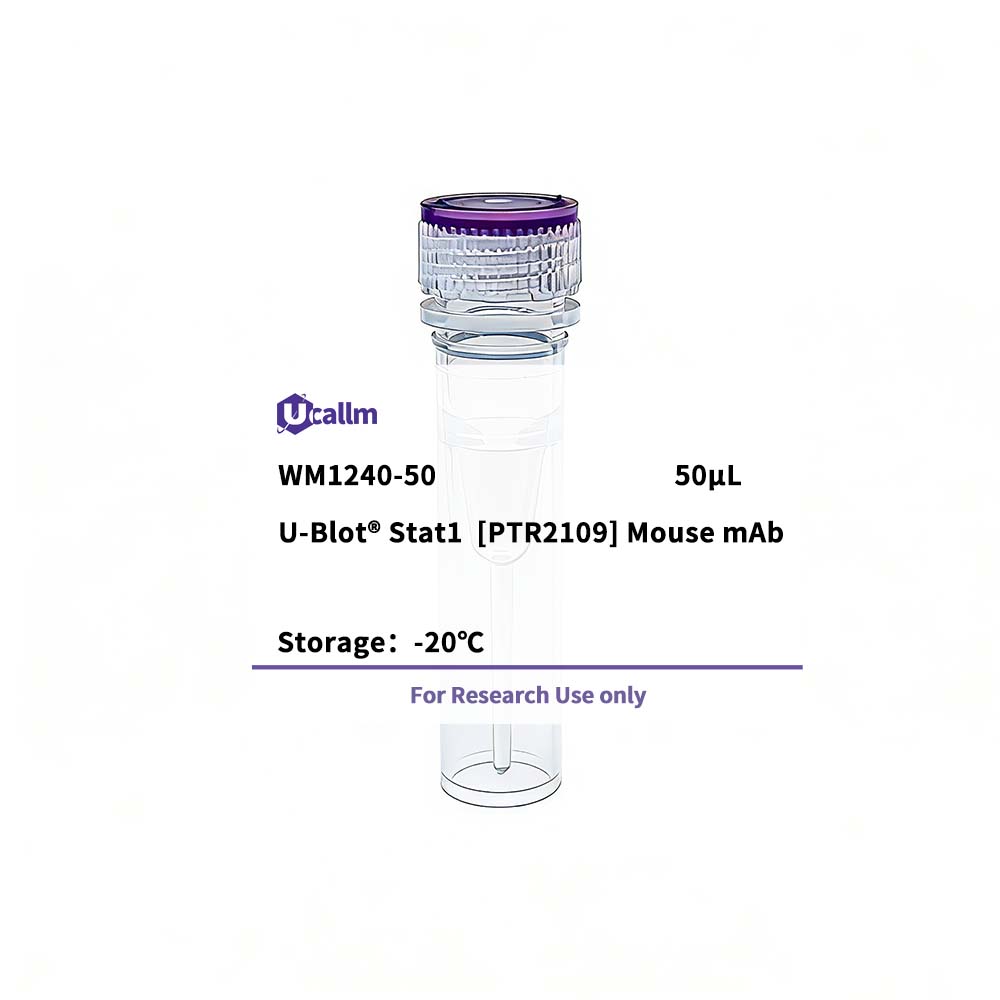
Ucallm_WM1240-50
Price range: $268.00 through $328.00
Product details
Background:
signal transducer and activator of transcription 1(STAT1) Homo sapiens The protein encoded by this gene is a member of the STAT protein family. In response to cytokines and growth factors, STAT family members are phosphorylated by the receptor associated kinases, and then form homo- or heterodimers that translocate to the cell nucleus where they act as transcription activators. This protein can be activated by various ligands including interferon-alpha, interferon-gamma, EGF, PDGF and IL6. This protein mediates the expression of a variety of genes, which is thought to be important for cell viability in response to different cell stimuli and pathogens. Two alternatively spliced transcript variants encoding distinct isoforms have been described. [provided by RefSeq, Jul 2008],
Specifications
| Size | 50μL/100μL |
| Target | STAT1 |
| Reactivity | Human, Dog |
| Applications | WB, IF, IP, ELISA |
| MW(Calculated) | 87kD |
| MW(Observed) | 87kD |
| Host Species | Mouse |
| Isotype | IgG2a,Kappa |
| Conjugate/Modification | Unmodified |
| Recommended Dilution Ratio | WB 1:500-2000; IF 1:100-500; ELISA 1:1000-5000; IP 1:50-1:200; |
| Formulation | PBS, 50% glycerol, 0.05% Proclin 300, 0.05%BSA |
| Purification | Recombinant Antibody expressed in animal component-free (ACF) media, purified via Protein G affinity chromatography. |
| Storage | -15°C to -25°C/1 year(Do not lower than -25°C) |
| Concentration | 1 mg/ml |
| Clonality | Monoclonal |
| Clone Number | RMMR2109 |
| Immunogen | Synthesized peptide derived from human Stat1. AA range: 650-750 |
| Specificity | This antibody detects endogenous levels of Stat1 protein. |
| Gene Name | STAT1 |
| Protein Name | Signal transducer and activator of transcription 1-alpha/beta (Transcription factor ISGF-3 components p91/p84) |
| Other Name | STAT1; / Signal transducer and activator of transcription 1-alpha/beta; / Transcription factor ISGF-3 components p91/p84 |
| Species | Human |
| Gene ID | 6772 |
| Uniprot | P42224, |
| Species.1 | Mouse |
| Gene ID.1 | |
| Uniprot.1 | P42225 |
| Species.2 | |
| Gene ID.2 | |
| Uniprot.2 | |
| Cellular Localization | |
| Tissue Expression | |
| Signaling_pathway | Cellular Processes >> Cell growth and death >> Necroptosis;Organismal Systems >> Immune system >> Toll-like receptor signaling pathway;Organismal Systems >> Immune system >> NOD-like receptor signaling pathway;Organismal Systems >> Immune system >> Th1 and Th2 cell differentiation;Organismal Systems >> Immune system >> Th17 cell differentiation;Organismal Systems >> Immune system >> Chemokine signaling pathway;Organismal Systems >> Endocrine system >> Prolactin signaling pathway;Organismal Systems >> Endocrine system >> Growth hormone synthesis, secretion and action;Organismal Systems >> Endocrine system >> Thyroid hormone signaling pathway;Organismal Systems >> Development and regeneration >> Osteoclast differentiation;Human Diseases >> Cancer: overview >> Pathways in cancer;Human Diseases >> Cancer: overview >> PD-L1 expression and PD-1 checkpoint pathway in cancer;Human Diseases >> Cancer: specific types >> Pancreatic cancer;Human Diseases >> Immune disease >> Inflammatory bowel disease;Environmental Information Processing >> Signal transduction >> JAK-STAT signaling pathway |
| Research Areas | |
| Function | Signal transducer and transcription activator that mediates cellular responses to interferons (IFNs), cytokine KITLG/SCF and other cytokines and other growth factors. Following type I IFN (IFN-alpha and IFN-beta) binding to cell surface receptors, signaling via protein kinases leads to activation of Jak kinases (TYK2 and JAK1) and to tyrosine phosphorylation of STAT1 and STAT2. The phosphorylated STATs dimerize and associate with ISGF3G/IRF-9 to form a complex termed ISGF3 transcription factor, that enters the nucleus . ISGF3 binds to the IFN stimulated response element (ISRE) to activate the transcription of IFN-stimulated genes (ISG), which drive the cell in an antiviral state. In response to type II IFN (IFN-gamma), STAT1 is tyrosine- and serine-phosphorylated . It then forms a homodimer termed IFN-gamma-activated factor (GAF), migrates into the nucleus and binds to the IFN gamma activated sequence (GAS) to drive the expression of the target genes, inducing a cellular antiviral state. Becomes activated in response to KITLG/SCF and KIT signaling. May mediate cellular responses to activated FGFR1, FGFR2, FGFR3 and FGFR4. |
Please login to post questions
Related products




