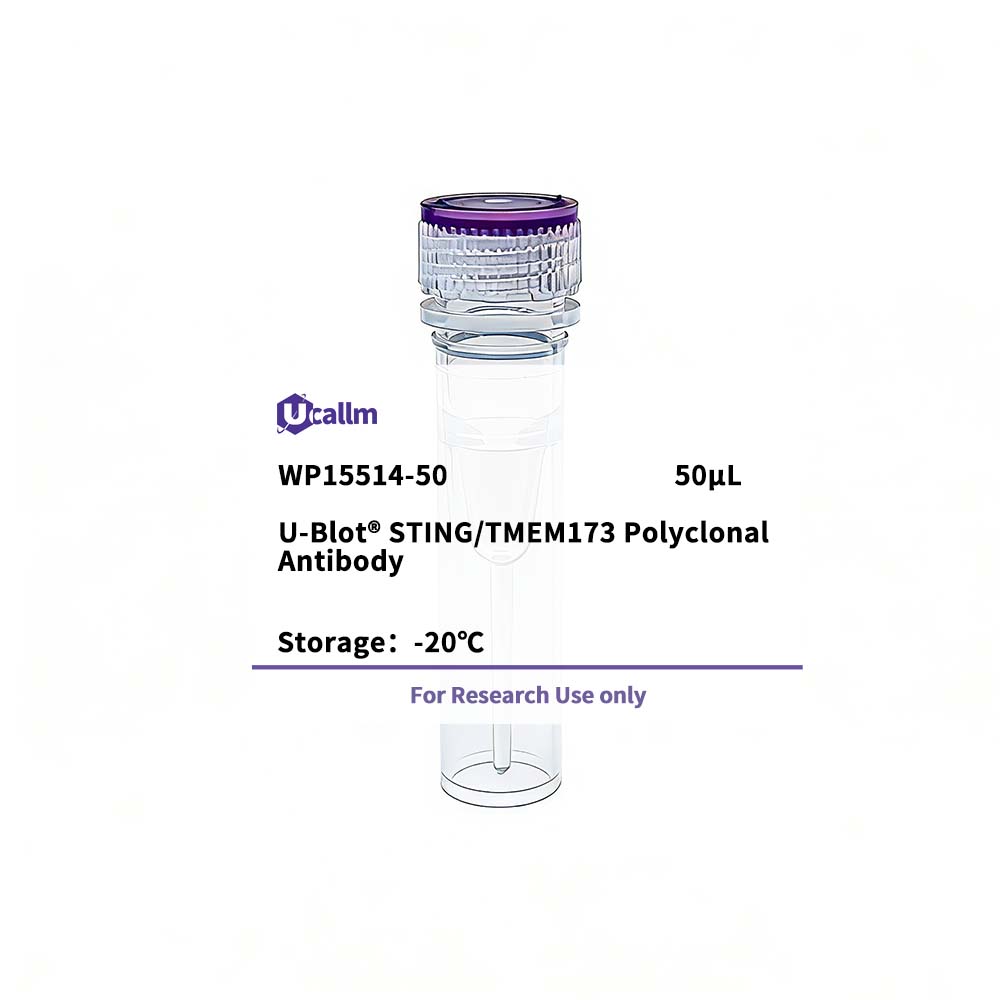
SKU: WP15514 Categories: ,

STING/TMEM173 Polyclonal Antibody

Price range: $268.00 through $328.00

SKU: WP15514-100
Enter the quantity you would like, or drag the panel to find the quantity and price that best for you
Bulk QuoteAuthorize OEM & ODM

Product details

Background:

This gene encodes a five transmembrane protein that functions as a major regulator of the innate immune response to viral and bacterial infections. The encoded protein is a pattern recognition receptor that detects cytosolic nucleic acids and transmits signals that activate type I interferon responses. The encoded protein has also been shown to play a role in apoptotic signaling by associating with type II major histocompatibility complex. Mutations in this gene are the cause of infantile-onset STING-associated vasculopathy. Alternate splicing results in multiple transcript variants. [provided by RefSeq, Sep 2014],

Specifications

Size50μL/100μL
TargetSTING/TMEM173
ReactivityHuman, Mouse
ApplicationsWB, IHC, IF, ELISA
MW(Calculated)
MW(Observed)38kD
Host SpeciesRabbit
IsotypeIgG
Conjugate/ModificationUnmodified
Recommended Dilution RatioWB 1:500-1:2000; IHC: 1:100-1:300; ELISA 1:20000; IF 1:50-200 / Note: For IHC, we suggest antigen retrieval with TE buffer pH 9.0 (Cat#WT1004)
FormulationLiquid in PBS containing 50% glycerol, 0.5% BSA and 0.02% sodium azide.
PurificationThe antibody was affinity-purified from rabbit antiserum by affinity-chromatography using epitope-specific immunogen.
Storage-15°C to -25°C/1 year(Do not lower than -25°C)
Concentration1 mg/ml
ClonalityPolyclonal
Clone Number
ImmunogenSynthesized peptide derived from Transmembrane protein 173 at AA range: 301-350
SpecificityTMEM173 Polyclonal Antibody detects endogenous levels of TMEM173 protein.
Gene NameTMEM173 ERIS MITA STING
Protein NameTransmembrane protein 173
Other NameTMEM173; / ERIS; / MITA; / STING; / Transmembrane protein 173; / Endoplasmic reticulum interferon stimulator; / ERIS; / Mediator of IRF3 activation; / hMITA; / Stimulator of interferon genes protein; / hSTING
SpeciesHuman
Gene ID340061
UniprotQ86WV6,
Species.1Mouse
Gene ID.172512
Uniprot.1Q3TBT3
Species.2
Gene ID.2
Uniprot.2
Cellular LocalizationEndoplasmic reticulum membrane; Multi-pass membrane protein . Cytoplasm, perinuclear region . Endoplasmic reticulum-Golgi intermediate compartment membrane; Multi-pass membrane protein . Golgi apparatus membrane; Multi-pass membrane protein . Cytoplasmic vesicle, autophagosome membrane; Multi-pass membrane protein . Mitochondrion outer membrane; Multi-pass membrane protein . Cell membrane; Multi-pass membrane protein . In response to double-stranded DNA stimulation, translocates from the endoplasmic reticulum through the endoplasmic reticulum-Golgi intermediate compartment and Golgi to post-Golgi vesicles, where the kinase TBK1 is recruited (PubMed:19433799, PubMed:30842659, PubMed:30842653, PubMed:29694889). Upon cGAMP-binding, translocates to the endoplasmic reticulum-Golgi intermediate compartment (ERGIC) in a process that is dependent on COPII vesicles; STING1-containing ERGIC serves as a membrane source for LC3 lipidation, which is a key step in autophagosome biogenesis (PubMed:30842662). .
Tissue ExpressionUbiquitously expressed. Expressed in skin endothelial cells, alveolar type 2 pneumocytes, bronchial epithelium and alveolar macrophages.
Signaling_pathwayOrganismal Systems >> Immune system >> NOD-like receptor signaling pathway;Organismal Systems >> Immune system >> RIG-I-like receptor signaling pathway;Organismal Systems >> Immune system >> Cytosolic DNA-sensing pathway
Research Areas>>NOD-like receptor signaling pathway; / >>RIG-I-like receptor signaling pathway; / >>Cytosolic DNA-sensing pathway; / >>Shigellosis; / >>Human cytomegalovirus infection; / >>Herpes simplex virus 1 infection; / >>Human immunodeficiency virus 1 infection; / >>Coronavirus disease - COVID-19
FunctionFunction:Acts as a facilitator of innate immune signaling. Able to activate both NF-kappa-B and IRF3 transcription pathways to induce expression of type I interferon (IFN-alpha and IFN-beta) and exert a potent anti-viral state following expression. May be involved in translocon function, the translocon possibly being able to influence the induction of type I interferons. May be involved in transduction of apoptotic signals via its association with the major histocompatibility complex class II (MHC-II). Mediates death signaling via activation of the extracellular signal-regulated kinase (ERK) pathway.,PTM:Phosphorylated on tyrosine residues upon MHC-II aggregation.,subunit:Associates with the MHC-II complex (By similarity). Interacts with DDX58/RIG-I, MAVS/VISA and SSR2.,tissue specificity:Ubiquitously expressed.,
Please login to post questions
Back to Top
Product has been added to your cart
