

Synaptotagmin XVI Polyclonal Antibody
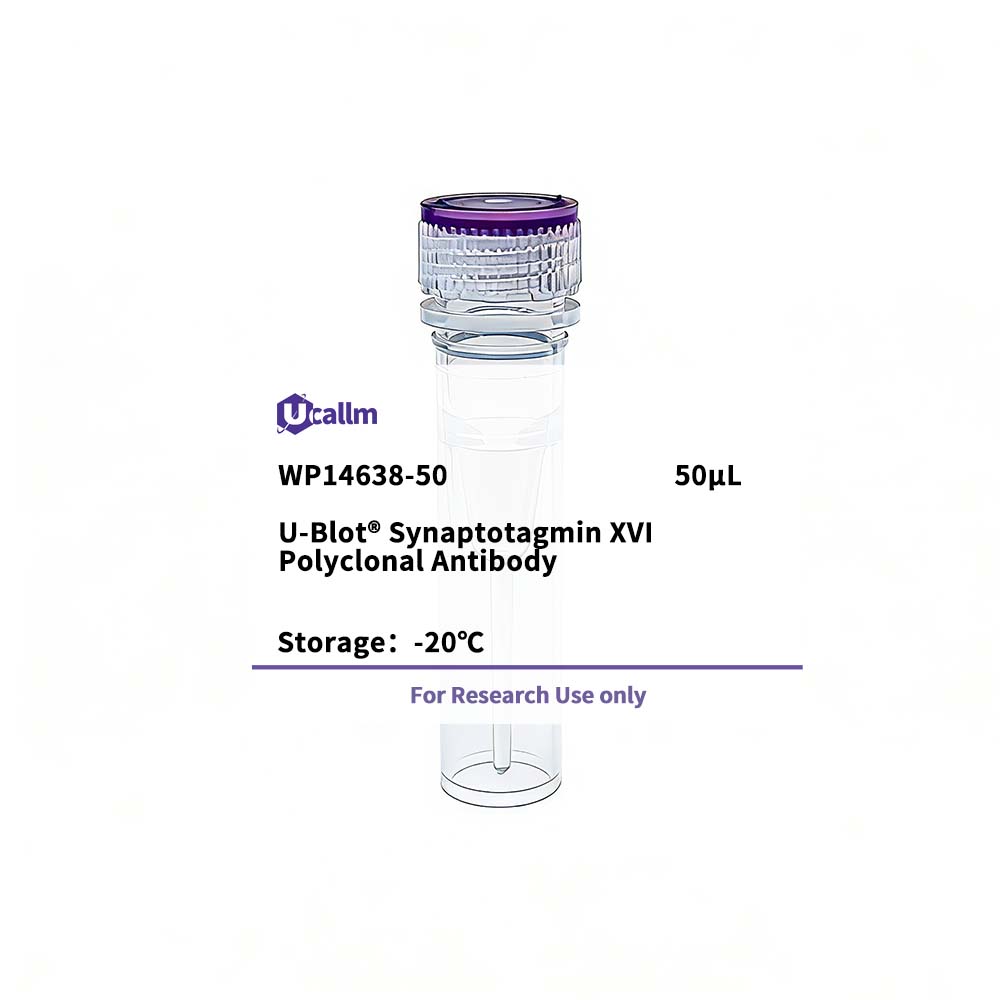
Ucallm_WP14638-50
Price range: $268.00 through $328.00
Product details
Background:
function:May be involved in the trafficking and exocytosis of secretory vesicles in non-neuronal tissues. Is Ca(2+)-independent., sequence caution:Translated as Gln., similarity:Belongs to the synaptotagmin family., similarity:Contains 2 C2 domains., subunit:Homodimer. Can also form heterodimers., tissue specificity:Expressed in brain.,
Specifications
| Size | 50μL/100μL |
| Target | Synaptotagmin XVI |
| Reactivity | Human, Mouse |
| Applications | WB, ELISA |
| MW(Calculated) | |
| MW(Observed) | 72kD |
| Host Species | Rabbit |
| Isotype | IgG |
| Conjugate/Modification | Unmodified |
| Recommended Dilution Ratio | WB 1:500-1:2000; ELISA 1:40000; Not yet tested in other applications. |
| Formulation | Liquid in PBS containing 50% glycerol, 0.5% BSA and 0.02% sodium azide. |
| Purification | The antibody was affinity-purified from rabbit antiserum by affinity-chromatography using epitope-specific immunogen. |
| Storage | -15°C to -25°C/1 year(Do not lower than -25°C) |
| Concentration | 1 mg/ml |
| Clonality | Polyclonal |
| Clone Number | |
| Immunogen | The antiserum was produced against synthesized peptide derived from human SYT16. AA range:231-280 |
| Specificity | Synaptotagmin XVI Polyclonal Antibody detects endogenous levels of Synaptotagmin XVI protein. |
| Gene Name | SYT16 |
| Protein Name | Synaptotagmin-16 |
| Other Name | SYT16; / STREP14; / SYT14L; / SYT14R; / Synaptotagmin-16; / Chr14Syt; / Synaptotagmin 14-like protein; / Synaptotagmin XIV-related protein |
| Species | Human |
| Gene ID | 83851 |
| Uniprot | Q17RD7, |
| Species.1 | Mouse |
| Gene ID.1 | |
| Uniprot.1 | Q7TN83 |
| Species.2 | |
| Gene ID.2 | |
| Uniprot.2 | |
| Cellular Localization | plasma membrane, |
| Tissue Expression | Expressed in brain. |
| Signaling_pathway | |
| Research Areas | |
| Function | Function:May be involved in the trafficking and exocytosis of secretory vesicles in non-neuronal tissues. Is Ca(2+)-independent.,sequence Caution:Translated as Gln.,similarity:Belongs to the synaptotagmin family.,similarity:Contains 2 C2 domains.,subunit:Homodimer. Can also form heterodimers.,tissue specificity:Expressed in brain., |
Please login to post questions
Related products





