

Product details
Background:
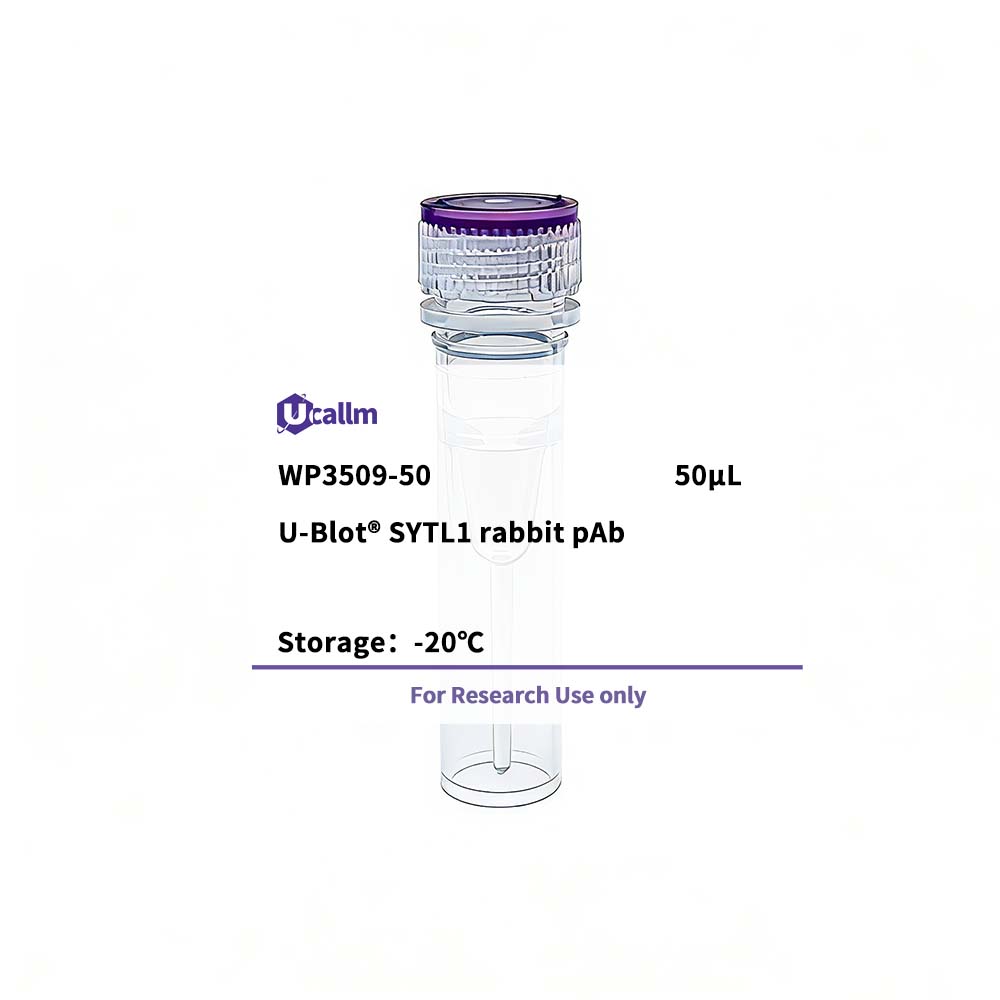
Price range: $268.00 through $328.00
Background:
| Size | 50μL/100μL |
| Target | SYTL1 |
| Reactivity | Human, Mouse |
| Applications | WB |
| MW(Calculated) | |
| MW(Observed) | 60kD |
| Host Species | Rabbit |
| Isotype | IgG |
| Conjugate/Modification | Unmodified |
| Recommended Dilution Ratio | WB 1:500-2000 |
| Formulation | Liquid in PBS containing 50% glycerol, 0.5% BSA and 0.02% sodium azide. |
| Purification | The antibody was affinity-purified from rabbit antiserum by affinity-chromatography using epitope-specific immunogen. |
| Storage | -15°C to -25°C/1 year(Do not lower than -25°C) |
| Concentration | 1 mg/ml |
| Clonality | Polyclonal |
| Clone Number | |
| Immunogen | Synthesized peptide derived from human SYTL1 AA range: 333-383 |
| Specificity | This antibody detects endogenous levels of SYTL1 at Human/Mouse |
| Gene Name | SYTL1 SLP1 SB146 |
| Protein Name | SYTL1 |
| Other Name | Synaptotagmin-like protein 1; / Exophilin-7; / Protein JFC1 |
| Species | Human |
| Gene ID | 84958 |
| Uniprot | Q8IYJ3, |
| Species.1 | Mouse |
| Gene ID.1 | |
| Uniprot.1 | Q99N80 |
| Species.2 | |
| Gene ID.2 | |
| Uniprot.2 | |
| Cellular Localization | Cell membrane; Peripheral membrane protein; Cytoplasmic side . Peripheral membrane protein tightly bound to the cytoplasmic side of cellular membranes. |
| Tissue Expression | Highly expressed in bone marrow and lymphoid tissues. Detected at lower levels in cerebellum, occipital lobe, prostate, stomach, kidney, appendix, lung and trachea. Expressed in cytotoxic T-lymphocytes (CTL). |
| Signaling_pathway | |
| Research Areas | |
| Function | Function:May act as Rab effector protein and play a role in vesicle trafficking (By similarity). Binds phosphatidylinositol 3,4,5-triphosphate.,similarity:Contains 1 C2 domain.,similarity:Contains 1 RabBD (Rab-binding) domain.,similarity:Contains 2 C2 domains.,subcellular location:Peripheral membrane protein tightly bound to the cytoplasmic side of cellular membranes.,subunit:Monomer. Binds NRXN1. Binds RAB27A that has been activated by GTP-binding via its N-terminus (By similarity). Binds NCF2.,tissue specificity:Highly expressed in bone marrow and lymphoid tissues. Detected at lower levels in cerebellum, occipital lobe, prostate, stomach, kidney, appendix, lung and trachea., |




