

U-Blot® TAGLN Rabbit mAb
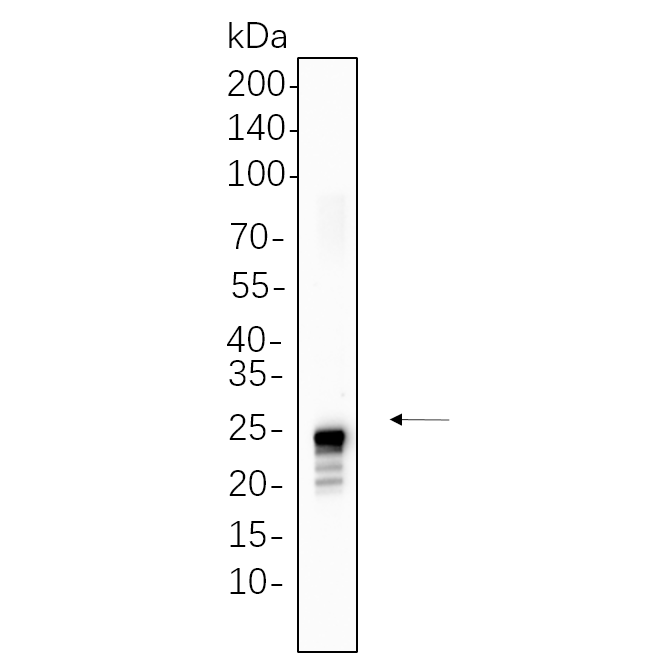
WR4277 Rat womb cell lysates were separated by 4-20% SDS-PAGE, and the membrane was blotted with primary antibody 1:1000. The HRP-conjugated Goat anti-Rabbit IgG(H + L) antibody was used to detect the antibody.
Price range: $268.00 through $328.00
Product details
Background:The protein encoded by this gene is a transformation and shape-change sensitive actin cross-linking/gelling protein found in fibroblasts and smooth muscle. Its expression is down-regulated in many cell lines, and this down-regulation may be an early and sensitive marker forThe onset of transformation. A functional role of this protein is unclear. Two transcript variants encodingThe same protein have been found for this gene. [provided by RefSeq, Jul 2008],
Specifications
| Size | 50μL/100μL |
| Target | TAGLN |
| Reactivity | Human, Mouse, Rat |
| Applications | WB, IHC, IF, ELISA |
| MW(Calculated) | 23kD |
| MW(Observed) | 23kD |
| Host Species | Rabbit |
| Isotype | IgG,Kappa |
| Conjugate/Modification | Unmodified |
| Recommended Dilution Ratio | IHC 1:200-1:1000; WB 1:2000-1:10000; IF 1:200-1:1000; ELISA 1:5000-1:20000; / Note: For IHC, we suggest antigen retrieval with TE buffer pH 9.0 (Cat#WT1004) |
| Formulation | PBS, 50% glycerol, 0.05% Proclin 300, 0.05%BSA |
| Purification | Recombinant Antibody expressed in animal component-free (ACF) media, purified via Protein A affinity chromatography. |
| Storage | -15°C to -25°C/1 year(Do not lower than -25°C) |
| Concentration | |
| Clonality | Monoclonal |
| Clone Number | RM0469R |
| Immunogen | The specific immunogen used to produce this antibody is proprietary information. |
| Specificity | Endogenous |
| Gene Name | TAGLN SM22 WS3-10 |
| Protein Name | Transgelin (22 kDa actin-binding protein) (Protein WS3-10) (Smooth muscle protein 22-alpha) (SM22-alpha) |
| Other Name | |
| Species | Human |
| Gene ID | 6876 |
| Uniprot | Q01995, |
| Species.1 | Mouse |
| Gene ID.1 | |
| Uniprot.1 | P37804, |
| Species.2 | Rat |
| Gene ID.2 | |
| Uniprot.2 | P31232 |
| Cellular Localization | Cytoplasm |
| Tissue Expression | Aorta,Bone marrow,Brain,Fibroblast,Human small intestine,Peripheral blood,Uterus,White Matter |
| Signaling_pathway | |
| Research Areas | |
| Function | Function:Actin cross-linking/gelling protein (By similarity). Involved in calcium interactions and contractile properties of the cell that may contribute to replicative senescence.,induction:Overexpressed in senescent human fibroblasts.,similarity:Belongs to the calponin family.,similarity:Contains 1 calponin-like repeat.,similarity:Contains 1 CH (calponin-homology) domain., |
Please login to post questions
Related products





