

U-Blot® TBK1 Rabbit mAb
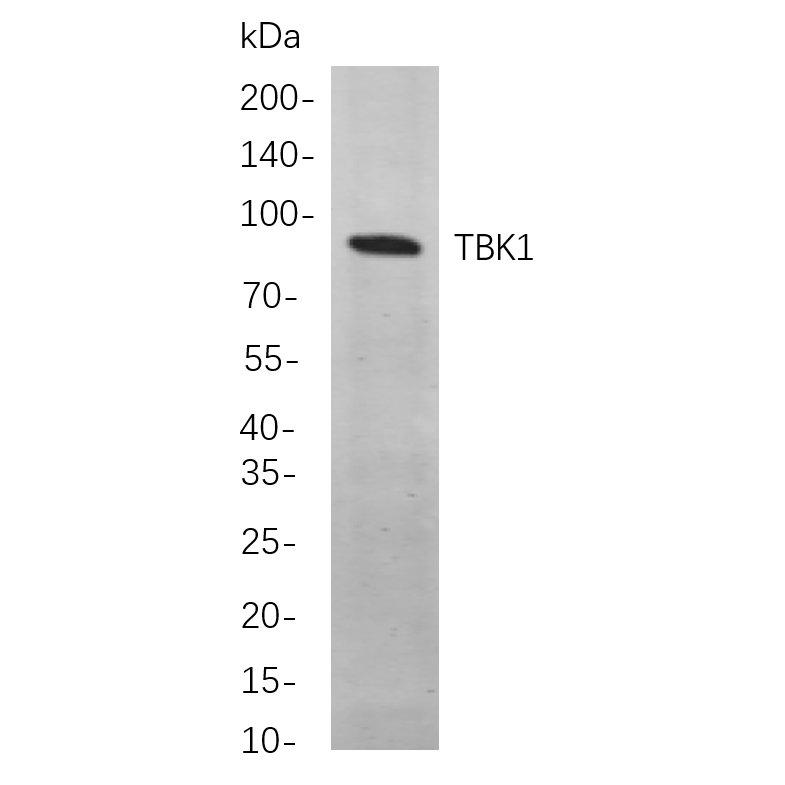
WR4295 Western blot analysis of lysates from Hela cells, using TBK1 Rabbit mAb. The HRP-conjugated Goat anti-Rabbit IgG antibody (WS0002) was used to detect the antibody.
Price range: $268.00 through $328.00
Product details
Background:The NF-kappa-B (NFKB) complex of proteins is inhibited by I-kappa-B (IKB) proteins, which inactivate NFKB by trapping it in the cytoplasm. Phosphorylation of serine residues on the IKB proteins by IKB kinases marks them for destruction via the ubiquitination pathway, thereby allowing activation and nuclear translocation of the NFKB complex. The protein encoded by this gene is similar to IKB kinases and can mediate NFKB activation in response to certain growth factors. [provided by RefSeq, Oct 2010],
Specifications
| Size | 50μL/100μL |
| Target | TBK1 |
| Reactivity | Human, Mouse, Rat |
| Applications | WB, IHC, IF, ELISA |
| MW(Calculated) | 84kD |
| MW(Observed) | 84kD |
| Host Species | Rabbit |
| Isotype | IgG,Kappa |
| Conjugate/Modification | Unmodified |
| Recommended Dilution Ratio | IHC 1:200-1:1000; WB 1:2000-1:10000; IF 1:200-1:1000; ELISA 1:5000-1:20000; / Note: For IHC, we suggest antigen retrieval with TE buffer pH 9.0 (Cat#WT1004) |
| Formulation | PBS, 50% glycerol, 0.05% Proclin 300, 0.05%BSA |
| Purification | Recombinant Antibody expressed in animal component-free (ACF) media, purified via Protein A affinity chromatography. |
| Storage | -15°C to -25°C/1 year(Do not lower than -25°C) |
| Concentration | |
| Clonality | Monoclonal |
| Clone Number | RM0490R |
| Immunogen | The specific immunogen used to produce this antibody is proprietary information. |
| Specificity | Endogenous |
| Gene Name | TBK1 |
| Protein Name | Serine/threonine-protein kinase TBK1 |
| Other Name | TBK1; / NAK; / Serine/threonine-protein kinase TBK1; / NF-kappa-B-activating kinase; / T2K; / TANK-binding kinase 1 |
| Species | Human |
| Gene ID | 29110 |
| Uniprot | Q9UHD2, |
| Species.1 | Mouse |
| Gene ID.1 | 56480 |
| Uniprot.1 | Q9WUN2 |
| Species.2 | |
| Gene ID.2 | |
| Uniprot.2 | |
| Cellular Localization | Cytoplasm |
| Tissue Expression | Ubiquitous with higher expression in testis. Expressed in the ganglion cells, nerve fiber layer and microvasculature of the retina. |
| Signaling_pathway | Cellular Processes >> Transport and catabolism >> Autophagy - animal;Cellular Processes >> Transport and catabolism >> Mitophagy - animal;Organismal Systems >> Immune system >> Toll-like receptor signaling pathway;Organismal Systems >> Immune system >> NOD-like receptor signaling pathway;Organismal Systems >> Immune system >> RIG-I-like receptor signaling pathway;Organismal Systems >> Immune system >> Cytosolic DNA-sensing pathway;Organismal Systems >> Immune system >> IL-17 signaling pathway;Human Diseases >> Neurodegenerative disease >> Amyotrophic lateral sclerosis;Human Diseases >> Neurodegenerative disease >> Pathways of neurodegeneration - multiple diseases;Environmental Information Processing >> Signal transduction >> Ras signaling pathway |
| Research Areas | >>Ras signaling pathway; / >>Mitophagy - animal; / >>Autophagy - animal; / >>Toll-like receptor signaling pathway; / >>NOD-like receptor signaling pathway; / >>RIG-I-like receptor signaling pathway; / >>Cytosolic DNA-sensing pathway; / >>IL-17 signaling pathway; / >>Alcoholic liver disease; / >>Amyotrophic lateral sclerosis; / >>Pathways of neurodegeneration - multiple diseases; / >>Shigellosis; / >>Yersinia infection; / >>Hepatitis C; / >>Hepatitis B; / >>Measles; / >>Human cytomegalovirus infection; / >>Influenza A; / >>Human papillomavirus infection; / >>Kaposi sarcoma-associated herpesvirus infection; / >>Herpes simplex virus 1 infection; / >>Epstein-Barr virus infection; / >>Human immunodeficiency virus 1 infection; / >>Coronavirus disease - COVID-19; / >>Lipid and atherosclerosis |
| Function | Catalytic activity:ATP + a protein = ADP + a phosphoprotein.,Function:Serine/threonine protein involved in the signaling cascade converging to the activation of the transcription factor NF-kappa-B. May function as an IKK kinase, playing an essential role in the transcription of a subset of TNF-alpha-induced genes. Also mediates production of RANTES/CCL5 and interferon-beta/IFNB1. Has a pivotal role in the innate immune response. Phosphorylates Borna disease virus (BDV) P protein. Phosphorylates and activates IRF3 and IRF7 and allows their nuclear localization. This leads to production of alpha/beta interferons and the development of a cellular antiviral state. It also seems to be a central factor in the induction of the antiviral interferon response. Inhibition of its interaction with IRF3, due to HCV NS3 binding or BDV P protein seems to be one mechanism of inhibition of the innate immune responses of hepatitis C virus (HCV) infection or Borna disease virus infection respectively.,similarity:Belongs to the protein kinase superfamily. Ser/Thr protein kinase family. I-kappa-B kinase subfamily.,similarity:Contains 1 protein kinase domain.,subunit:Interacts with TIRAP, TANK and TRAF2. Part of a ternary complex consisting of TANK, TRAF2 and TBK1. Interacts with AZI2. Interacts with SIKE. Interacts with TICAM1/TRIF, IRF3 and DDX58/RIG-I, interactions are disrupted by the interaction between TBK1 and SIKE. Interacts with HCV NS3, a hepatitis C virus protein and with BDV P protein, a Borna disease virus protein.,tissue specificity:Ubiquitous with higher expression in testis., |
Please login to post questions
Related products





