

Specifications
| Size | 50μL/100μL |
| Target | TFEB |
| Reactivity | Human, Mouse, Rat |
| Applications | WB, IHC, IF, IP, ELISA |
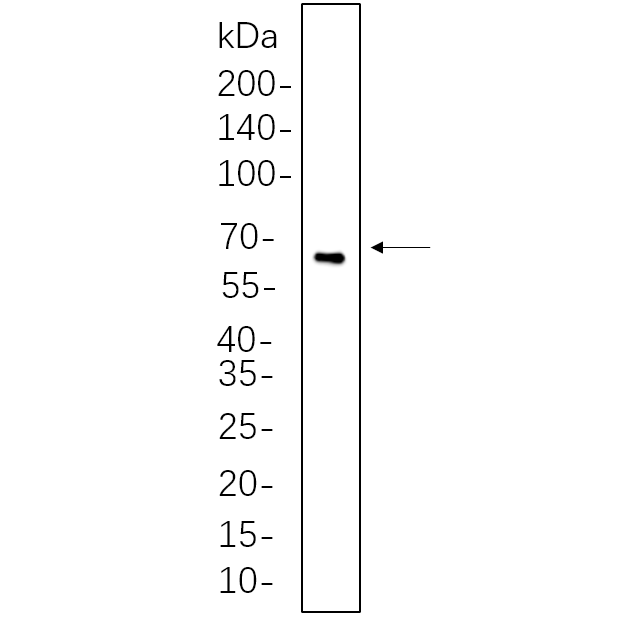
| MW(Calculated) | 53kD |
| MW(Observed) | 65-70kD |
| Host Species | Rabbit |
| Isotype | IgG,Kappa |
| Conjugate/Modification | Unmodified |
| Recommended Dilution Ratio | IHC 1:200-1:1000; WB 1:2000-1:10000; IF 1:200-1:1000; ELISA 1:5000-1:20000; IP 1:50-1:200; / Note: For IHC, we suggest antigen retrieval with TE buffer pH 9.0 (Cat#WT1004) |
| Formulation | PBS, 50% glycerol, 0.05% Proclin 300, 0.05%BSA |
| Purification | Recombinant Antibody expressed in animal component-free (ACF) media, purified via Protein A affinity chromatography. |
| Storage | -15°C to -25°C/1 year(Do not lower than -25°C) |
| Concentration | |
| Clonality | Monoclonal |
| Clone Number | RM0684R |
| Immunogen | The specific immunogen used to produce this antibody is proprietary information. |
| Specificity | Endogenous |
| Gene Name | TFEB BHLHE35 |
| Protein Name | Transcription factor EB (Class E basic helix-loop-helix protein 35) (bHLHe35) |
| Other Name | |
| Species | Human |
| Gene ID | 7942 |
| Uniprot | P19484, |
| Species.1 | Mouse |
| Gene ID.1 | 21425 |
| Uniprot.1 | Q9R210 |
| Species.2 | |
| Gene ID.2 | |
| Uniprot.2 | |
| Cellular Localization | Cytoplasm, Nucleus |
| Tissue Expression | |
| Signaling_pathway | Cellular Processes >> Transport and catabolism >> Mitophagy - animal;Environmental Information Processing >> Signal transduction >> Calcium signaling pathway |
| Research Areas | |
| Function | Transcription factor that acts as a master regulator of lysosomal biogenesis, autophagy, lysosomal exocytosis, lipid catabolism, energy metabolism and immune response . Specifically recognizes and binds E-box sequences (5'-CANNTG-3'); efficient DNA-binding requires dimerization with itself or with another MiT/TFE family member such as TFE3 or MITF . Involved in the cellular response to amino acid availability by acting downstream of MTOR: in the presence of nutrients, TFEB phosphorylation by MTOR promotes its cytosolic retention and subsequent inactivation . Upon starvation or lysosomal stress, inhibition of MTOR induces TFEB dephosphorylation, resulting in nuclear localization and transcription factor activity . Specifically recognizes and binds the CLEAR-box sequence (5'-GTCACGTGAC-3') present in the regulatory region of many lysosomal genes, leading to activate their expression, thereby playing a central role in expression of lysosomal genes . Regulates lysosomal positioning in response to nutrient deprivation by promoting the expression of PIP4P1 . Acts as a positive regulator of autophagy by promoting expression of genes involved in autophagy . In association with TFE3, activates the expression of CD40L in T-cells, thereby playing a role in T-cell-dependent antibody responses in activated CD4(+) T-cells and thymus-dependent humoral immunity (By similarity). Specifically recognizes the gamma-E3 box, a subset of E-boxes, present in the heavy-chain immunoglobulin enhancer . Plays a role in the signal transduction processes required for normal vascularization of the placenta (By similarity). Involved in the immune response to infection by the bacteria S.aureus or S.enterica, acting downstream of protein kinase D (PKD), probably by regulating cytokine and chemokine expression (By similarity). |





