

TRAC-1 Polyclonal Antibody
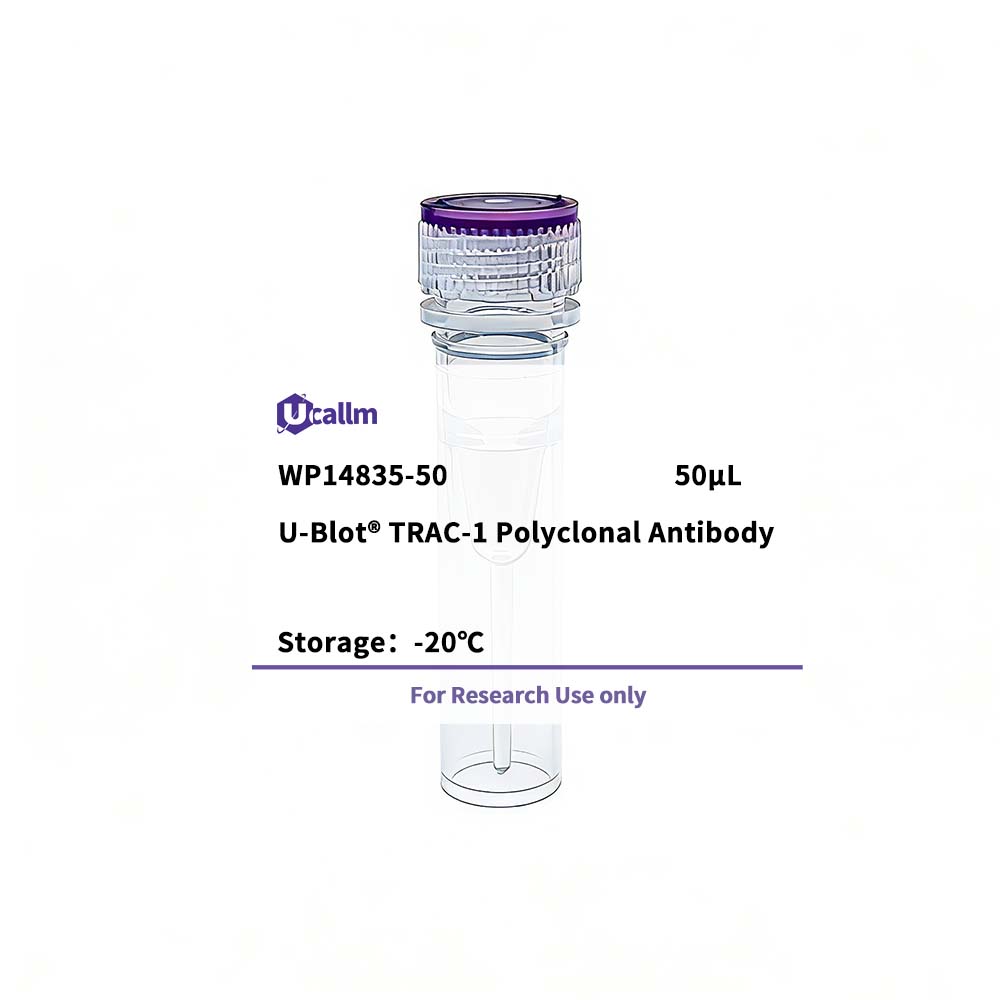
Ucallm_WP14835-50
Price range: $268.00 through $328.00
Product details
Background:
ring finger protein 125(RNF125) Homo sapiens This gene encodes a novel E3 ubiquitin ligase that contains a RING finger domain in the N-terminus and three zinc-binding and one ubiquitin-interacting motif in the C-terminus. As a result of myristoylation, this protein associates with membranes and is primarily localized to intracellular membrane systems. The encoded protein may function as a positive regulator in the T-cell receptor signaling pathway. [provided by RefSeq, Mar 2012],
Specifications
| Size | 50μL/100μL |
| Target | TRAC-1 |
| Reactivity | Human, Mouse, Rat |
| Applications | WB, IHC, IF, ELISA |
| MW(Calculated) | |
| MW(Observed) | 26kD |
| Host Species | Rabbit |
| Isotype | IgG |
| Conjugate/Modification | Unmodified |
| Recommended Dilution Ratio | WB 1:500-1:2000; IHC 1:100-1:300; ELISA 1:10000; IF 1:50-200 / Note: For IHC, we suggest antigen retrieval with TE buffer pH 9.0 (Cat#WT1004) |
| Formulation | Liquid in PBS containing 50% glycerol, 0.5% BSA and 0.02% sodium azide. |
| Purification | The antibody was affinity-purified from rabbit antiserum by affinity-chromatography using epitope-specific immunogen. |
| Storage | -15°C to -25°C/1 year(Do not lower than -25°C) |
| Concentration | 1 mg/ml |
| Clonality | Polyclonal |
| Clone Number | |
| Immunogen | The antiserum was produced against synthesized peptide derived from human RNF125. AA range:131-180 |
| Specificity | TRAC-1 Polyclonal Antibody detects endogenous levels of TRAC-1 protein. |
| Gene Name | RNF125 |
| Protein Name | E3 ubiquitin-protein ligase RNF125 |
| Other Name | RNF125; / E3 ubiquitin-protein ligase RNF125; / RING finger protein 125; / T-cell RING activation protein 1; / TRAC-1 |
| Species | Human |
| Gene ID | 54941 |
| Uniprot | Q96EQ8, |
| Species.1 | Mouse |
| Gene ID.1 | 67664 |
| Uniprot.1 | Q9D9R0 |
| Species.2 | |
| Gene ID.2 | |
| Uniprot.2 | |
| Cellular Localization | Golgi apparatus membrane; Lipid-anchor . Shows a reticular staining pattern within the cell and is probably expressed at other intracellular membranes in addition to the Golgi membrane. Not detected at the plasma membrane. . |
| Tissue Expression | Predominantly expressed in lymphoid tissues, including bone marrow, spleen and thymus. Also weakly expressed in other tissues. Predominant in the CD4(+) and CD8(+) T-cells, suggesting that it is preferentially confined to T-cells. |
| Signaling_pathway | Organismal Systems >> Immune system >> RIG-I-like receptor signaling pathway |
| Research Areas | >>RIG-I-like receptor signaling pathway |
| Function | Function:E3 ubiquitin-protein ligase that acts as a positive regulator of T-cell activation. E3 ligase proteins mediate ubiquitination and subsequent proteasomal degradation of target proteins.,pathway:Protein modification; protein ubiquitination.,similarity:Contains 1 RING-type zinc finger.,tissue specificity:Predominantly expressed in lymphoid tissues, including bone marrow, spleen and thymus. Also weakly expressed in other tissues. Predominant in the CD4+ and CD8+ T-cells, suggesting that it is preferentially confined to T-cells., |
Please login to post questions
Related products




