


TRBP rabbit pAb
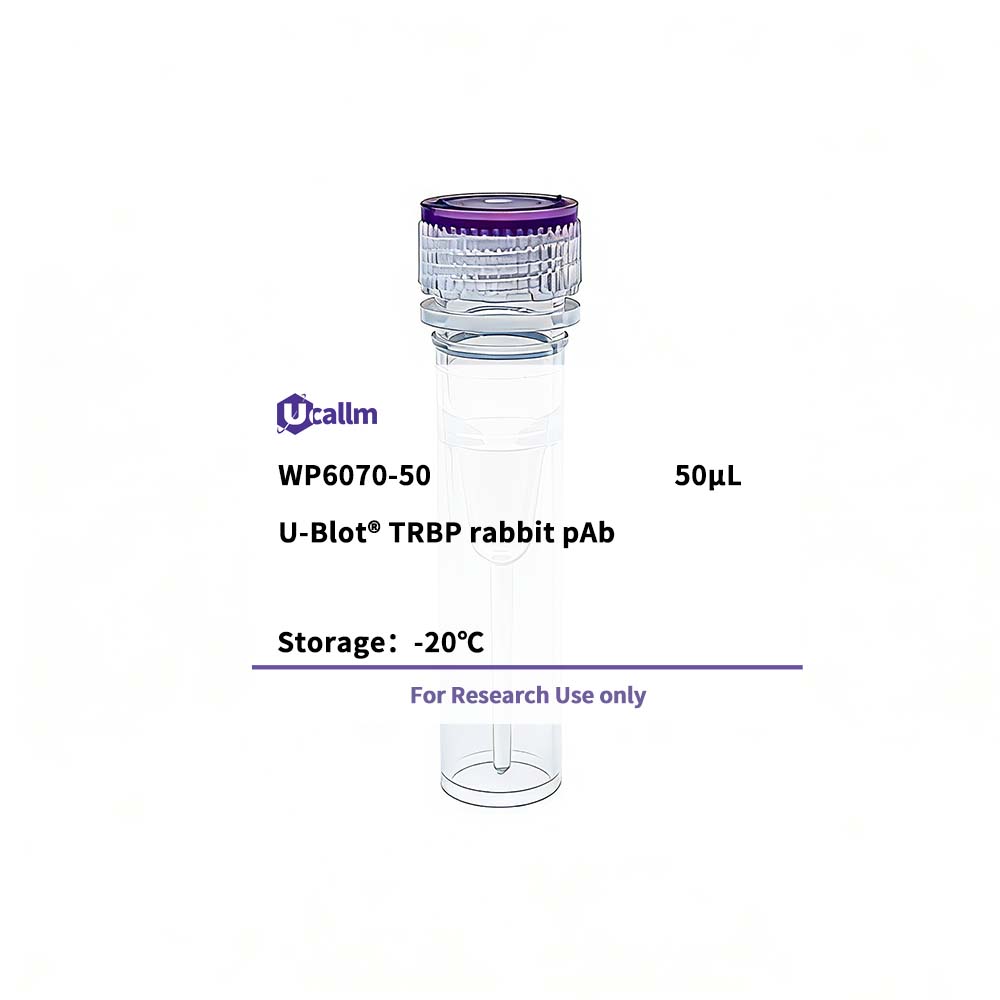
Ucallm_WP6070-50
Price range: $268.00 through $328.00
Product details
Background:
Specifications
| Size | 50μL/100μL |
| Target | TARBP2 |
| Reactivity | Human, Mouse, Rat |
| Applications | WB |
| MW(Calculated) | 40kD |
| MW(Observed) | |
| Host Species | Rabbit |
| Isotype | IgG |
| Conjugate/Modification | Unmodified |
| Recommended Dilution Ratio | WB 1:500-2000 |
| Formulation | Liquid in PBS containing 50% glycerol, 0.5% BSA and 0.02% sodium azide. |
| Purification | The antibody was affinity-purified from rabbit antiserum by affinity-chromatography using epitope-specific immunogen. |
| Storage | -15°C to -25°C/1 year(Do not lower than -25°C) |
| Concentration | 1 mg/ml |
| Clonality | Polyclonal |
| Clone Number | |
| Immunogen | Synthesized peptide derived from human TRBP |
| Specificity | This antibody detects endogenous levels of TRBP at Human, Mouse,Rat |
| Gene Name | TARBP2 TRBP |
| Protein Name | RISC-loading complex subunit TARBP2 (TAR RNA-binding protein 2) (Trans-activation-responsive RNA-binding protein) |
| Other Name | |
| Species | Human |
| Gene ID | 6895 |
| Uniprot | Q15633, |
| Species.1 | Mouse |
| Gene ID.1 | 21357 |
| Uniprot.1 | P97473, |
| Species.2 | Rat |
| Gene ID.2 | 363006 |
| Uniprot.2 | Q3SWU0 |
| Cellular Localization | Cytoplasm. Cytoplasm, perinuclear region. Nucleus. |
| Tissue Expression | |
| Signaling_pathway | |
| Research Areas | |
| Function | Required for formation of the RNA induced silencing complex (RISC). Component of the RISC loading complex (RLC), also known as the micro-RNA (miRNA) loading complex (miRLC), which is composed of DICER1, AGO2 and TARBP2. Within the RLC/miRLC, DICER1 and TARBP2 are required to process precursor miRNAs (pre-miRNAs) to mature miRNAs and then load them onto AGO2. AGO2 bound to the mature miRNA constitutes the minimal RISC and may subsequently dissociate from DICER1 and TARBP2. May also play a role in the production of short interfering RNAs (siRNAs) from double-stranded RNA (dsRNA) by DICER1.; (Microbial infection) Binds to the HIV-1 TAR RNA which is located in the long terminal repeat (LTR) of HIV-1, and stimulates translation of TAR-containing RNAs . This is achieved in part at least by binding to and inhibiting EIF2AK2/PKR, thereby reducing phosphorylation and inhibition of EIF2S1/eIF-2-alpha . May also promote translation of TAR-containing RNAs independently of EIF2AK2/PKR . Mediates recruitment of FTSJ3 methyltransferase to HIV-1 RNA, leading to 2'-O-methylation of the viral genome, allowing HIV-1 to escape the innate immune system . |
Please login to post questions
Related products





