


TREX1 rabbit pAb
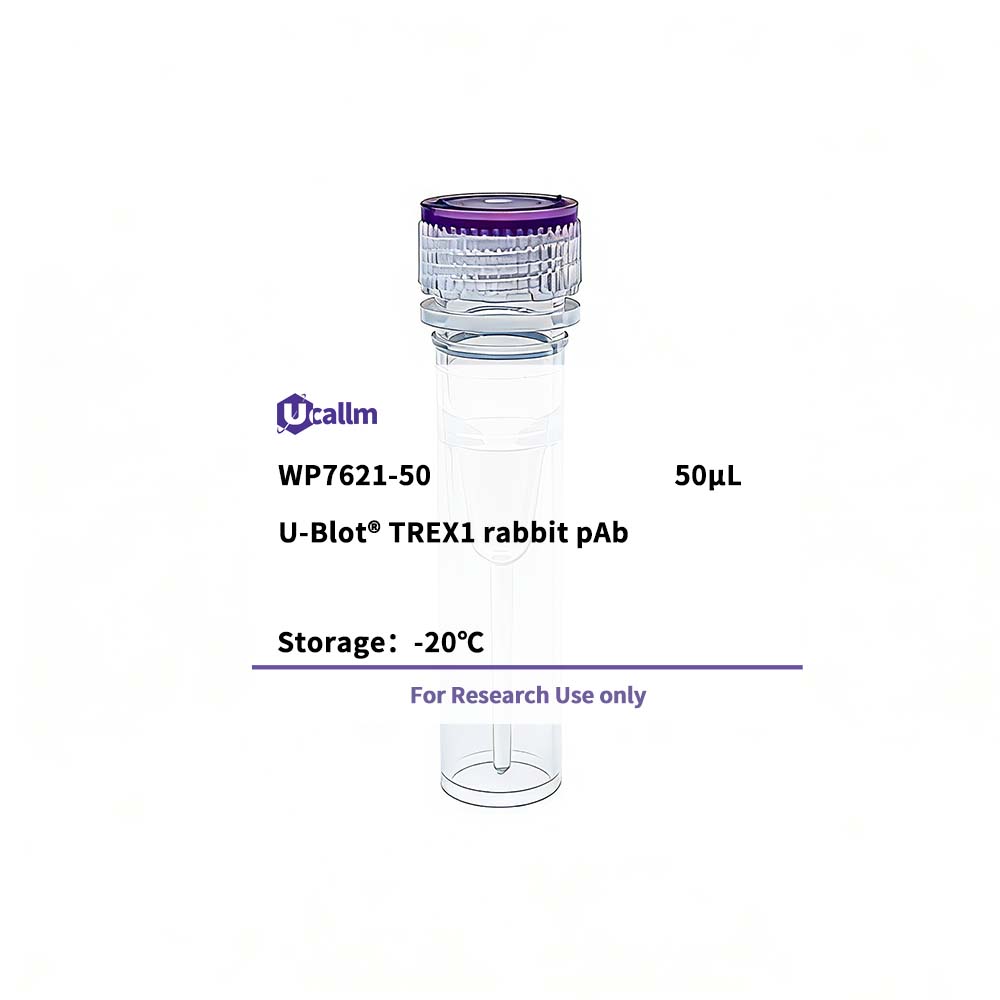
Ucallm_WP7621-50
Price range: $268.00 through $328.00
Product details
Background:
Specifications
| Size | 50μL/100μL |
| Target | TREX1 |
| Reactivity | Human, Mouse |
| Applications | WB |
| MW(Calculated) | 35kD |
| MW(Observed) | |
| Host Species | Rabbit |
| Isotype | IgG |
| Conjugate/Modification | Unmodified |
| Recommended Dilution Ratio | WB 1:500-2000 |
| Formulation | Liquid in PBS containing 50% glycerol, 0.5% BSA and 0.02% sodium azide. |
| Purification | The antibody was affinity-purified from rabbit antiserum by affinity-chromatography using epitope-specific immunogen. |
| Storage | -15°C to -25°C/1 year(Do not lower than -25°C) |
| Concentration | 1 mg/ml |
| Clonality | Polyclonal |
| Clone Number | |
| Immunogen | Synthesized peptide derived from human TREX1 |
| Specificity | This antibody detects endogenous levels of TREX1 at Human, Mouse |
| Gene Name | TREX1 |
| Protein Name | Three prime repair exonuclease 1 (3'-5' exonuclease TREX1) (DNase III) |
| Other Name | |
| Species | Human |
| Gene ID | 11277 |
| Uniprot | Q9NSU2, |
| Species.1 | Mouse |
| Gene ID.1 | 22040 |
| Uniprot.1 | Q91XB0 |
| Species.2 | |
| Gene ID.2 | |
| Uniprot.2 | |
| Cellular Localization | Nucleus . Cytoplasm, cytosol . Endoplasmic reticulum membrane; Peripheral membrane protein . Retained in the cytoplasm through the C-terminal region (By similarity). Localization to the endoplasmic reticulum membrane is required to direct TREX1 to ruptured micronuclei (PubMed:33476576). In response to DNA damage, translocates to the nucleus where it is specifically recruited to replication foci (PubMed:16818237). Translocation to the nucleus also occurs during GZMA-mediated cell death (PubMed:16818237). . |
| Tissue Expression | Detected in thymus, spleen, liver, brain, heart, small intestine and colon. |
| Signaling_pathway | Organismal Systems >> Immune system >> Cytosolic DNA-sensing pathway |
| Research Areas | |
| Function | Major cellular 3'-to-5' DNA exonuclease which digests single-stranded DNA (ssDNA) and double-stranded DNA (dsDNA) with mismatched 3' termini . Prevents cell-intrinsic initiation of autoimmunity . Acts by metabolizing DNA fragments from endogenous retroelements, including L1, LTR and SINE elements . Plays a key role in degradation of DNA fragments at cytosolic micronuclei arising from genome instability: its association with the endoplasmic reticulum membrane directs TREX1 to ruptured micronuclei, leading to micronuclear DNA degradation . Micronuclear DNA degradation is required to limit CGAS activation and subsequent inflammation . Unless degraded, these DNA fragments accumulate in the cytosol and activate the cGAS-STING innate immune signaling, leading to the production of type I interferon . Prevents chronic ATM-dependent checkpoint activation, by processing ssDNA polynucleotide species arising from the processing of aberrant DNA replication intermediates . Inefficiently degrades oxidized DNA, such as that generated upon antimicrobial reactive oxygen production or upon absorption of UV light . During GZMA-mediated cell death, contributes to DNA damage in concert with NME1 . NME1 nicks one strand of DNA and TREX1 removes bases from the free 3' end to enhance DNA damage and prevent DNA end reannealing and rapid repair . |
Please login to post questions
Related products





