


TRIO Polyclonal Antibody
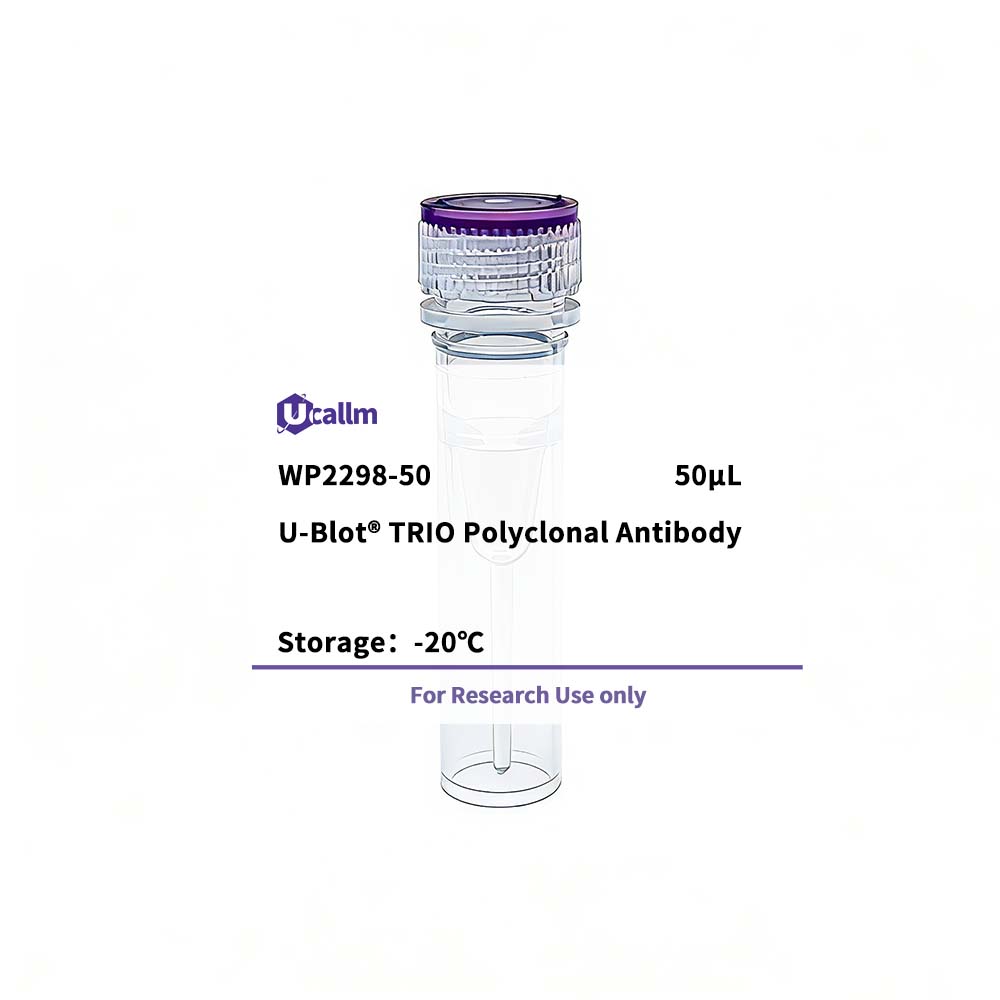
Ucallm_WP2298-50
Price range: $268.00 through $328.00
Product details
Background:
This gene encodes a large protein that functions as a GDP to GTP exchange factor. This protein promotes the reorganization of the actin cytoskeleton, thereby playing a role in cell migration and growth. Alternative splicing results in multiple transcript variants. [provided by RefSeq, Dec 2015],
Specifications
| Size | 50μL/100μL |
| Target | TRIO |
| Reactivity | Human, Mouse |
| Applications | IHC, IF |
| MW(Calculated) | |
| MW(Observed) | 340kD |
| Host Species | Rabbit |
| Isotype | IgG |
| Conjugate/Modification | Unmodified |
| Recommended Dilution Ratio | IHC 1:50-300; IF 1:50-200 / Note: For IHC, we suggest antigen retrieval with TE buffer pH 9.0 (Cat#WT1004) |
| Formulation | Liquid in PBS containing 50% glycerol,0.5% BSA and 0.02% sodium azide. |
| Purification | The antibody was affinity-purified from rabbit antiserum by affinity-chromatography using epitope-specific immunogen. |
| Storage | -15°C to -25°C/1 year(Do not lower than -25°C) |
| Concentration | 1 mg/ml |
| Clonality | Polyclonal |
| Clone Number | |
| Immunogen | Synthesized peptide derived from part region of human protein |
| Specificity | TRIO Polyclonal Antibody detects endogenous levels of protein. |
| Gene Name | TRIO |
| Protein Name | Triple functional domain protein (PTPRF-interacting protein) |
| Other Name | |
| Species | Human |
| Gene ID | 7204 |
| Uniprot | O75962, |
| Species.1 | Mouse |
| Gene ID.1 | |
| Uniprot.1 | Q0KL02 |
| Species.2 | |
| Gene ID.2 | |
| Uniprot.2 | |
| Cellular Localization | Cytoplasm . Cell projection . |
| Tissue Expression | Widely expressed, with highest levels in heart, skeletal muscle, and brain. |
| Signaling_pathway | |
| Research Areas | |
| Function | Catalytic activity:ATP + a protein = ADP + a phosphoprotein.,Domain:The N-terminal DBL/GEF domain specifically catalyzes nucleotide exchange for RAC1, leading to the activation of Jun kinase and the production of membrane ruffles. The second DBL/GEF domain is an exchange factor for rhoa and induces the formation of stress fibers.,Function:Promotes the exchange of GDP by GTP. Together with leukocyte antigen-related (LAR) protein, it could play a role in coordinating cell-matrix and cytoskeletal rearrangements necessary for cell migration and cell growth.,PTM:Phosphorylated on serine residue(s).,similarity:Belongs to the protein kinase superfamily. CAMK Ser/Thr protein kinase family.,similarity:Contains 1 CRAL-TRIO domain.,similarity:Contains 1 Ig-like C2-type (immunoglobulin-like) domain.,similarity:Contains 1 protein kinase domain.,similarity:Contains 2 DH (DBL-homology) domains.,similarity:Contains 2 PH domains.,similarity:Contains 2 SH3 domains.,similarity:Contains 4 spectrin repeats.,subunit:Interacts to form a complex with leukocyte antigen related protein.,tissue specificity:Highly expressed in heart, skeletal muscle, brain, pancreas, placenta, liver, kidney and lung., |
Please login to post questions
Related products





