SKU: WR5148 Categories: ,

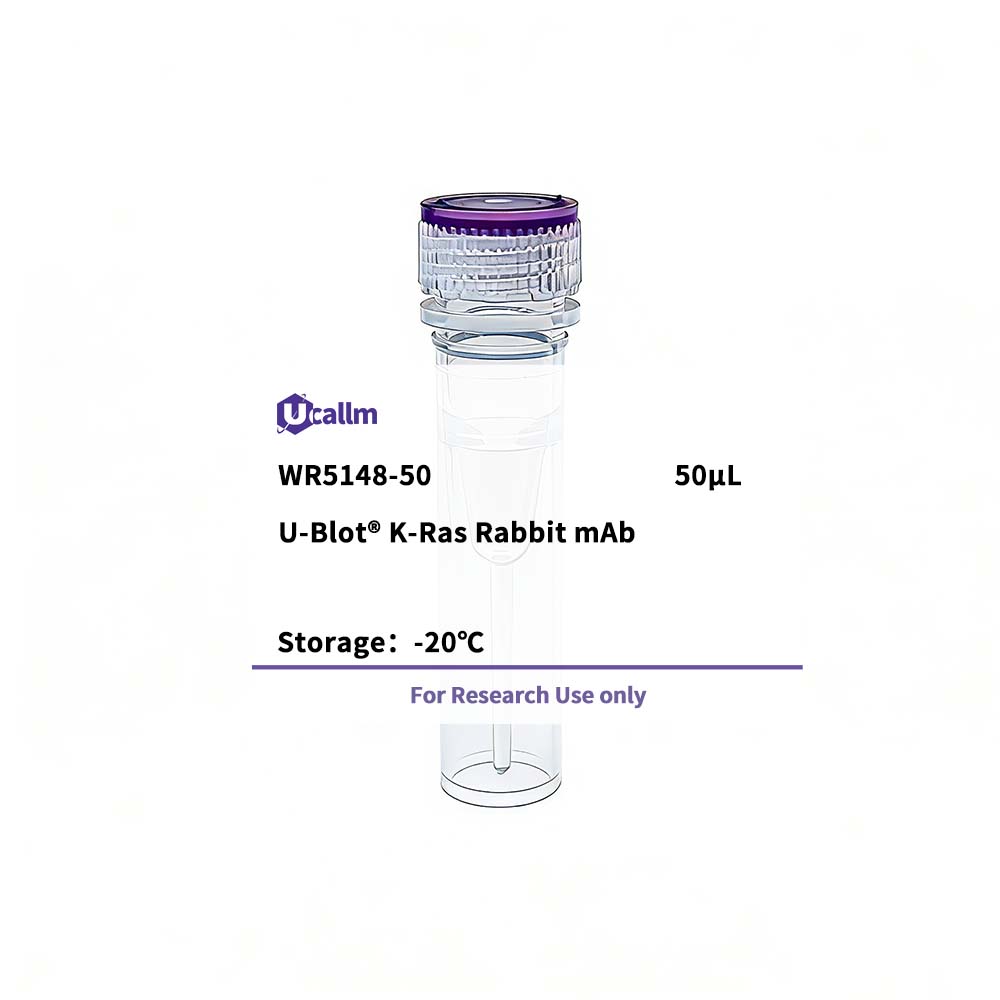
U-Blot® K-Ras Rabbit mAb

Price range: $268.00 through $328.00

SKU: WR5148-50
Enter the quantity you would like, or drag the panel to find the quantity and price that best for you
Bulk QuoteAuthorize OEM & ODM

Product details

Background:This gene, a Kirsten ras oncogene homolog from the mammalian ras gene family, encodes a protein that is a member of the small GTPase superfamily. A single amino acid substitution is responsible for an activating mutation. The transforming protein that results is implicated in various malignancies, including lung adenocarcinoma, mucinous adenoma, ductal carcinoma of the pancreas and colorectal carcinoma. Alternative splicing leads to variants encoding two isoforms that differ in the C-terminal region. [provided by RefSeq, Jul 2008],

Specifications

Size50μL/100μL
TargetK-Ras
ReactivityHuman, Mouse, Rat
ApplicationsWB, IHC, IF, ELISA
MW(Calculated)22kD
MW(Observed)22kD
Host SpeciesRabbit
IsotypeIgG,Kappa
Conjugate/ModificationUnmodified
Recommended Dilution RatioIHC 1:100-1:500; WB 1:2000-1:10000; IF 1:200-1:1000; ELISA 1:5000-1:20000; / Note: For IHC, we suggest antigen retrieval with TE buffer pH 9.0 (Cat#WT1004)
FormulationPBS, 50% glycerol, 0.05% Proclin 300, 0.05%BSA
PurificationRecombinant Antibody expressed in animal component-free (ACF) media, purified via Protein A affinity chromatography.
Storage-15°C to -25°C/1 year(Do not lower than -25°C)
Concentration
ClonalityMonoclonal
Clone NumberRM1378R
ImmunogenThe specific immunogen used to produce this antibody is proprietary information.
SpecificityEndogenous
Gene NameKRAS
Protein Namev-Ki-ras2 Kirsten rat sarcoma viral oncogene homolog
Other NameGTPase KRas; / K-Ras 2; / Ki-Ras; / c-K-ras; / c-Ki-ras
SpeciesHuman
Gene ID3845
UniprotP01116,
Species.1Mouse
Gene ID.116653
Uniprot.1P32883,
Species.2Rat
Gene ID.2
Uniprot.2P08644
Cellular LocalizationCell membrane; Lipid-anchor; Cytoplasmic side . Endomembrane system . Cytoplasm, cytosol .; [Isoform 2B]: Cell membrane; Lipid-anchor .
Tissue ExpressionBrain,Cervix carcinoma,Colon carcinoma,Gallbladder tumor,Lung,Lung carcinom
Signaling_pathwayCellular Processes >> Transport and catabolism >> Autophagy - animal;Cellular Processes >> Transport and catabolism >> Mitophagy - animal;Cellular Processes >> Cell growth and death >> Apoptosis;Cellular Processes >> Cell growth and death >> Cellular senescence;Cellular Processes >> Cellular community - eukaryotes >> Gap junction;Cellular Processes >> Cellular community - eukaryotes >> Signaling pathways regulating pluripotency of stem cells;Cellular Processes >> Cell motility >> Regulation of actin cytoskeleton;Organismal Systems >> Immune system >> Natural killer cell mediated cytotoxicity;Organismal Systems >> Immune system >> T cell receptor signaling pathway;Organismal Systems >> Immune system >> B cell receptor signaling pathway;Organismal Systems >> Immune system >> Fc epsilon RI signaling pathway;Organismal Systems >> Immune system >> Chemokine signaling pathway;Organismal Systems >> Endocrine system >> Insulin signaling pathway;Organismal Systems >> Endocrine system >> GnRH signaling pathway;Organismal Systems >> Endocrine system >> Estrogen signaling pathway;Organismal Systems >> Endocrine system >> Prolactin signaling pathway;Organismal Systems >> Endocrine system >> Oxytocin signaling pathway;Organismal Systems >> Endocrine system >> Relaxin signaling pathway;Organismal Systems >> Endocrine system >> Growth hormone synthesis, secretion and action;Organismal Systems >> Endocrine system >> Thyroid hormone signaling pathway;Organismal Systems >> Nervous system >> Cholinergic synapse;Organismal Systems >> Nervous system >> Neurotrophin signaling pathway;Organismal Systems >> Aging >> Longevity regulating pathway;Organismal Systems >> Aging >> Longevity regulating pathway - multiple species;Human Diseases >> Cancer: overview >> Pathways in cancer;Human Diseases >> Cancer: overview >> MicroRNAs in cancer;Human Diseases >> Cancer: overview >> Central carbon metabolism in cancer;Human Diseases >> Cancer: overview >> PD-L1 expression and PD-1 checkpoint pathway in cancer;Human Diseases >> Cancer: specific types >> Colorectal cancer;Human Diseases >> Cancer: specific types >> Pancreatic cancer;Human Diseases >> Cancer: specific types >> Hepatocellular carcinoma;Human Diseases >> Cancer: specific types >> Gastric cancer;Human Diseases >> Cancer: specific types >> Glioma;Human Diseases >> Cancer: specific types >> Thyroid cancer;Human Diseases >> Cancer: specific types >> Acute myeloid leukemia;Human Diseases >> Cancer: specific types >> Chronic myeloid leukemia;Human Diseases >> Cancer: specific types >> Melanoma;Human Diseases >> Cancer: specific types >> Renal cell carcinoma;Human Diseases >> Cancer: specific types >> Bladder cancer;Human Diseases >> Cancer: specific types >> Prostate cancer;Human Diseases >> Cancer: specific types >> Endometrial cancer;Human Diseases >> Cancer: specific types >> Breast cancer;Human Diseases >> Cancer: specific types >> Non-small cell lung cancer;Human Diseases >> Neurodegenerative disease >> Alzheimer disease;Human Diseases >> Neurodegenerative disease >> Pathways of neurodegeneration - multiple diseases;Environmental Information Processing >> Signal transduction >> MAPK signaling pathway;Environmental Information Processing >> Signal transduction >> ErbB signaling pathway;Environmental Information Processing >> Signal transduction >> Ras signaling pathway;Environmental Information Processing >> Signal transduction >> Rap1 signaling pathway;Environmental Information Processing >> Signal transduction >> VEGF signaling pathway;Environmental Information Processing >> Signal transduction >> Apelin signaling pathway;Environmental Information Processing >> Signal transduction >> FoxO signaling pathway;Environmental Information Processing >> Signal transduction >> Phospholipase D signaling pathway;Environmental Information Processing >> Signal transduction >> Sphingolipid signaling pathway;Environmental Information Processing >> Signal transduction >> PI3K-Akt signaling pathway;Environmental Information Processing >> Signal transduction >> mTOR signaling pathway
Research Areas>>EGFR tyrosine kinase inhibitor resistance; / >>Endocrine resistance; / >>MAPK signaling pathway; / >>ErbB signaling pathway; / >>Ras signaling pathway; / >>Rap1 signaling pathway; / >>Chemokine signaling pathway; / >>FoxO signaling pathway; / >>Sphingolipid signaling pathway; / >>Phospholipase D signaling pathway; / >>Mitophagy - animal; / >>Autophagy - animal; / >>mTOR signaling pathway; / >>PI3K-Akt signaling pathway; / >>Apoptosis; / >>Longevity regulating pathway; / >>Longevity regulating pathway - multiple species; / >>Cellular senescence; / >>Axon guidance; / >>VEGF signaling pathway; / >>Apelin signaling pathway; / >>Gap junction; / >>Signaling pathways regulating pluripotency of stem cells; / >>C-type lectin receptor signaling pathway; / >>Natural killer cell mediated cytotoxicity; / >>T cell receptor signaling pathway; / >>B cell receptor signaling pathway; / >>Fc epsilon RI signaling pathway; / >>Thermogenesis; / >>Long-term potentiation; / >>Neurotrophin signaling pathway; / >>Cholinergic synapse; / >>Serotonergic synapse; / >>Long-term depression; / >>Regulation of actin cytoskeleton; / >>Insulin signaling pathway; / >>GnRH signaling pathway; / >>Progesterone-mediated oocyte maturation; / >>Estrogen signaling pathway; / >>Melanogenesis; / >>Prolactin signaling pathway; / >>Thyroid hormone signaling pathway; / >>Oxytocin signaling pathway; / >>Relaxin signaling pathway; / >>GnRH secretion; / >>AGE-RAGE signaling pathway in diabetic complications; / >>Growth hormone synthesis, secretion and action; / >>Aldosterone-regulated sodium reabsorption; / >>Alzheimer disease; / >>Pathways of neurodegeneration - multiple diseases; / >>Alcoholism; / >>Hepatitis C; / >>Hepatitis B; / >>Human cytomegalovirus infection; / >>Human papillomavirus infection; / >>Human T-cell leukemia virus 1 infection; / >>Kaposi sarcoma-associated herpesvirus infection; / >>Human immunodeficiency virus 1 infection; / >>Pathways in cancer; / >>Viral carcinogenesis; / >>Proteoglycans in cancer; / >>MicroRNAs in cancer; / >>Chemical carcinogenesis - receptor activation; / >>Chemical carcinogenesis - reactive oxygen species; / >>Colorectal cancer; / >>Renal cell carcinoma; / >>Pancreatic cancer; / >>Endometrial cancer; / >>Glioma; / >>Prostate cancer; / >>Thyroid cancer; / >>Melanoma; / >>Bladder cancer; / >>Chronic myeloid leukemia; / >>Acute myeloid leukemia; / >>Non-small cell lung cancer; / >>Breast cancer; / >>Hepatocellular carcinoma; / >>Gastric cancer; / >>Central carbon metabolism in cancer; / >>Choline metabolism in cancer; / >>PD-L1 expression and PD-1 checkpoint pathway in cancer; / >>Lipid and atherosclerosis
FunctionAlternative products:Isoforms differ in the C-terminal region which is encoded by two alternative exons (IVA and IVB),Disease:Defects in KRAS are a cause of acute myelogenous leukemia (AML) [MIM:601626]. AML is a malignant disease in which hematopoietic precursors are arrested in an early stage of development.,Disease:Defects in KRAS are a cause of cardiofaciocutaneous syndrome (CFC syndrome) [MIM:115150]; also known as cardio-facio-cutaneous syndrome. CFC syndrome is characterized by a distinctive facial appearance, heart defects and mental retardation. Heart defects include pulmonic stenosis, atrial septal defects and hypertrophic cardiomyopathy. Some affected individuals present with ectodermal abnormalities such as sparse, friable hair, hyperkeratotic skin lesions and a generalized ichthyosis-like condition. Typical facial features are similar to Noonan syndrome. They include high forehead with bitemporal constriction, hypoplastic supraorbital ridges, downslanting palpebral fissures, a depressed nasal bridge, and posteriorly angulated ears with prominent helices. The inheritance of CFC syndrome is autosomal dominant.,Disease:Defects in KRAS are a cause of juvenile myelomonocytic leukemia (JMML) [MIM:607785]. JMML is a pediatric myelodysplastic syndrome that constitutes approximately 30% of childhood cases of myelodysplastic syndrome (MDS) and 2% of leukemia. It is characterized by leukocytosis with tissue infiltration and in vitro hypersensitivity of myeloid progenitors to granulocyte-macrophage colony stimulating factor.,Disease:Defects in KRAS are the cause of Noonan syndrome 3 (NS3) [MIM:609942]. Noonan syndrome (NS) [MIM:163950] is a disorder characterized by dysmorphic facial features, short stature, hypertelorism, cardiac anomalies, deafness, motor delay, and a bleeding diathesis. It is a genetically heterogeneous and relatively common syndrome, with an estimated incidence of 1 in 1000-2500 live births. Rarely, NS is associated with juvenile myelomonocytic leukemia (JMML). NS3 inheritance is autosomal dominant.,Disease:KRAS mutations are involved in cancer development.,enzyme regulation:Alternate between an inactive form bound to GDP and an active form bound to GTP. Activated by a guanine nucleotide-exchange factor (GEF) and inactivated by a GTPase-activating protein (GAP).,Function:Ras proteins bind GDP/GTP and possess intrinsic GTPase activity.,online information:The Singapore human mutation and polymorphism database,similarity:Belongs to the small GTPase superfamily. Ras family.,subunit:Interacts with PHLPP.,
Please login to post questions
Back to Top
Product has been added to your cart


