

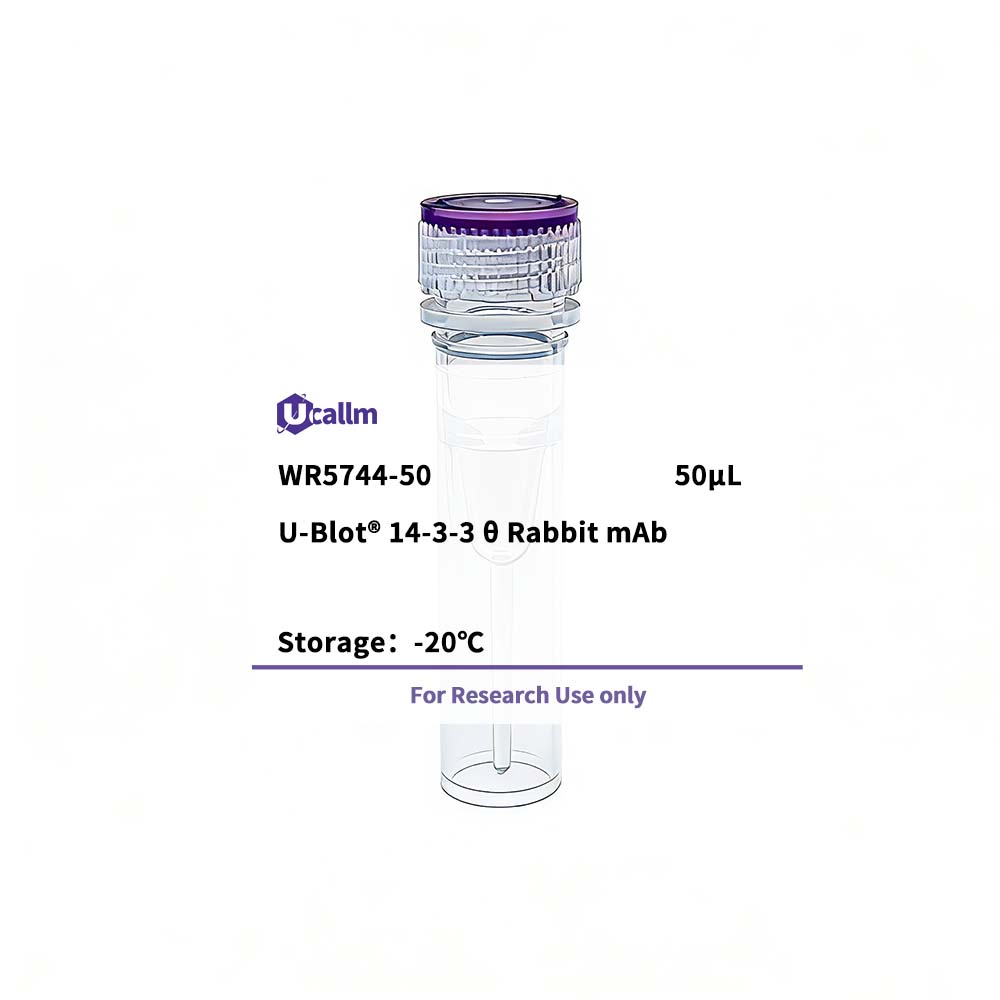
Specifications
| Size | 50μL/100μL |
| Target | 14-3-3 θ |
| Reactivity | Human, Mouse, Rat |
| Applications | WB, IHC, IF, ELISA |
| MW(Calculated) | 28kD |
| MW(Observed) | 28kD |
| Host Species | Rabbit |
| Isotype | IgG,Kappa |
| Conjugate/Modification | Unmodified |
| Recommended Dilution Ratio | IHC 1:200-1:1000; WB 1:2000-1:10000; IF 1:200-1:1000; ELISA 1:5000-1:20000; / Note: For IHC, we suggest antigen retrieval with TE buffer pH 9.0 (Cat#WT1004) |
| Formulation | PBS, 50% glycerol, 0.05% Proclin 300, 0.05%BSA |
| Purification | Recombinant Antibody expressed in animal component-free (ACF) media, purified via Protein A affinity chromatography. |
| Storage | -15°C to -25°C/1 year(Do not lower than -25°C) |
| Concentration | |
| Clonality | Monoclonal |
| Clone Number | RM1706R |
| Immunogen | The specific immunogen used to produce this antibody is proprietary information. |
| Specificity | Endogenous |
| Gene Name | YWHAQ |
| Protein Name | 14-3-3 protein theta |
| Other Name | YWHAQ; / 14-3-3 protein theta; / 14-3-3 protein T-cell; / 14-3-3 protein tau; / Protein HS1 |
| Species | Human |
| Gene ID | 10971 |
| Uniprot | P27348, |
| Species.1 | Mouse |
| Gene ID.1 | 22630 |
| Uniprot.1 | P68254, |
| Species.2 | Rat |
| Gene ID.2 | 25577 |
| Uniprot.2 | P68255 |
| Cellular Localization | Cytoplasm. In neurons, axonally transported to the nerve terminals. |
| Tissue Expression | Abundantly expressed in brain, heart and pancreas, and at lower levels in kidney and placenta. Up-regulated in the lumbar spinal cord from patients with sporadic amyotrophic lateral sclerosis (ALS) compared with controls, with highest levels of expression in individuals with predominant lower motor neuron involvement. |
| Signaling_pathway | Cellular Processes >> Cell growth and death >> Cell cycle;Environmental Information Processing >> Signal transduction >> Hippo signaling pathway;Environmental Information Processing >> Signal transduction >> PI3K-Akt signaling pathway |
| Research Areas | >>Cell cycle; / >>Oocyte meiosis; / >>PI3K-Akt signaling pathway; / >>Hippo signaling pathway; / >>Hepatitis C; / >>Hepatitis B; / >>Viral carcinogenesis |
| Function | Function:Adapter protein implicated in the regulation of a large spectrum of both general and specialized signaling pathway. Binds to a large number of partners, usually by recognition of a phosphoserine or phosphothreonine motif. Binding generally results in the modulation of the activity of the binding partner.,similarity:Belongs to the 14-3-3 family.,subcellular location:In neurons, axonally transported to the nerve terminals.,subunit:Homodimer. Interacts with PCTK1 (By similarity). Interacts with SSH1. Interacts with CDKN1B ('Thr-198' phosphorylated form); the interaction translocates CDKN1B to the cytoplasm.,tissue specificity:Abundantly expressed in brain, heart and pancreas, and at lower levels in kidney and placenta. Up-regulated in the lumbar spinal cord from patients with sporadic amyotrophic lateral sclerosis (ALS) compared with controls, with highest levels of expression in individuals with predominant lower motor neuron involvement., |



