SKU: WR8001 Categories: ,

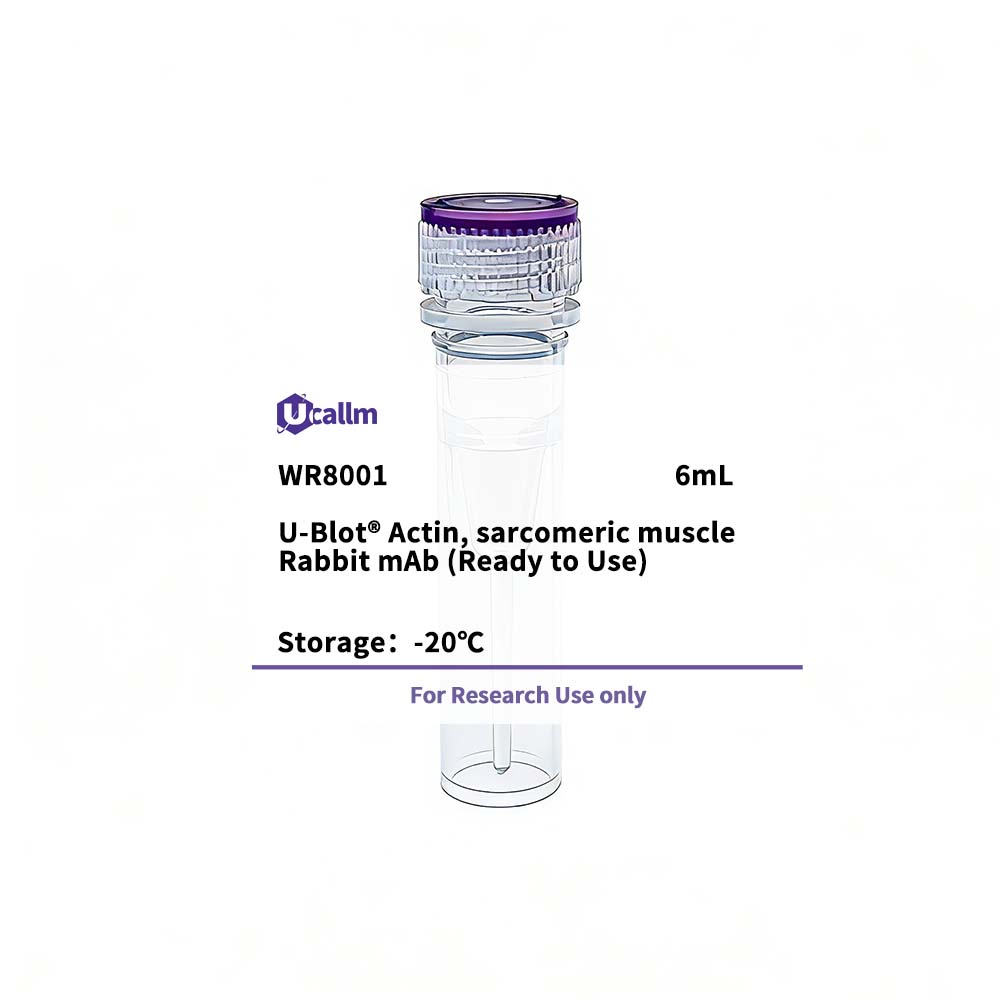
U-Blot® Actin, sarcomeric muscle Rabbit mAb (Ready to Use)

$168.00

SKU: WR8001
Enter the quantity you would like, or drag the panel to find the quantity and price that best for you
Bulk QuoteAuthorize OEM & ODM

Product details

Background:
The product encoded by this gene belongs to the actin family of proteins, which are highly conserved proteins that play a role in cell motility, structure and integrity. Alpha, beta and gamma actin isoforms have been identified, with alpha actins being a major constituent of the contractile apparatus, while beta and gamma actins are involved in the regulation of cell motility. This actin is an alpha actin that is found in skeletal muscle. Mutations in this gene cause nemaline myopathy type 3, congenital myopathy with excess of thin myofilaments, congenital myopathy with cores, and congenital myopathy with fiber-type disproportion, diseases that lead to muscle fiber defects. [provided by RefSeq, Jul 2008],

Specifications

Size6mL
TargetActin_sarcomeric muscle
ReactivityHuman, Mouse, Rat, Bovine, Pig, Chicken
ApplicationsIHC
MW(Calculated)
MW(Observed)
Host SpeciesRabbit
IsotypeIgG1,Kappa
Conjugate/ModificationUnmodified
Recommended Dilution RatioReady to use for IHC / Note: For IHC, we suggest antigen retrieval with TE buffer pH 9.0 (Cat#WT1004)
FormulationThe prediluted ready-to-use antibody is diluted in phosphate buffer saline containing stabilizing protein and 0.05% Proclin 300
PurificationRecombinant Expression and Affinity purified
Storage2°C to 8°C/1 year,Ship by ice bag
Concentration
ClonalityMonoclonal
Clone NumberRM55R
ImmunogenSynthesized peptide derived from human Actin, sarcomeric muscle AA range:2-50
SpecificityThis antibody detects endogenous levels of Actin, sarcomeric muscle
Gene NameACTA1; ACTA; ACTC1; ACTC
Protein NameActin, sarcomeric muscle
Other NameActin, alpha skeletal muscle; / Alpha-actin-1; / ACTA1; / Actin, alpha cardiac muscle 1; / Alpha-cardiac actin; / ACTC1
SpeciesHuman
Gene ID375;377
UniprotP68032
Species.1
Gene ID.1
Uniprot.1
Species.2
Gene ID.2
Uniprot.2
Cellular LocalizationCytoplasm, cytoskeleton.
Tissue ExpressionEpithelium,Skeletal muscle,
Signaling_pathwayEnvironmental Information Processing >> Signal transduction >> Phospholipase D signaling pathway
Research Areas
FunctionDisease:Defects in ACTA1 are a cause of congenital myopathy with excess of thin myofilaments (CM) [MIM:102610].,Disease:Defects in ACTA1 are a cause of congenital myopathy with fiber-type disproportion (CFTD) [MIM:255310]; also known as congenital fiber-type disproportion myopathy (CFTDM). CFTD is a genetically heterogeneous disorder in which there is relative hypotrophy of type 1 muscle fibers compared to type 2 fibers on skeletal muscle biopsy. However, these findings are not specific and can be found in many different myopathic and neuropathic conditions.,Disease:Defects in ACTA1 are the cause of nemaline myopathy type 3 (NEM3) [MIM:161800]. Nemaline myopathy (NEM) is a form of congenital myopathy characterized by abnormal thread- or rod-like structures in muscle fibers on histologic examination. The clinical phenotype is highly variable, with differing age at onset and severity.,Function:Actins are highly conserved proteins that are involved in various types of cell motility and are ubiquitously expressed in all eukaryotic cells.,miscellaneous:In vertebrates 3 main groups of actin isoforms, alpha, beta and gamma have been identified. The alpha actins are found in muscle tissues and are a major constituent of the contractile apparatus. The beta and gamma actins coexist in most cell types as components of the cytoskeleton and as mediators of internal cell motility.,similarity:Belongs to the actin family.,subunit:Polymerization of globular actin (G-actin) leads to a structural filament (F-actin) in the form of a two-stranded helix. Each actin can bind to 4 others. Interacts with TTID.,
Please login to post questions
Back to Top
Product has been added to your cart
