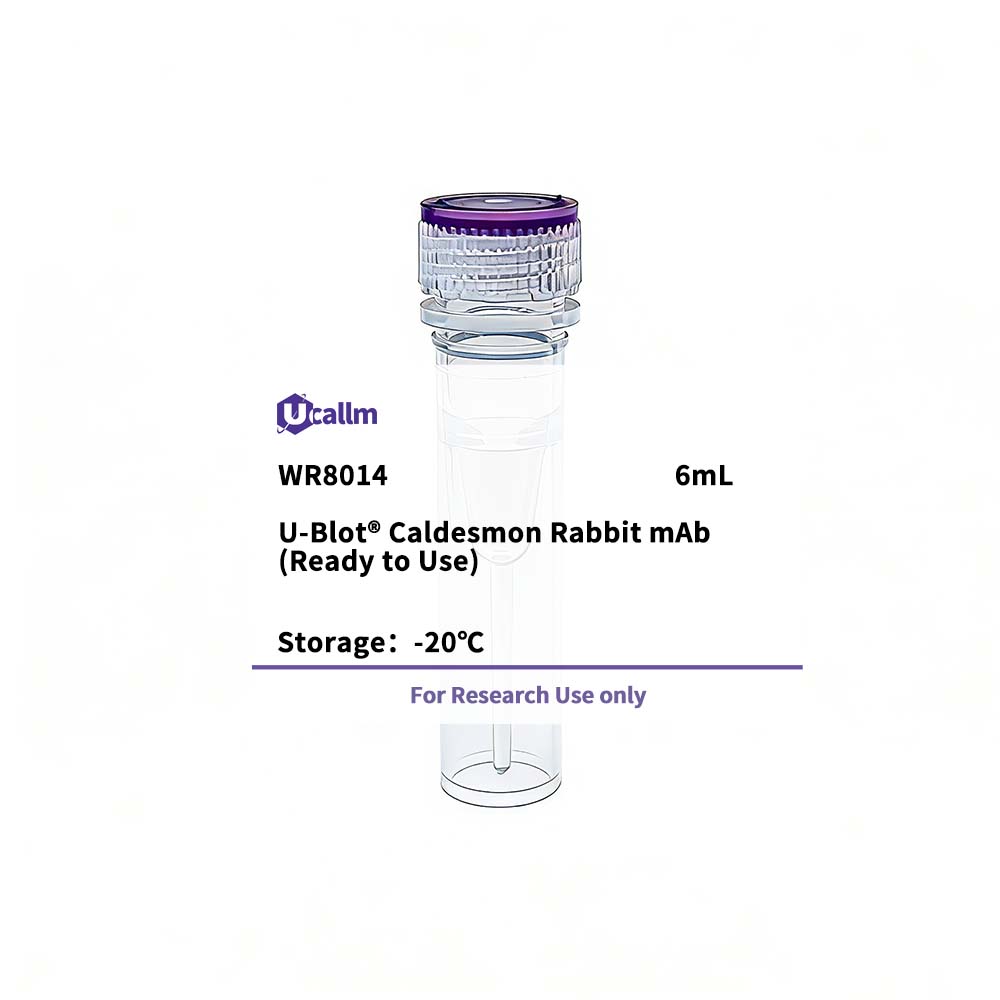
SKU: WR8014 Categories: ,

U-Blot® Caldesmon Rabbit mAb (Ready to Use)

$168.00

SKU: WR8014
Enter the quantity you would like, or drag the panel to find the quantity and price that best for you
Bulk QuoteAuthorize OEM & ODM

Product details

Background:
This gene encodes a calmodulin- and actin-binding protein that plays an essential role in the regulation of smooth muscle and nonmuscle contraction. The conserved domain of this protein possesses the binding activities to Ca(2+)-calmodulin, actin, tropomyosin, myosin, and phospholipids. This protein is a potent inhibitor of the actin-tropomyosin activated myosin MgATPase, and serves as a mediating factor for Ca(2+)-dependent inhibition of smooth muscle contraction. Alternative splicing of this gene results in multiple transcript variants encoding distinct isoforms. [provided by RefSeq, Jul 2008],


Specifications

Size6mL
TargetCaldesmon
ReactivityHuman
ApplicationsIHC
MW(Calculated)
MW(Observed)
Host SpeciesRabbit
IsotypeIgG1,Kappa
Conjugate/ModificationUnmodified
Recommended Dilution RatioReady to use for IHC / Note: For IHC, we suggest antigen retrieval with TE buffer pH 9.0 (Cat#WT1004)
FormulationThe prediluted ready-to-use antibody is diluted in phosphate buffer saline containing stabilizing protein and 0.05% Proclin 300
PurificationRecombinant Expression and Affinity purified
Storage2°C to 8°C/1 year,Ship by ice bag
Concentration
ClonalityMonoclonal
Clone NumberRM146R
ImmunogenSynthesized peptide derived from human Caldesmon pan AA range:100-200
SpecificityThis antibody detects endogenous levels of Caldesmon
Gene NameCALD1 CAD CDM
Protein NameCaldesmon
Other NameCALD1; / CAD; / CDM; / Caldesmon; / CDM
SpeciesHuman
Gene ID800
UniprotQ05682
Species.1
Gene ID.1
Uniprot.1
Species.2
Gene ID.2
Uniprot.2
Cellular LocalizationCytoplasmic
Tissue ExpressionHigh-molecular-weight caldesmon (isoform 1) is predominantly expressed in smooth muscles, whereas low-molecular-weight caldesmon (isoforms 2, 3, 4 and 5) are widely distributed in non-muscle tissues and cells. Not expressed in skeletal muscle or heart.
Signaling_pathwayOrganismal Systems >> Circulatory system >> Vascular smooth muscle contraction
Research Areas>>Vascular smooth muscle contraction
FunctionDomain:The N-terminal part seems to be a myosin/calmodulin-binding domain, and the C-terminal a tropomyosin/actin/calmodulin-binding domain. These two domains are separated by a central helical region in the smooth-muscle form.,Function:Actin- and myosin-binding protein implicated in the regulation of actomyosin interactions in smooth muscle and nonmuscle cells (could act as a bridge between myosin and actin filaments). Stimulates actin binding of tropomyosin which increases the stabilization of actin filament structure. In muscle tissues, inhibits the actomyosin ATPase by binding to F-actin. This inhibition is attenuated by calcium-calmodulin and is potentiated by tropomyosin. Interacts with actin, myosin, two molecules of tropomyosin and with calmodulin. Also play an essential role during cellular mitosis and receptor capping.,PTM:In non-muscle cells, phosphorylation by CDC2 during mitosis causes caldesmon to dissociate from microfilaments. Phosphorylation reduces caldesmon binding to actin, myosin, and calmodulin as well as its inhibition of actomyosin ATPase activity. Phosphorylation also occurs in both quiescent and dividing smooth muscle cells with similar effects on the interaction with actin and calmodulin and on microfilaments reorganization.,similarity:Belongs to the caldesmon family.,subcellular location:On thin filaments in smooth muscle and on stress fibers in fibroblasts (nonmuscle).,tissue specificity:High-molecular-weight caldesmon (isoform 1) is predominantly expressed in smooth muscles, whereas low-molecular-weight caldesmon (isoforms 2, 3, 4 and 5) are widely distributed in non-muscle tissues and cells. Not expressed in skeletal muscle or heart.,
Please login to post questions
Back to Top
Product has been added to your cart
