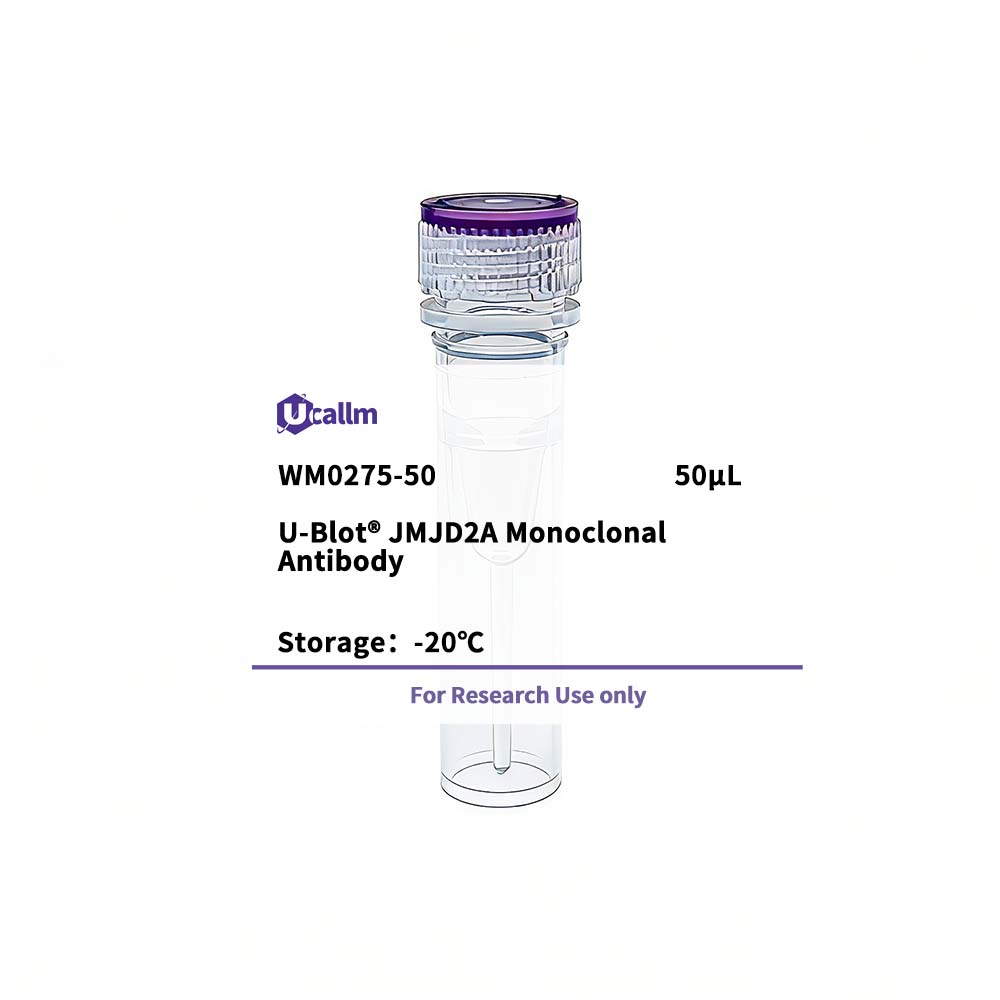
SKU: WM0275 Categories: ,

JMJD2A Monoclonal Antibody

Price range: $268.00 through $328.00

SKU: WM0275-50
Enter the quantity you would like, or drag the panel to find the quantity and price that best for you
Bulk QuoteAuthorize OEM & ODM

Product details

Background:
This gene is a member of the Jumonji domain 2 (JMJD2) family and encodes a protein containing a JmjN domain, a JmjC domain, a JD2H domain, two TUDOR domains, and two PHD-type zinc fingers. This nuclear protein functions as a trimethylation-specific demethylase, converting specific trimethylated histone residues to the dimethylated form, and as a transcriptional repressor. [provided by RefSeq, Apr 2009],

Specifications

Size50μL/100μL
TargetJMJD2A
ReactivityHuman
ApplicationsWB, IHC, IF, ELISA
MW(Calculated)121kD
MW(Observed)
Host SpeciesMouse
Isotype
Conjugate/ModificationUnmodified
Recommended Dilution RatioWB 1:500-1:2000; IHC 1:200-1:1000; IF 1:200-1:1000; ELISA 1:10000; Not yet tested in other applications. / Note: For IHC, we suggest antigen retrieval with TE buffer pH 9.0 (Cat#WT1004)
FormulationLiquid in PBS containing 50% glycerol, 0.5% BSA and 0.02% sodium azide.
PurificationAffinity purification
Storage-15°C to -25°C/1 year(Do not lower than -25°C)
Concentration
ClonalityMonoclonal
Clone Number9C12
ImmunogenPurified recombinant fragment of human JMJD2A expressed in E. Coli.
SpecificityJMJD2A Monoclonal Antibody detects endogenous levels of JMJD2A protein.
Gene NameKDM4A
Protein NameLysine-specific demethylase 4A
Other NameKDM4A; / JHDM3A; / JMJD2; / JMJD2A; / KIAA0677; / Lysine-specific demethylase 4A; / JmjC domain-containing histone demethylation protein 3A; / Jumonji domain-containing protein 2A
SpeciesHuman
Gene ID9682
UniprotO75164,
Species.1Mouse
Gene ID.1
Uniprot.1Q8BW72
Species.2
Gene ID.2
Uniprot.2
Cellular LocalizationNucleus .
Tissue ExpressionUbiquitous.
Signaling_pathway
Research Areas
Functioncofactor:Binds 1 Fe(2+) ion per subunit.,Domain:The 2 Tudor domains recognize and bind methylated histone H3 'Lys-4' residue. Double Tudor domain has an interdigitated structure and the unusual fold is required for its ability to bind methylated histone tails. Trimethylated H3 'Lys-4' is bound in a cage of 3 aromatic residues, 2 of which are from the Tudor domain 2, while the binding specificity is determined by side-chain interactions involving residues from the Tudor domain 1. The Tudor domains are able to bind trimethylated histone H3 'Lys-4', trimethylated histone H3 'Lys-9', di- and trimethylated H4 'Lys-20'.,Function:Histone demethylase that specifically demethylates 'Lys-9' and 'Lys-36' residues of histone H3, thereby playing a central role in histone code. Does not demethylate histone H3 'Lys-4', H3 'Lys-27' nor H4 'Lys-20'. Demethylates trimethylated H3 'Lys-9' and H3 'Lys-36' residue, while it has no activity on mono- and dimethylated residues. Demethylation of Lys residue generates formaldehyde and succinate. Participates in transcriptional repression of ASCL2 and E2F-responsive promoters via the recruitment of histone deacetylases and NCOR1, respectively.,similarity:Belongs to the JHDM3 histone demethylase family.,similarity:Contains 1 JmjC domain.,similarity:Contains 1 JmjN domain.,similarity:Contains 2 PHD-type zinc fingers.,similarity:Contains 2 Tudor domains.,subunit:Interacts with histone deacetylase proteins HDAC1, HDAC2 and HDAC3. Interacts with RB and NCOR1. Interacts with HTLV-1 Tax protein.,tissue specificity:Ubiquitous.,
Please login to post questions
Back to Top
Product has been added to your cart

