

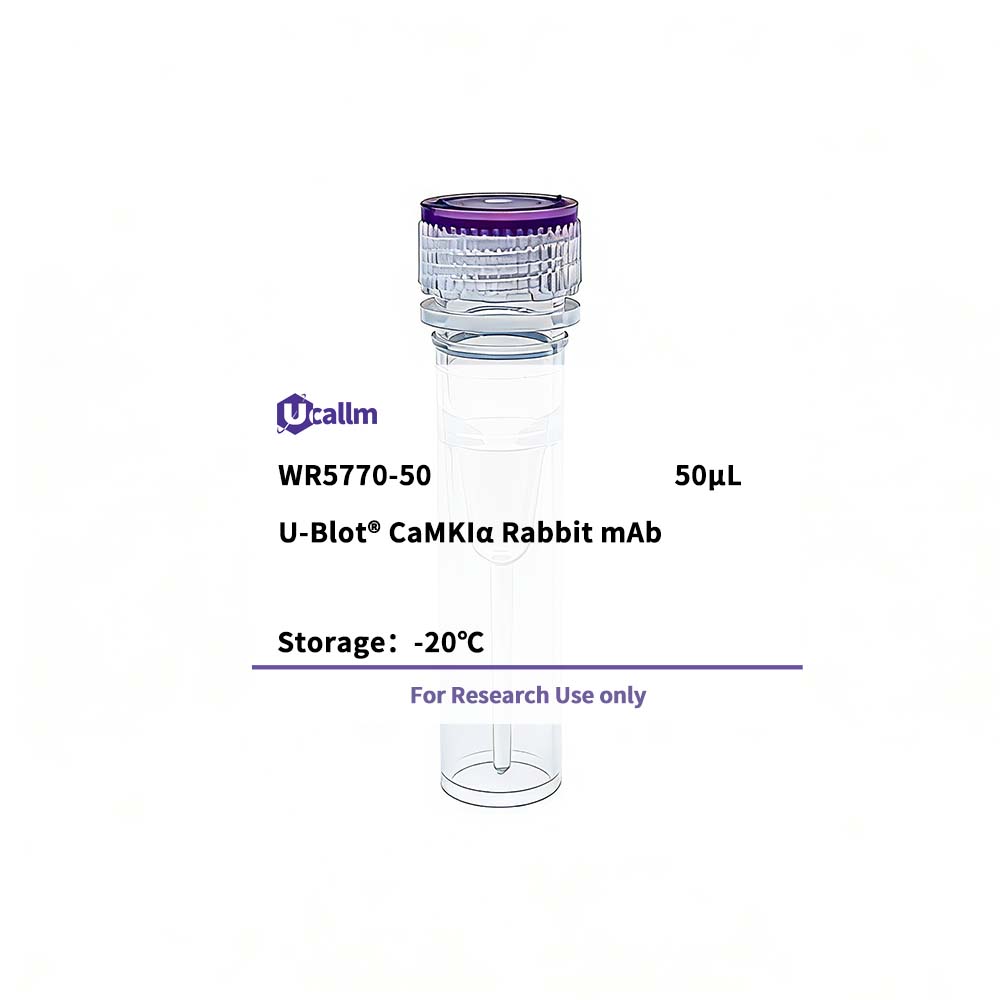
Specifications
| Size | 50μL/100μL |
| Target | CaMKIα |
| Reactivity | Human, Mouse, Rat |
| Applications | WB, IHC, IF, ELISA |
| MW(Calculated) | 41kD |
| MW(Observed) | 43kD |
| Host Species | Rabbit |
| Isotype | IgG,Kappa |
| Conjugate/Modification | Unmodified |
| Recommended Dilution Ratio | IHC 1:200-1:1000; WB 1:2000-1:10000; IF 1:200-1:1000; ELISA 1:5000-1:20000; / Note: For IHC, we suggest antigen retrieval with TE buffer pH 9.0 (Cat#WT1004) |
| Formulation | PBS, 50% glycerol, 0.05% Proclin 300, 0.05%BSA |
| Purification | Recombinant Antibody expressed in animal component-free (ACF) media, purified via Protein A affinity chromatography. |
| Storage | -15°C to -25°C/1 year(Do not lower than -25°C) |
| Concentration | |
| Clonality | Monoclonal |
| Clone Number | RM1733R |
| Immunogen | The specific immunogen used to produce this antibody is proprietary information. |
| Specificity | Endogenous |
| Gene Name | CAMK1 |
| Protein Name | Calcium/calmodulin-dependent protein kinase type 1 |
| Other Name | CAMK1; / Calcium/calmodulin-dependent protein kinase type 1; / CaM kinase I; / CaM-KI; / CaM kinase I alpha; / CaMKI-alpha |
| Species | Human |
| Gene ID | 8536 |
| Uniprot | Q14012, |
| Species.1 | Mouse |
| Gene ID.1 | 52163 |
| Uniprot.1 | Q91YS8, |
| Species.2 | Rat |
| Gene ID.2 | 171503 |
| Uniprot.2 | Q63450 |
| Cellular Localization | Cytoplasm . Nucleus . Predominantly cytoplasmic. . |
| Tissue Expression | Widely expressed. Expressed in cells of the zona glomerulosa of the adrenal cortex. |
| Signaling_pathway | Organismal Systems >> Endocrine system >> Oxytocin signaling pathway;Organismal Systems >> Endocrine system >> Aldosterone synthesis and secretion;Human Diseases >> Cancer: specific types >> Glioma;Environmental Information Processing >> Signal transduction >> Calcium signaling pathway |
| Research Areas | >>Calcium signaling pathway; / >>Oxytocin signaling pathway; / >>Aldosterone synthesis and secretion; / >>Glioma |
| Function | Catalytic activity:ATP + a protein = ADP + a phosphoprotein.,Domain:The autoinhibitory domain overlaps with the calmodulin binding region and interacts in the inactive folded state with the catalytic domain as a pseudosubstrate.,enzyme regulation:Activated by Ca(2+)/calmodulin. Binding of calmodulin results in a conformational change that generates functional binding sites for both, substrate and ATP, and thus releaves intrasteric autoinhibition. Must be phosphorylated to be maximally active. Phosphorylated by CAMKK1 or CAMKK2.,Function:Calcium/calmodulin-dependent protein kinase belonging to a proposed calcium-triggered signaling cascade involved in a number of cellular processes like transcriptional regulation, hormone production, translational regulation, regulation of actin filament organization and neurite outgrowth. Involved in calcium-dependent activation of the ERK pathway (By similarity). Recognizes the substrate consensus sequence [MVLIF]-x-R-x(2)-[ST]-x(3)-[MVLIF]. Phosphorylates EIF4G3/eIF4GII. In vitro phosphorylates CREB1, ATF1, CTFR, MYL9, SYN1/synapsin I and SYNII/synapsin II.,similarity:Belongs to the protein kinase superfamily.,similarity:Belongs to the protein kinase superfamily. CAMK Ser/Thr protein kinase family. CaMK subfamily.,similarity:Contains 1 protein kinase domain.,subcellular location:Predominantly cytoplasmic.,subunit:Monomer. Interacts with XPO1.,tissue specificity:Ubiquitous., |




